
Download Official Form IT2104E (PDF)
Opens the official government PDF in a new tab
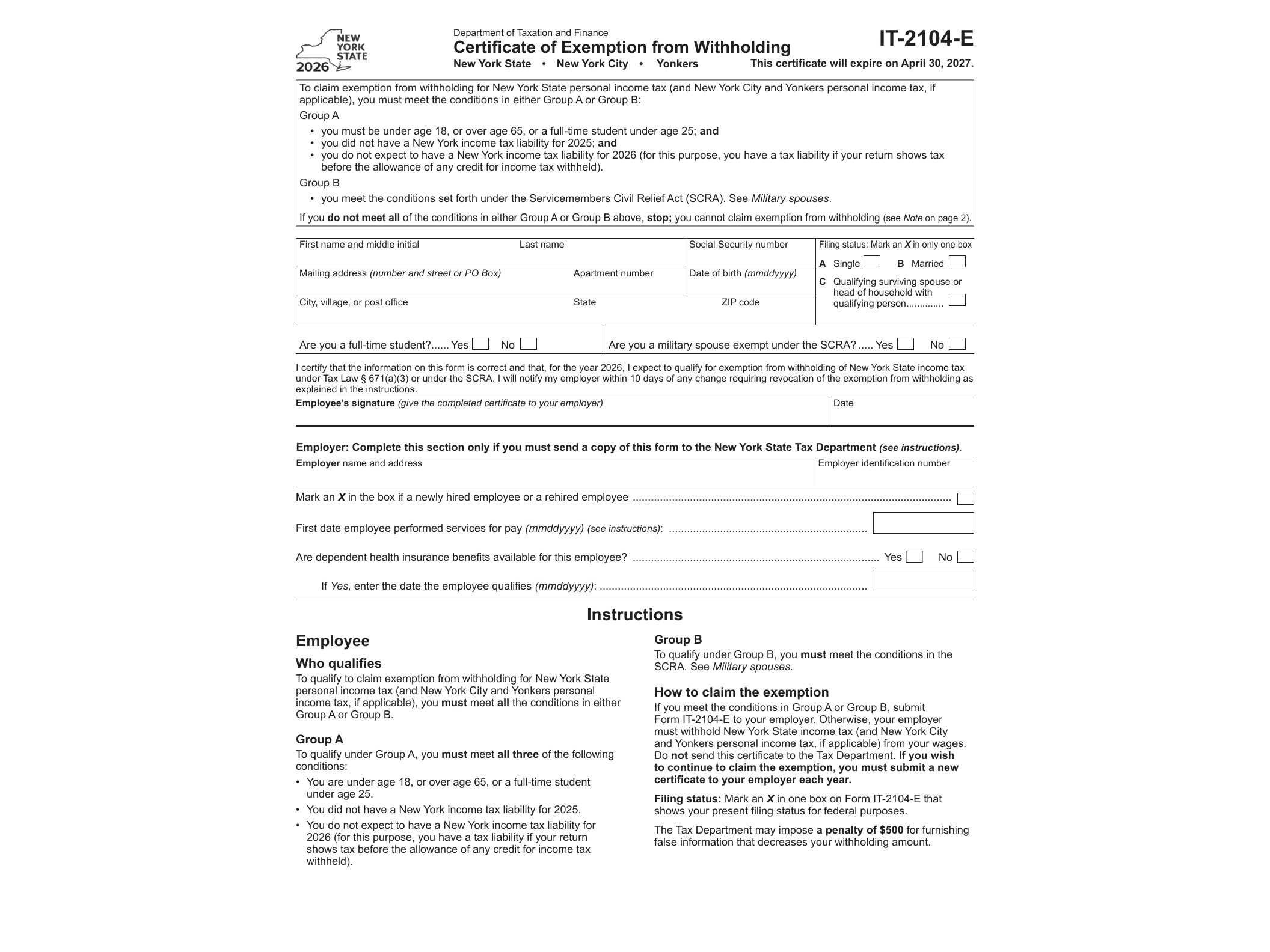
Form IT-2104-E, Certificate of Exemption from Withholding, is issued by the New York State Department of Taxation and Finance for employees who want to claim they owe no New York State, New York City, or Yonkers income tax and therefore want no tax withheld from their wages. Unlike the standard IT-2104, which tells an employer how many allowances to withhold for, this form tells the employer to withhold nothing at all because the employee expects to have no tax liability for the year.
This exemption isn’t automatic and it isn’t available to everyone. To qualify, you generally need to meet two conditions: you had no New York State, New York City, or Yonkers income tax liability last year, and you don’t expect to have any liability this year either. That usually means your income falls below the filing threshold, or your deductions and credits are enough to zero out your tax bill entirely. Students working part-time, seasonal workers, and dependents with minimal income are the most common filers of this form.
Who Should Use Form IT-2104-E
You should file this form only if you’re confident you won’t owe New York income tax for the year. If you’re a dependent claimed on someone else’s return, there are additional income limits to check before you can claim the exemption — the form’s instructions include a worksheet to help determine whether you qualify. If you’re not sure, it’s safer to file the regular IT-2104 with accurate allowances instead of risking underwithholding, which can lead to a balance due plus possible penalties when you file your annual return.
Nonresident employees who work in New York but live elsewhere have separate rules and generally can’t use IT-2104-E to avoid withholding just because they live out of state — residency status alone doesn’t create an exemption. The exemption is tied to actual tax liability, not where you live.
When to Submit It
Form IT-2104-E needs to be given to your employer, not mailed to the Tax Department. It’s an internal document your employer keeps on file to justify not withholding state and local tax from your paycheck. The exemption is only valid for one calendar year, so anyone who wants to keep claiming it must submit a new IT-2104-E by February 15 of each year. If you don’t refile by that deadline, your employer is required to start withholding tax as if you had claimed single with zero allowances, which usually means a much larger deduction from your paycheck than you’d expect.
If your situation changes during the year — for example, you pick up a second job, get a raise that pushes you over the income threshold, or otherwise expect to owe tax — you’re required to file a new withholding certificate within 10 days of the change. Continuing to claim exemption after your circumstances no longer support it can create a tax bill and penalties down the road.
How to Fill It Out
The current version of IT-2104-E is a fillable PDF, so you can complete it on a computer before printing it for your employer’s records or submitting it digitally if your employer accepts electronic forms. You’ll need to provide your name, Social Security number, address, and certify under penalty of perjury that you meet the exemption requirements. If you’re claiming exemption as a dependent, you’ll also need to work through the income worksheet included in the instructions to confirm eligibility.
Because this form deals directly with payroll withholding, it pairs closely with other New York withholding documents. Employers who need to report withheld amounts to employees, for instance, rely on related paperwork like Form IT-2102.6, Certificate of Income Tax Withheld, which documents actual withholding for the year rather than an exemption from it. If you’re weighing whether you truly qualify for exemption versus just adjusting your allowances, comparing your expected income against New York’s filing thresholds before submitting anything is worth the extra few minutes.
Getting the exemption status right matters because errors run in both directions — claiming exemption when you don’t qualify can leave you owing tax and penalties at filing time, while failing to claim it when you do qualify just means unnecessary withholding sitting with the state until you file your return and request a refund. Reviewing your prior year’s tax outcome before deciding is the simplest way to avoid both problems.
Download Official Form IT2104E (PDF)
Opens the official government PDF in a new tab