
Download Official Form RP467J (PDF)
Opens the official government PDF in a new tab
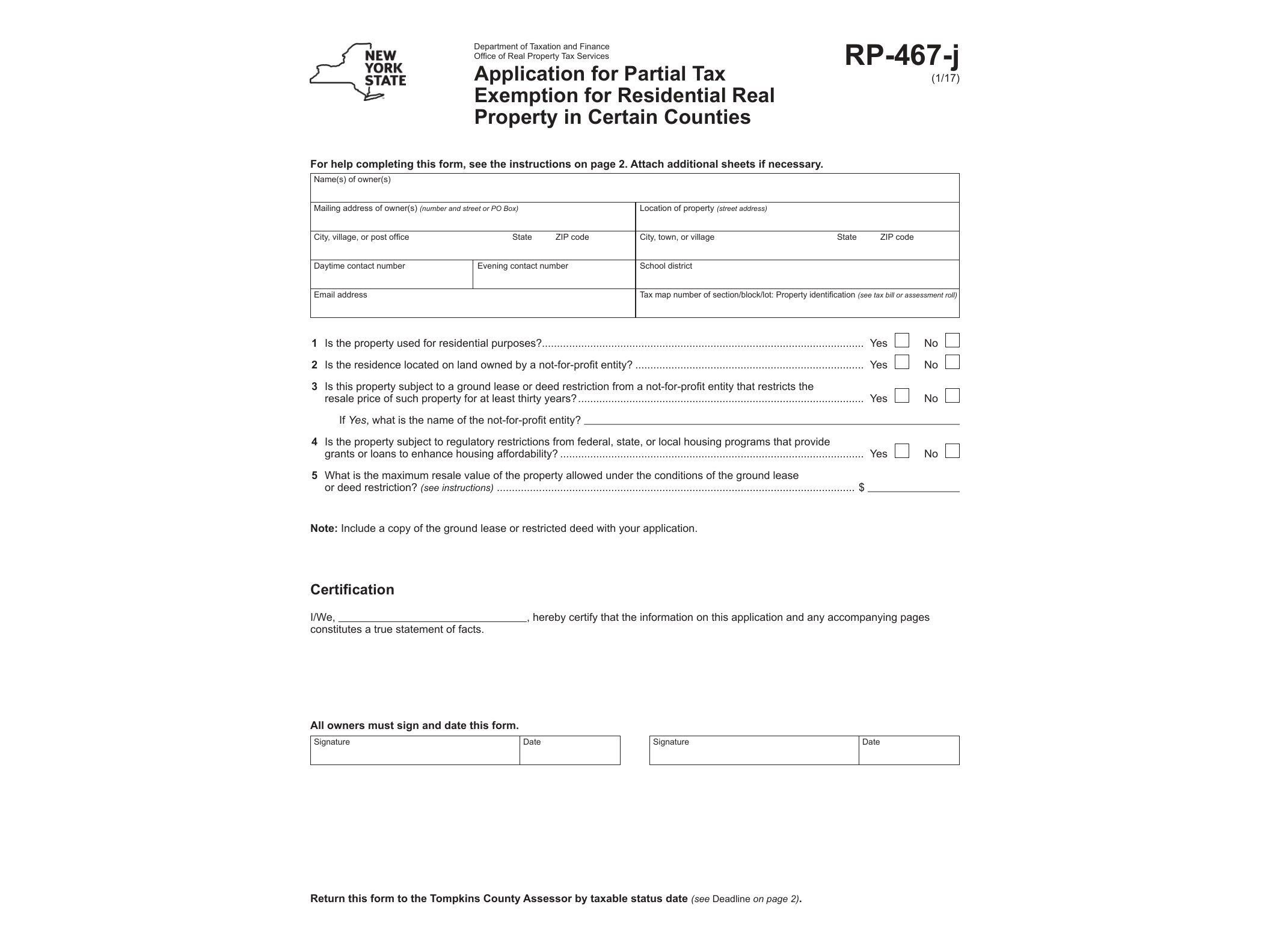
Form RP-467-J, issued by the New York State Department of Taxation and Finance, is an application for a partial property tax exemption available to residential property owners in specific counties that have adopted a local law authorizing this benefit. Unlike statewide exemptions, this one only applies where the county, city, town, or village has passed the corresponding local legislation, so eligibility depends heavily on where your property is located.
This exemption was created to give local governments a tool to ease the property tax burden on qualifying homeowners in designated counties, often tied to specific conditions such as income limits, age, or other criteria set by the local taxing jurisdiction. Because the rules vary from one county to another, the assessor’s office in your municipality is the best source for confirming whether the exemption is active in your area and what conditions apply locally.
Who Needs This Form
You’ll need Form RP-467-J if you own residential real property in a county that has opted into this partial exemption program and you meet the eligibility requirements set by that local jurisdiction. Typically, this includes homeowners who occupy the property as their primary residence and fall within income thresholds or other qualifying factors established by local law. If you’re unsure whether your county participates, contact your local assessor before filling out the paperwork, since submitting the form in a non-participating jurisdiction won’t result in any tax reduction.
It’s also worth noting that this exemption is distinct from other residential exemptions New York offers. For example, seniors receiving a related benefit may need to file Form RP-467-AFF/CTV to affirm continued eligibility for the Senior Citizens Partial School Tax Exemption on an annual basis. These are separate programs with separate paperwork, so make sure you’re using the correct form for the exemption you’re pursuing.
When to File Form RP-467-J
Property tax exemption applications in New York generally follow the taxable status date set by your local assessing unit, which is often March 1 in many municipalities, though this can vary. Filing after this date typically means the exemption won’t apply until the following tax year, so it pays to check with your assessor’s office early and submit your paperwork well before any local deadline. If you’re a new homeowner or recently became eligible due to a change in income or residency status, this is the time to look into whether Form RP-467-J applies to your situation.
How to Complete and Submit the Form
Form RP-467-J is available as a fillable PDF directly from the New York State Department of Taxation and Finance website, which means you can type your information directly into the form fields before printing it for signature and submission. The form asks for standard identifying details, including the property owner’s name, the property’s address and tax map identification, and information supporting your eligibility under the local exemption criteria.
Because this form works alongside local law provisions, you may need to attach supporting documentation such as proof of income, residency, or other criteria specified by your county. Once completed, the form is submitted to your local assessor’s office rather than to the state tax department directly. Keep a copy for your records, and follow up with the assessor if you don’t receive confirmation that your exemption has been applied to your assessment roll.
Homeowners exploring other localized property tax breaks might also find it useful to review programs like the flood insurance property exemption in Syracuse or the Ocean Rescue Squad Members Exemption in the Town of Southampton, both examples of how New York allows individual municipalities to tailor exemptions to local needs. These localized exemptions often get overlooked simply because homeowners aren’t aware their specific county or town has adopted them, so it’s always worth checking with your assessor about what’s available where you live.
If your county hasn’t adopted the local law enabling this exemption, Form RP-467-J won’t provide any benefit, and you’ll want to ask your assessor about alternative exemptions you might qualify for instead. Keeping your paperwork current and reapplying when required by local rules will help you avoid gaps in your tax savings from year to year.
Download Official Form RP467J (PDF)
Opens the official government PDF in a new tab