
Download Official Form IT238 (PDF)
Opens the official government PDF in a new tab
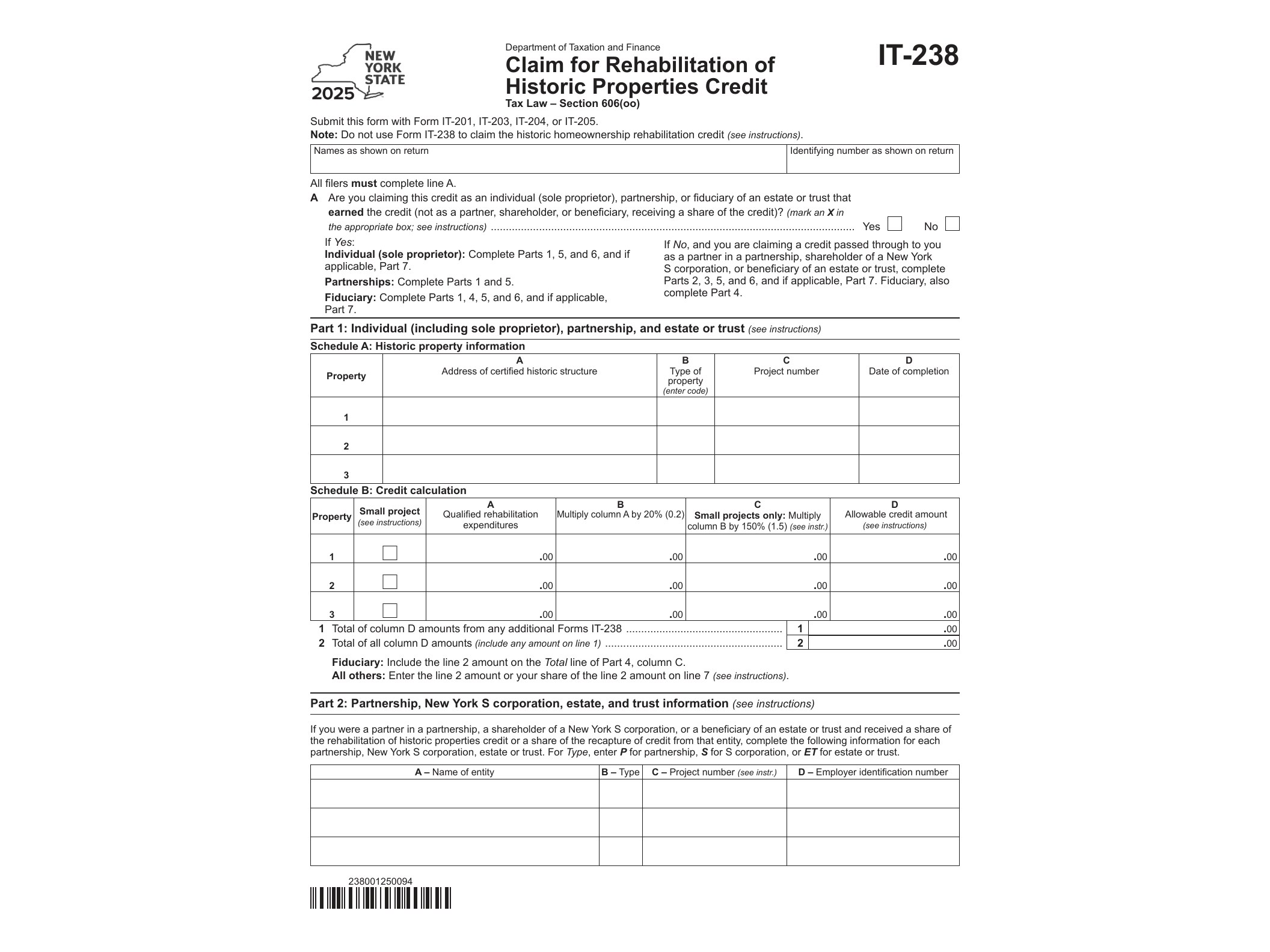
Form IT-238 is how New York State taxpayers claim the Rehabilitation of Historic Properties Credit, a tax incentive designed to encourage the restoration of historic buildings across the state. If you own a certified historic structure and invested money into rehabilitating it, this form lets you convert a portion of those qualified expenses into a credit against your New York State personal income tax.
The credit is tied to the federal historic rehabilitation tax credit under Section 47 of the Internal Revenue Code. In practice, this means you generally can’t file IT-238 on its own — your property and your rehabilitation project need to have already qualified for the federal credit before New York will let you claim the state version. The state credit is calculated as a percentage of the federal credit amount, subject to a cap, so the paperwork trail from the federal side matters a lot when you sit down to fill this out.
Who Needs to File Form IT-238
This form is for individuals, estates, trusts, and owners of pass-through entities (partnerships, S corporations, LLCs) who rehabilitated a certified historic structure located in New York State and used it for business, rental, or income-producing purposes. It’s not intended for someone who simply renovated a personal residence without going through the certification process with the National Park Service and the State Historic Preservation Office.
If your rehabilitation project was approved as a certified rehabilitation of a certified historic structure, and the property is located in an eligible census tract, you’re likely a candidate for this credit. Owners of shares in partnerships or S corporations that did the rehabilitation work also file IT-238 to claim their proportional share of the credit, based on the information passed through from the entity.
When You Use This Form
You’ll attach Form IT-238 to your New York State personal income tax return for the year in which the rehabilitated property was placed in service, or for later years if you’re carrying forward unused credit. New York allows unused portions of this credit to be carried forward, so even if your tax liability isn’t large enough to absorb the full credit in one year, you don’t lose the remaining balance — you just keep applying it in subsequent tax years using the same form.
Keep in mind this is a nonrefundable credit. That means it can reduce your tax bill to zero, but it won’t generate a refund beyond what you actually owe. Any excess credit rolls forward rather than getting paid out directly.
What You’ll Need to Complete It
Before filling out IT-238, gather your federal certification paperwork showing the rehabilitation was approved, along with documentation of your qualified rehabilitation expenditures. You’ll need to know the federal credit amount you claimed (or your share of it, if the project came through a partnership or S corporation), since the New York calculation is based on that figure. The form also asks for details identifying the property, including its location and certification information, so having your historic preservation approval letter on hand makes this part straightforward.
Like many New York credit forms, IT-238 has fillable fields in the PDF, so you can type your figures directly into the document rather than filling it out by hand. It’s still worth double-checking your math against your federal paperwork before submitting, since mismatches between the state and federal figures are a common reason these claims get flagged for review.
Property owners and pass-through entity investors juggling multiple state credits often find it useful to compare how different New York credit forms are structured. For example, if you’re also looking into contributions-based credits, Form IT-228 covers a completely different category of New York credit but follows a similar attachment process with your personal income tax return. And if your rehabilitation project involves out-of-state property transactions or exchanges, it may be worth understanding how other states handle related reporting, such as California’s Form 3840 for like-kind exchanges, particularly if you hold historic properties in multiple jurisdictions.
Once completed, IT-238 gets filed along with your regular New York State income tax return — it isn’t submitted separately. Make sure the credit amount you enter carries over correctly to the appropriate credit summary form on your return, since New York requires several credit schedules to reconcile before your final tax liability is calculated.
Download Official Form IT238 (PDF)
Opens the official government PDF in a new tab