
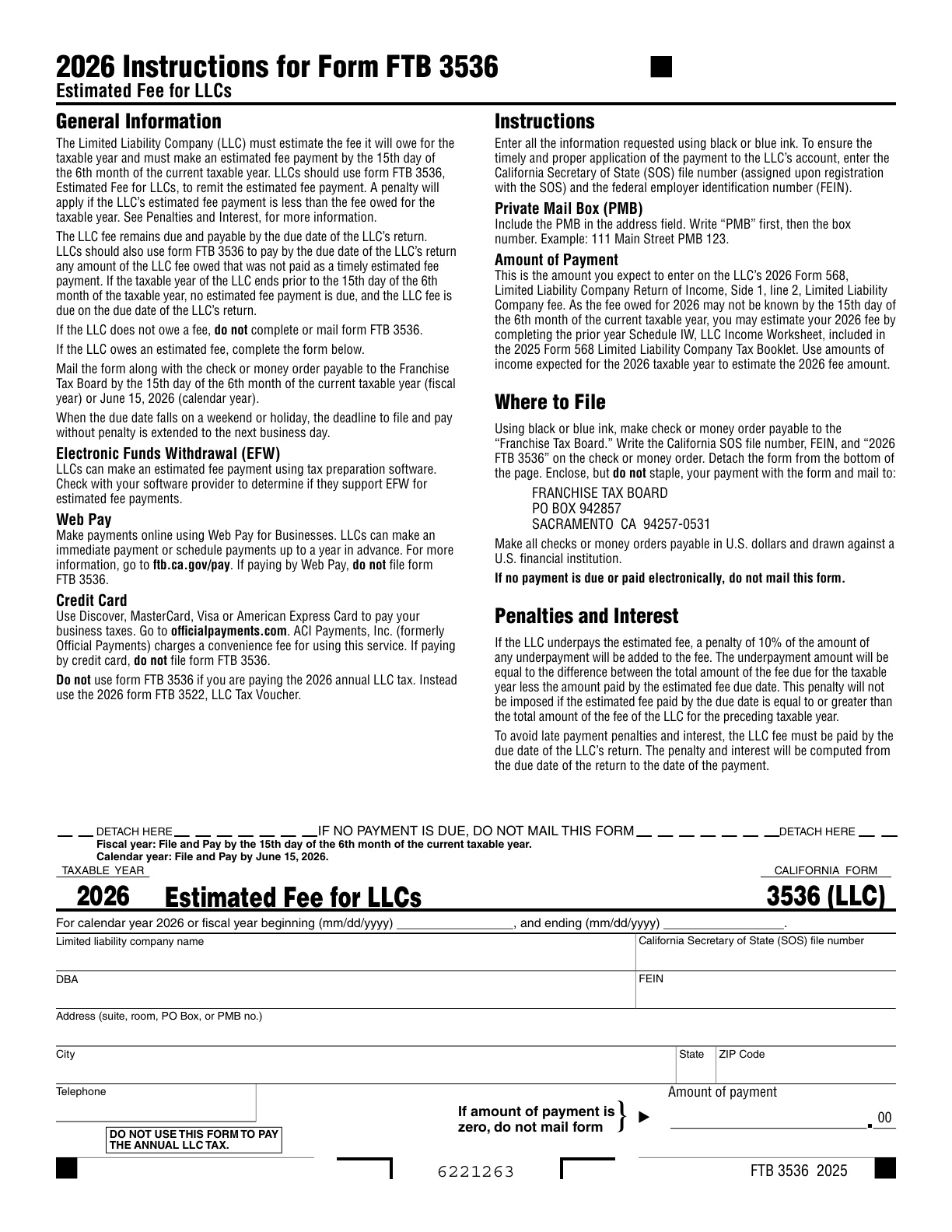
If you own a limited liability company registered in California, chances are you’ve come across Form 3536 during tax season. This form isn’t optional paperwork you can skip — it’s how the Franchise Tax Board collects the LLC estimated fee from businesses that expect to earn above a certain income threshold. Getting it wrong, or missing the deadline, can trigger penalties that are easy to avoid once you understand how the form actually works.
Before going further, grab the official document straight from the source: download FTB Form 3536 (PDF). Having it open while you read makes the rest of this easier to follow.
What Is FTB Form 3536?
Form 3536, officially titled “Estimated Fee for LLCs,” is used by California LLCs to prepay a fee based on their projected total annual income. This is separate from the flat $800 annual LLC tax that every California LLC pays regardless of earnings. The estimated fee only applies once a company’s total income from all sources — not just California income — reaches $250,000 or more in a taxable year.
The fee itself is calculated on a sliding scale set by the Franchise Tax Board, increasing as gross income rises. Since the LLC won’t know its exact final income until the year closes, the form asks for a good-faith estimate, which is why it’s called an “estimated” fee rather than a final tax bill.
Who Needs to File This Form?
Any LLC classified as a partnership or disregarded entity for tax purposes, doing business in California or registered with the Secretary of State, must file Form 3536 if it anticipates total income of $250,000 or more for the taxable year. This includes single-member LLCs, multi-member LLCs, and foreign LLCs registered to do business in the state.
LLCs taxed as corporations don’t use this form — they follow different estimated tax procedures entirely. If your LLC expects income below the $250,000 threshold, you generally don’t need to submit this form at all, though it’s smart to reassess mid-year if your projections change.
When Is the Form Due?
The estimated fee, along with Form 3536, is due by the 15th day of the 6th month of the taxable year. For most LLCs operating on a calendar year, that means the deadline falls on June 15. This is separate from the $800 annual tax, which follows its own payment schedule tied to when the LLC was formed or registered.
Filing late or underpaying the estimated fee can result in penalties and interest charges from the FTB, so it’s worth marking this date clearly on your business calendar rather than treating it as an afterthought alongside your regular tax filing.
How to Complete and Submit Form 3536
The 2026 version of Form 3536 is a fillable PDF, meaning you can type your entity information, tax year, and estimated fee amount directly into the document before printing or submitting electronically. You’ll need your LLC’s California Secretary of State entry number or FTB-issued identification number, along with your best estimate of total annual income.
Payment can be made online through the FTB’s Web Pay system, by mail with a check attached to the printed form, or through your tax software if it supports California LLC filings. Many business owners choose to slightly overestimate their income projection to avoid underpayment penalties, then true up the difference when filing their final return.
Keep a copy of the submitted form and payment confirmation for your records — the FTB may request proof of timely filing if questions arise about your LLC’s compliance history down the road.
Don’t wait until the deadline is staring you down. Get the official FTB Form 3536 PDF here and take care of your estimated fee before penalties start piling up.