
Download Official Form CT186 (PDF)
Opens the official government PDF in a new tab
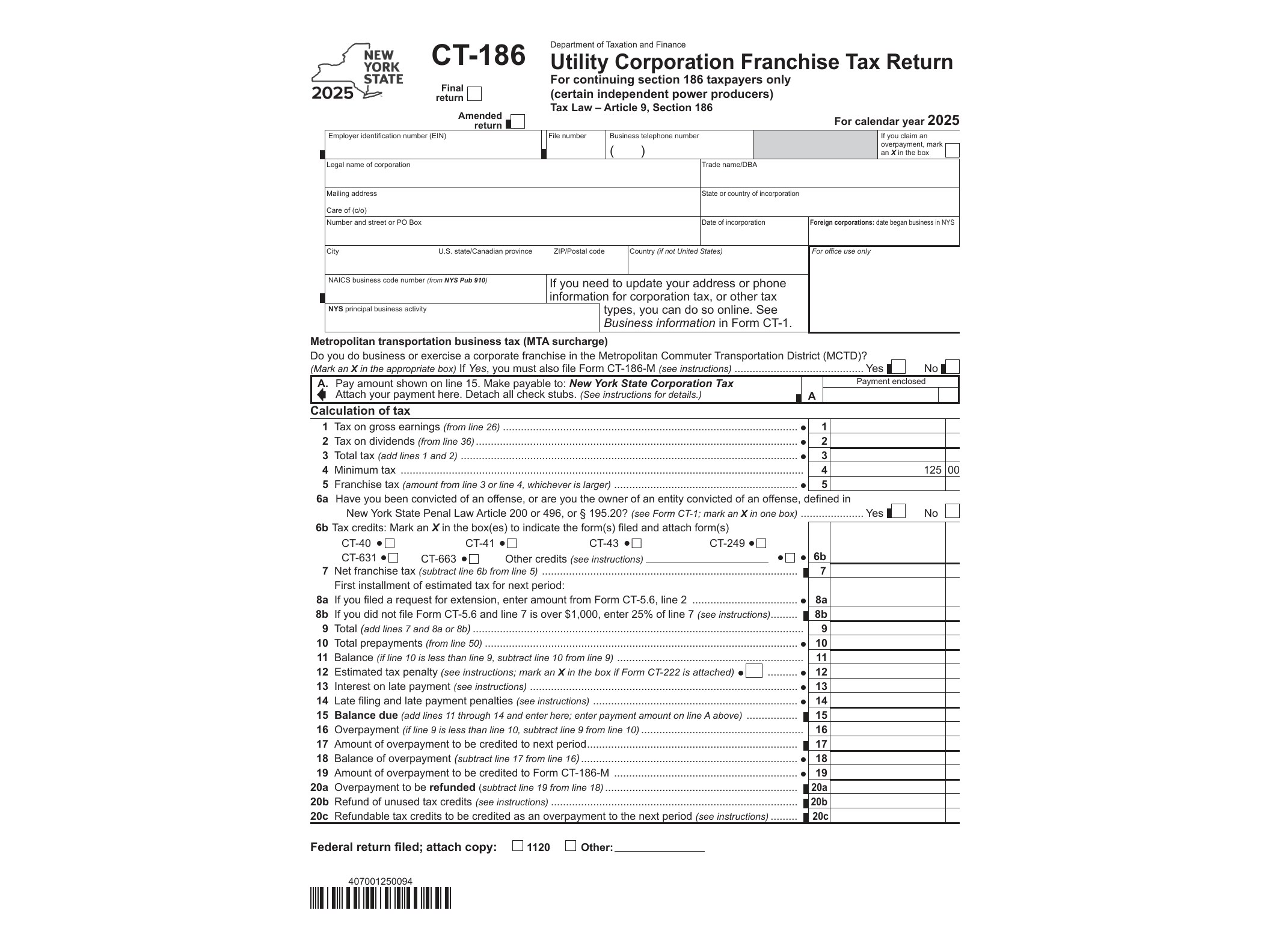
Form CT-186, Utility Corporation Franchise Tax Return, is issued by the New York State Department of Taxation and Finance for utility corporations doing business in the state. This return calculates the franchise tax owed on gross earnings, and for tax year 2025, the state has released an updated fillable version with an AcroForm layout so filers can type directly into the PDF before printing or submitting.
Who Needs to File Form CT-186
This return applies to companies operating as utility corporations under New York’s Tax Law Article 9. That generally includes businesses engaged in transportation, transmission, or distribution of gas, electricity, water, or steam, as well as certain other regulated utility operations. If your business holds a certificate of authority or franchise to operate as a utility within New York State, you’re likely required to file this return annually, regardless of whether the company shows a profit for the year.
Corporations that primarily generate electricity for sale, rather than transmitting or distributing it, may fall under a different filing category, so it’s worth confirming your classification with the Department of Taxation and Finance before assuming CT-186 is the correct form. Misclassifying a utility business is a common error that can lead to notices or amended filings later.
When Form CT-186 Is Used
Form CT-186 covers the franchise tax based on gross earnings from utility operations conducted within New York during the tax year. Filers use this return to report gross income, calculate any applicable deductions, and determine the franchise tax due. The 2025 version corresponds to the tax year running through the standard corporate filing calendar, and due dates typically align with other corporate franchise tax returns filed with the state, usually falling in the months following the close of the tax year.
Businesses that stop utility operations partway through the year, merge with another entity, or change their corporate structure may still need to file a final CT-186 covering the period they were active. Keeping accurate records of gross earnings by month makes this process considerably easier if a mid-year change occurs.
How to Complete and Submit the Form
The fillable PDF allows you to enter your corporation’s identifying information, tax period, gross earnings figures, and tax computation directly into the document. Because this is an AcroForm, the fields are structured to guide you through each section in order: entity information first, followed by income reporting, then tax calculation and signature sections. Double-check figures before printing, since some fields calculate automatically based on entries in prior sections while others require manual input.
Supporting documentation, such as records of gross earnings broken down by utility service type, should be kept on file even though it isn’t submitted with the return itself. If your corporation also handles other municipal or local tax obligations, it may help to review resources like the City/County Business Tax Program Participation Guide for a broader picture of how state and local filings interact.
Corporations juggling multiple types of business expense documentation alongside this franchise return might also find it useful to reference general recordkeeping guidance, such as the breakdown found in the Business Expenses Worksheet explainer, even though that particular form applies to a different state agency. The underlying principle of tracking deductible costs accurately carries over regardless of jurisdiction.
Once completed, Form CT-186 is mailed to the address specified in the instructions accompanying the form, since New York does not currently offer e-filing for every version of this particular return. Always verify the current mailing address and any electronic filing options directly on the Department of Taxation and Finance website before submitting, as addresses and options can change from year to year.
Nonprofit utility-adjacent entities winding down operations should note that franchise tax obligations don’t disappear simply because dissolution is underway. If your organization is a nonprofit corporation weighing dissolution alongside outstanding tax matters, the overview on pre-dissolution tax abatement requests offers useful context, though CT-186 filers should confirm their specific obligations with New York State directly rather than assuming rules from other jurisdictions apply.
Given the technical nature of utility tax calculations, many corporations rely on a tax professional familiar with Article 9 filings to review the return before submission. Errors in gross earnings classification can trigger follow-up correspondence from the state, so accuracy on the first submission saves time down the line.
Download Official Form CT186 (PDF)
Opens the official government PDF in a new tab