
Download Official Form CT184M (PDF)
Opens the official government PDF in a new tab
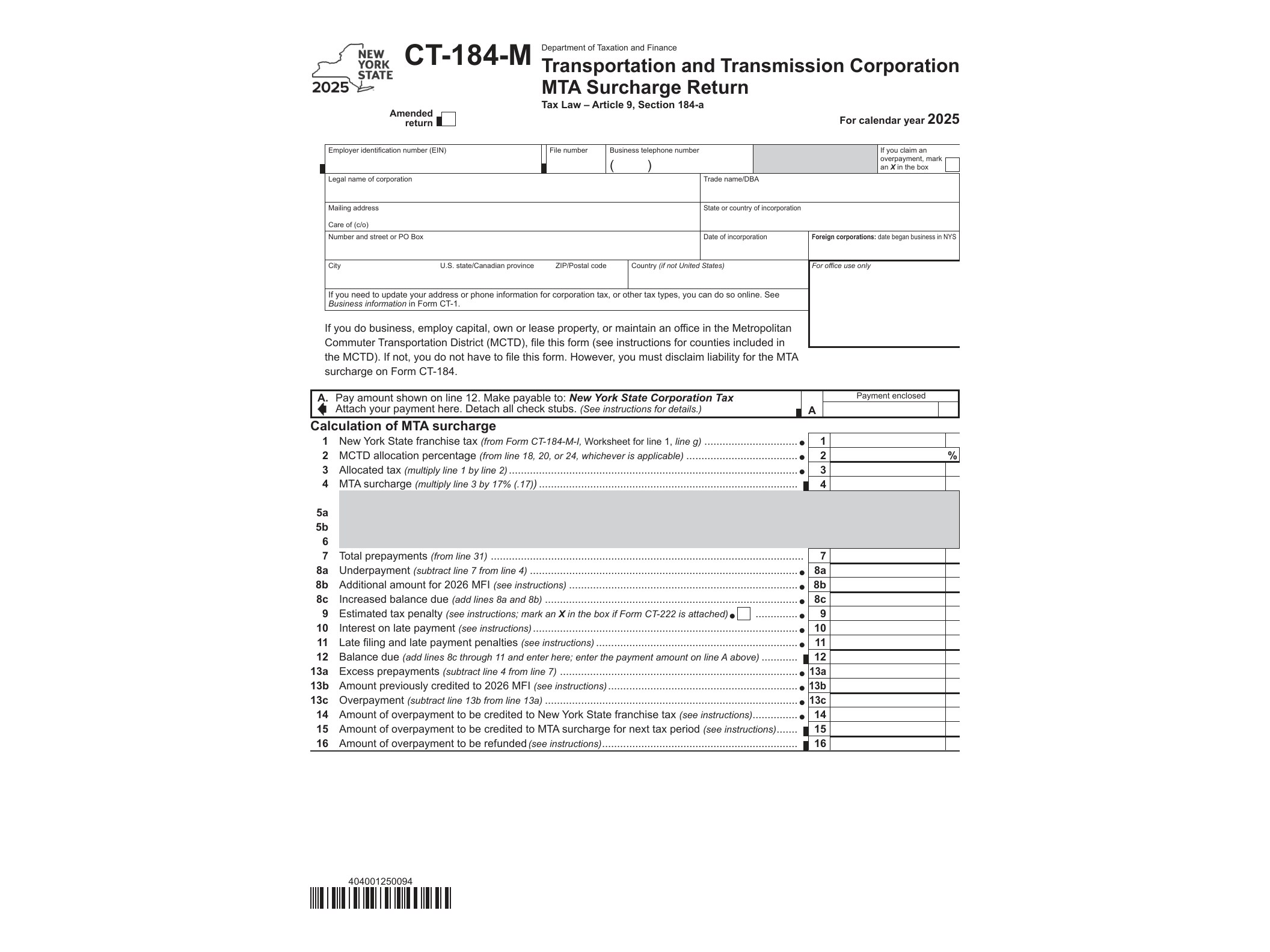
Form CT-184-M is the MTA (Metropolitan Transportation Authority) Surcharge Return that transportation and transmission corporations must file with the New York State Department of Taxation and Finance when they do business within the Metropolitan Commuter Transportation District (MCTD). This surcharge applies on top of the regular franchise tax and helps fund transit operations across the New York City metro region, including parts of Long Island and the lower Hudson Valley counties.
If your company operates as a transportation or transmission corporation and generates income from business conducted inside the MCTD, this form isn’t optional. It works alongside your base franchise tax filing to calculate the additional surcharge owed based on the portion of your business activity that falls within the district’s boundaries.
Who Needs to File Form CT-184-M
Any transportation or transmission corporation subject to tax under Article 9 of the New York Tax Law, and that conducts business within the MCTD, is required to file this surcharge return. This typically includes companies involved in trucking, railroad operations, pipeline transmission, and similar transportation-related services operating in or through the counties that make up the district: New York City’s five boroughs, Nassau, Suffolk, Westchester, Rockland, Putnam, Orange, and Dutchess.
This form is closely tied to Form CT-183, the main franchise tax return for transportation and transmission corporations. In most cases, companies filing CT-183 will also need to complete CT-184-M if any part of their business activity occurs within the MCTD. The two forms are filed together, with CT-184-M calculating the additional surcharge amount owed on top of the base franchise tax liability.
When to Use This Form
Form CT-184-M for tax year 2025 covers the corporation’s fiscal or calendar year filing period during 2025. Corporations must file it by the same due date as their franchise tax return, generally within three and a half months after the close of the tax year for calendar-year filers, which typically falls around mid-March for a December 31 year-end. Fiscal-year filers should calculate their due date based on their specific accounting period.
Extensions available for the main franchise tax return generally extend the deadline for this surcharge return as well, but corporations need to make sure any extension request explicitly covers both filings to avoid penalties or interest on the surcharge portion.
How to Complete and Submit Form CT-184-M
The form itself is available as a fillable PDF directly from the New York State Department of Taxation and Finance website. Since it includes AcroForm fields, you can type your information directly into the document using standard PDF reader software rather than printing it out and filling it in by hand. This makes the process faster and reduces the chance of errors from illegible handwriting.
To complete it accurately, you’ll need your corporation’s total business allocation percentage within the MCTD, which is typically calculated using the same apportionment factors applied on your base franchise tax return. The surcharge rate gets applied to the portion of your tax liability attributable to business conducted within the district. Have your CT-183 figures ready before starting, since several entries carry over directly.
Once completed, the form is submitted alongside your other Article 9 filings, either through New York State’s e-file system or by mail if paper filing is still permitted for your situation. Keep a copy of the completed return with your other corporate tax records, since the state may request supporting documentation for your MCTD allocation calculations during an audit or review.
Corporations that also operate utility services alongside transportation activities should check whether Form CT-186 applies to their situation instead of, or in addition to, CT-183 and CT-184-M, since utility corporations fall under a separate set of franchise tax rules with their own surcharge requirements.
Getting this filing right matters because errors in MCTD allocation percentages are a common source of amended returns and follow-up notices from the state. Double-checking your apportionment figures against your base franchise tax return before submission can save time and avoid unnecessary correspondence with the Department of Taxation and Finance later on.
Download Official Form CT184M (PDF)
Opens the official government PDF in a new tab