
Download Official Form TP385 (PDF)
Opens the official government PDF in a new tab
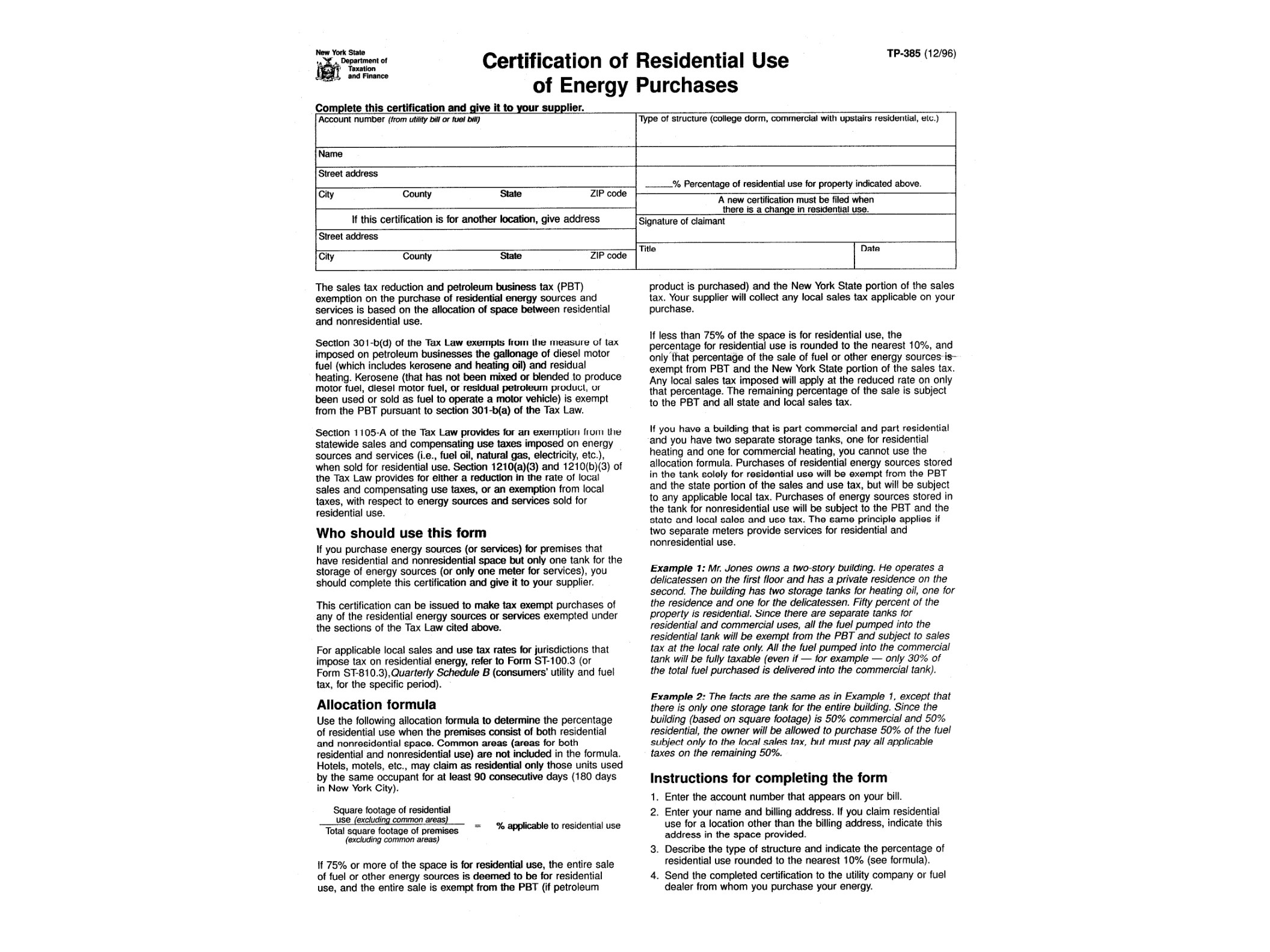
Form TP-385, officially titled Certification of Residential Use of Energy Purchases, is issued by the New York State Department of Taxation and Finance. It exists to help residential customers and their utility providers document that energy purchases—like electricity, gas, propane, or heating oil—are used for residential purposes and therefore qualify for a reduced or exempt sales tax rate under New York tax law.
New York generally taxes energy sources at the standard state and local sales tax rates, but residential energy use gets favorable treatment. The catch is that utility companies and energy suppliers can’t automatically assume every account is residential, especially in cases involving mixed-use properties, multi-unit buildings, or accounts where the billing address doesn’t clearly indicate residential use. That’s where Form TP-385 comes in: it’s a formal certification that tells the vendor, in writing, that the energy purchased at a specific location is for residential consumption, not commercial or industrial use.
Who Needs to File Form TP-385
This form is typically completed by the person responsible for the utility account—usually a homeowner, tenant, landlord, or property manager—who wants to confirm eligibility for the residential sales tax exemption or reduced rate. It’s especially relevant for:
- Owners of mixed-use buildings where part of the property is residential and part is commercial
- Landlords billing tenants directly for energy usage
- Property managers overseeing multiple residential units under one utility account
- Anyone whose service address might otherwise be misclassified by the energy provider as non-residential
If your energy bills already reflect a clear residential classification and you’ve never had issues with tax rates applied, you probably won’t need this form. It becomes necessary when there’s ambiguity about how a property is used, or when a utility company specifically requests certification before applying the residential tax treatment.
When Is This Form Used
Form TP-385 is generally submitted directly to the energy provider or utility company, not to the Department of Taxation and Finance itself. It’s a one-time or periodic certification depending on the vendor’s requirements. Situations that commonly trigger the need for this form include:
- Setting up new utility service at a residential property with an unclear classification
- Correcting a billing error where residential energy was taxed at the higher commercial rate
- Responding to a vendor’s audit or compliance review of exemption certificates on file
- Converting a property from commercial to residential use, or vice versa, requiring updated documentation
Because this is a certification rather than a tax return, there’s no filing deadline tied to it in the way there is with income or sales tax returns. Instead, it should be submitted whenever the vendor needs proof of residential use to apply the correct tax treatment going forward.
How to Get and Complete Form TP-385
Form TP-385 is available as a fillable PDF directly from the New York State Department of Taxation and Finance website. Since it includes AcroForm fields, you can fill it out digitally on your computer before printing it for signature, which cuts down on handwriting errors and makes it easier to keep a clean copy for your records.
When completing the form, you’ll need to provide identifying information about the property, the account holder, and a statement certifying that the energy purchased is used for residential purposes. Accuracy matters here—since this document is used to justify a tax exemption or reduced rate, any misrepresentation could lead to back taxes owed if the property is later found to be non-residential.
Once completed and signed, the form goes to the energy provider or utility company handling your account, not to the state tax department directly. Keep a copy for your own records in case the vendor or the state later requests verification.
If you’re dealing with other New York sales tax exemption paperwork, it’s worth getting familiar with related certifications. For example, property owners involved in industrial development projects might also need to review Form ST-65 for recaptured sales tax benefits, or Form ST-62 if their property falls under an IDA compliance reporting requirement. Those dealing with specialty exemptions, like purchases related to service animals, can also check out Form ST-860 for a similar example of how New York structures its exemption certificate system.
Download Official Form TP385 (PDF)
Opens the official government PDF in a new tab