
Download Official Form 3506 (PDF)
Opens the official government PDF in a new tab
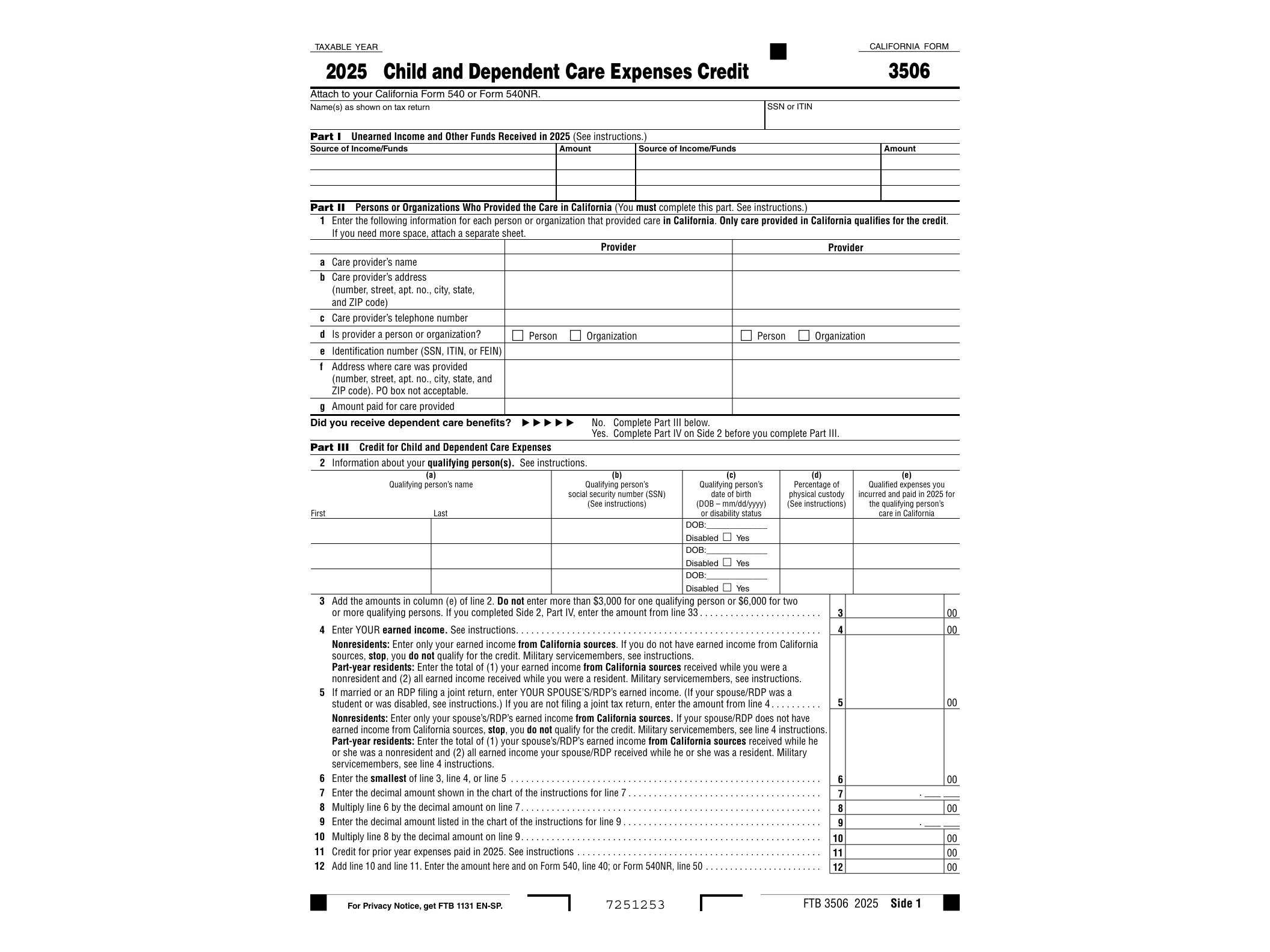
Form 3506 is the California Franchise Tax Board’s Child and Dependent Care Expenses Credit form. It lets California taxpayers claim a state-level credit for money spent on care for a qualifying child, spouse, or dependent while they worked or looked for work. It runs alongside the federal child and dependent care credit but has its own rules, income limits, and worksheet, so filers can’t just copy numbers from their federal return without checking the California version.
The credit exists because California, like the IRS, recognizes that care expenses — daycare, after-school programs, summer day camp, or in-home caregivers — are often a necessary cost of holding a job. Form 3506 converts a portion of those expenses into a nonrefundable credit against state income tax, reducing what you owe the Franchise Tax Board.
Who Needs to File Form 3506
You generally need this form if you paid someone to care for a qualifying person so you (and your spouse, if filing jointly) could work or actively search for work. A qualifying person is usually a child under 13, a spouse who is physically or mentally incapable of self-care, or another dependent who can’t care for themselves. Both spouses on a joint return typically need earned income, unless one was a full-time student or was disabled.
There’s also an income ceiling. California limits this credit to taxpayers below a certain adjusted gross income threshold, which is lower than the federal cutoff. Higher-income households that qualify for the federal credit may find they don’t qualify for the California version at all, so it’s worth checking the current-year threshold before assuming you’re eligible.
When the Form Is Used
Form 3506 is filed as an attachment to your California Form 540 or 540 2EZ for the tax year in which you incurred the care expenses. You can’t submit it on its own — it supports the credit claimed on your main state income tax return. The version referenced here is the 2016 form, but the Franchise Tax Board updates this form annually, so always confirm you’re using the correct tax-year version before submitting.
Common triggers for needing this form include paying for licensed daycare centers, preschool costs tied to care rather than education, before- and after-school programs, and payments to a nanny or relative (with some restrictions) who watched a dependent while you worked.
How to Fill Out and Submit Form 3506
The form asks for information about the care provider — name, address, and taxpayer identification number or Social Security number — along with the amount paid during the year. You’ll also need to identify each qualifying person and calculate your allowable expenses based on earned income limits for both spouses. The form includes a worksheet to determine your applicable percentage, which is then applied to your qualified expenses to arrive at the credit amount.
Because this is an AcroForm-enabled PDF, you can fill in the fields directly on your computer before printing or attaching it to an e-filed return, rather than handwriting every entry. Double-check that the provider’s tax ID is accurate, since mismatched or missing identification numbers are one of the most common reasons this credit gets flagged or delayed during processing.
Taxpayers dealing with other state-specific credits or exclusions sometimes run into similar documentation requirements. For comparison, filers in New York handling disability-related tax matters might look at Form IT-221 for the Disability Income Exclusion, which follows a similar attachment-to-main-return structure. Employers navigating wage-related credits in New York may also find Form IT-226 on the Employer Compensation Expense Program Wage Credit useful background reading.
If you run into problems with a California return more broadly — delays, unresolved account issues, or disputes with the Franchise Tax Board — it’s worth knowing that a separate remedy exists. The FTB Form 914 Taxpayer Advocate Assistance Request is designed for exactly that kind of situation, giving taxpayers a way to escalate problems that haven’t been resolved through normal channels.
Keep copies of receipts, provider statements, and any correspondence related to your care expenses for at least four years, since California can request documentation to support the credit during an audit or review.
Download Official Form 3506 (PDF)
Opens the official government PDF in a new tab