
Download Official Form 587 (PDF)
Opens the official government PDF in a new tab
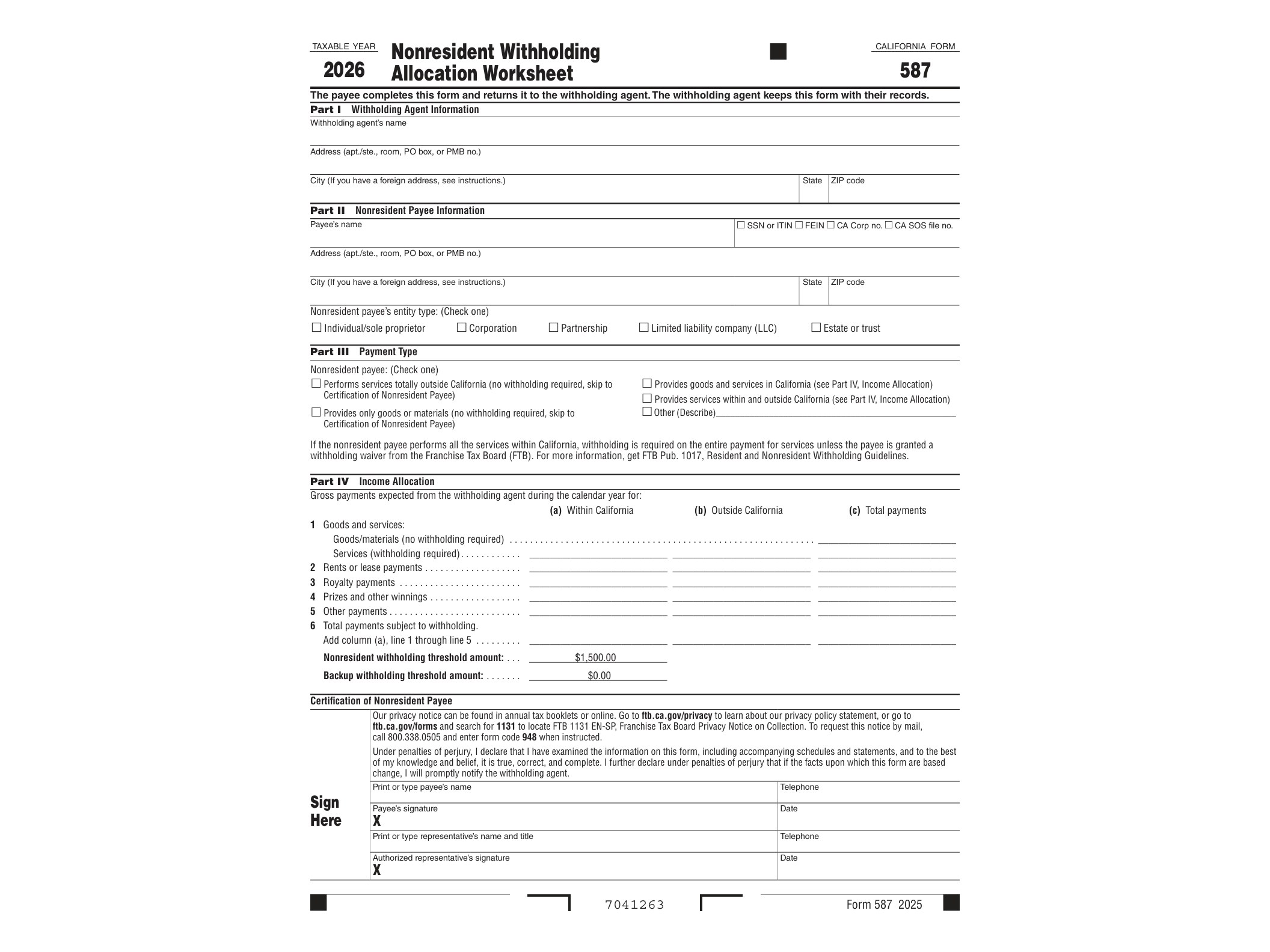
Form 587, issued by the California Franchise Tax Board, is the Nonresident Withholding Allocation Worksheet. Businesses and individuals in California use it to determine whether payments made to a nonresident payee (an individual, corporation, partnership, LLC, estate, or trust) are subject to California withholding, and if so, how much of that income is actually attributable to California sources.
The form matters because California generally requires withholding at a rate of 7% on payments made to nonresidents for services performed in the state, rentals, and certain other income types. But not every payment triggers withholding. Form 587 is the mechanism that lets the payee certify their residency status and, when applicable, allocate the portion of income that is California-source versus income earned outside the state. Without this documentation, the payer (called the withholding agent) may be required to withhold on the full payment amount regardless of how much work was actually performed in California.
Who Needs to Complete Form 587
The payee — not the payer — fills out and signs Form 587. This includes independent contractors, consultants, entertainers, athletes, and any nonresident entity receiving payment for services rendered partly or entirely in California. It also applies to certain rental income situations where the recipient lives outside the state. The withholding agent (the business or individual making the payment) keeps the completed form on file; it is not typically mailed to the FTB unless requested during an audit or review.
If the nonresident payee instead qualifies for a full waiver of withholding based on prior tax compliance or other exemptions, they would use Form 588, the Nonresident Withholding Waiver Request, rather than Form 587. The two forms serve different purposes: 587 allocates income and determines partial withholding exemption, while 588 requests a complete waiver from withholding obligations.
When Form 587 Is Used
The form should be completed before or at the time payment is made, since the withholding agent needs it to calculate the correct amount to withhold (if any). It’s commonly requested by California businesses hiring out-of-state contractors, production companies working with nonresident talent, and property managers dealing with out-of-state landlords. Once completed, the payee’s certification remains valid for the specific contract or payment arrangement described on the form, and a new form is generally needed for each new contract or if circumstances change.
The worksheet portion of Form 587 walks through a series of questions to establish whether the income is:
- Entirely California source (full withholding may apply, subject to the 7% rate)
- Partially California source (allocation based on days worked in-state versus out-of-state, or another reasonable method)
- Not subject to withholding at all, based on total payments being under the threshold or other exceptions
How to Get and Fill Out Form 587
The current version of Form 587 is available directly from the Franchise Tax Board as a fillable PDF, meaning you can type your information directly into the form fields before printing or saving it electronically. This AcroForm functionality makes it easier for both payees and withholding agents to keep clean, legible records without handwriting entries.
To complete it, the payee will need basic identifying information (name, address, taxpayer ID or SSN), details about the type of income being paid, and answers to the residency and allocation questions in Part I and Part II of the form. Part III includes the certification signature, which confirms under penalty of perjury that the information provided is accurate.
Once signed, the form should be given to the withholding agent, who retains it in their records. If the FTB later audits either party, having a properly completed and signed Form 587 on file is what supports the withholding treatment applied. Businesses handling multiple contractor payments often keep a system similar to how New York liquor and beverage manufacturers track their annual filing status using Form MT-38 — maintaining organized documentation tied to each reporting period or contract.
Because withholding rules and thresholds can shift from year to year, it’s worth confirming you’re using the version of Form 587 that matches the current tax year before submitting it, since the FTB updates the form periodically to reflect rate or procedural changes.
Download Official Form 587 (PDF)
Opens the official government PDF in a new tab