
Download Official Form DTF622 (PDF)
Opens the official government PDF in a new tab
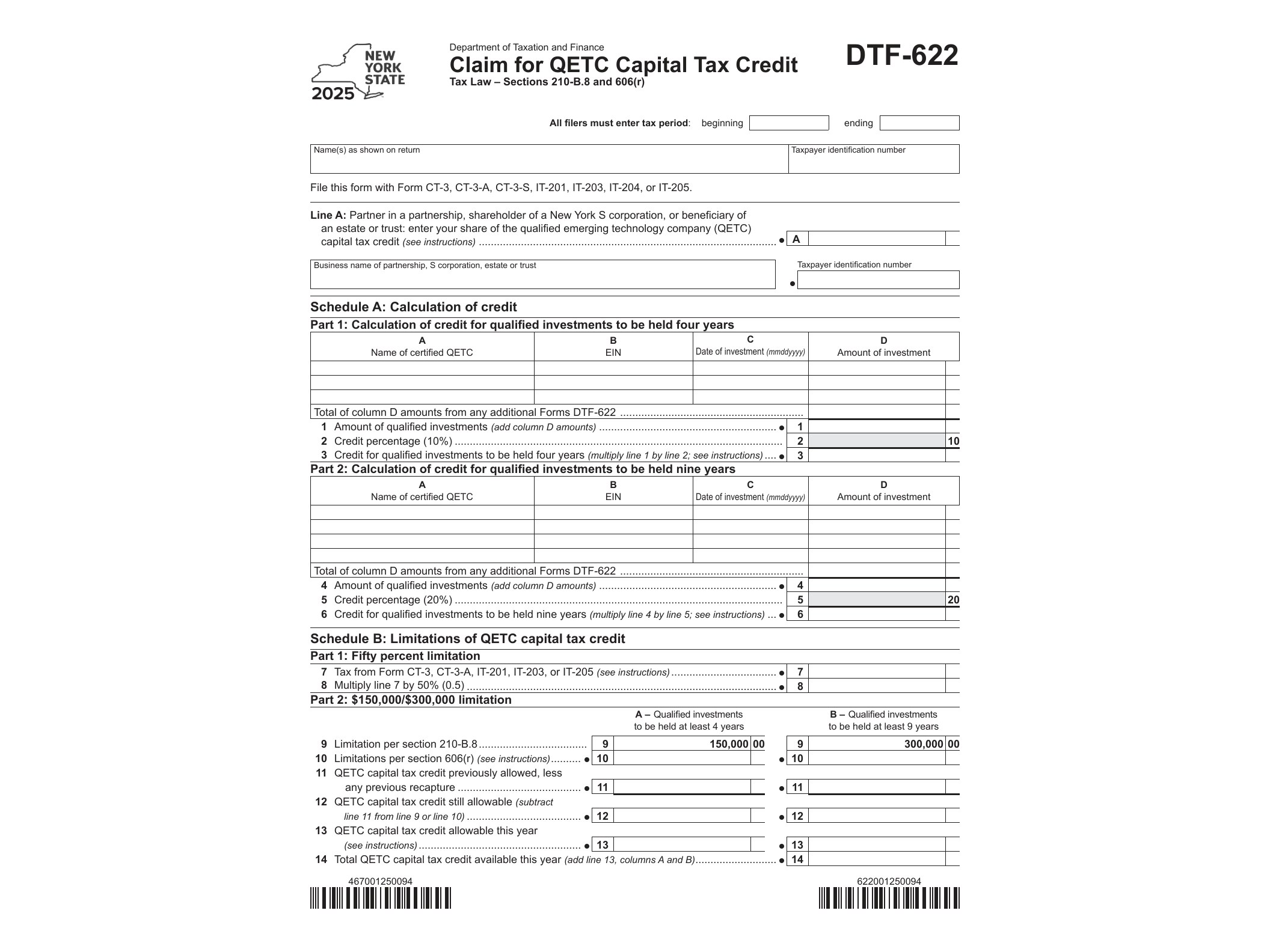
Form DTF-622, Claim for QETC Capital Tax Credit, is issued by the New York State Department of Taxation and Finance for taxpayers who made qualifying investments in a Qualified Emerging Technology Company (QETC). If you put money into an early-stage tech business based in New York and that investment meets the state’s criteria, this is the form you use to claim a credit against your New York tax liability.
What the QETC Capital Tax Credit Covers
The credit rewards individuals and businesses that provide capital to emerging technology companies operating in New York State. These are typically small, research-driven or technology-focused businesses that meet specific employment, product, and revenue thresholds set by the state. The credit is calculated as a percentage of the qualified investment and is designed to encourage private funding into the state’s tech sector rather than relying solely on public grants or loans.
There are generally two components to how the credit is figured: an early-stage investment credit and a credit tied to holding the investment for a required period. Form DTF-622 walks you through both calculations, and the amount you can claim depends on how long you held the investment before selling or disposing of it. Selling too soon can trigger a recapture of part of the credit, so the form also includes sections for reporting any recapture amount if that applies to your situation.
Who Needs to File This Form
You need DTF-622 if you’re an individual, partnership, or corporation that invested in a certified QETC and want to reduce your New York State tax bill using that investment. This isn’t a form for every investor — the company you invested in must have been certified as a QETC by Empire State Development at the time of the investment. If you’re not sure whether the business you invested in qualifies, check with the company directly or verify their certification status before completing this form, since the credit will be denied or adjusted if the underlying investment doesn’t meet the criteria.
Partnerships and S corporations that pass this credit through to partners or shareholders also need to complete portions of this form so each partner can claim their allocated share on their own return.
When to Use Form DTF-622
You file this form for the tax year in which you’re claiming the credit, which could be the year you made the investment or a later year, depending on when the holding period requirements are satisfied. Because the credit involves a holding period test, some taxpayers end up filing this form for several consecutive years to properly report the investment, the credit earned, and any recapture triggered by an early sale. Keep your investment documentation — purchase dates, certification records, and any sale or disposition paperwork — because you’ll need those details each year you file.
How to Get and Complete the Form
Form DTF-622 is a fillable PDF available directly from the New York State Department of Taxation and Finance. Since it’s an AcroForm, you can type your figures directly into the document using any standard PDF reader before printing or attaching it to your return, rather than filling it out by hand. This makes it easier to get calculations right, especially in the sections dealing with investment percentages and holding period adjustments.
Before submitting, double-check the QETC’s certification number and the dates tied to your investment, since errors here are one of the most common reasons claims get delayed. This form is attached to your New York State income tax return for the year you’re claiming the credit — it isn’t filed on its own. If you’re also dealing with other New York state tax matters, such as identity verification issues, it’s worth reviewing related guidance like the DTF-275 identity theft declaration to understand how the state handles verification on other credit and refund claims. And if you prepare returns electronically or work with a tax professional who files on your behalf, understanding e-file provider requirements outlined in resources like the e-file provider handbook can help clarify how supporting forms like DTF-622 get transmitted along with your main return.
Keep a copy of the completed form and all supporting investment records for your files, since the state may request documentation to verify the QETC certification and the investment amount claimed.
Download Official Form DTF622 (PDF)
Opens the official government PDF in a new tab