
Download Official Form IT205A (PDF)
Opens the official government PDF in a new tab
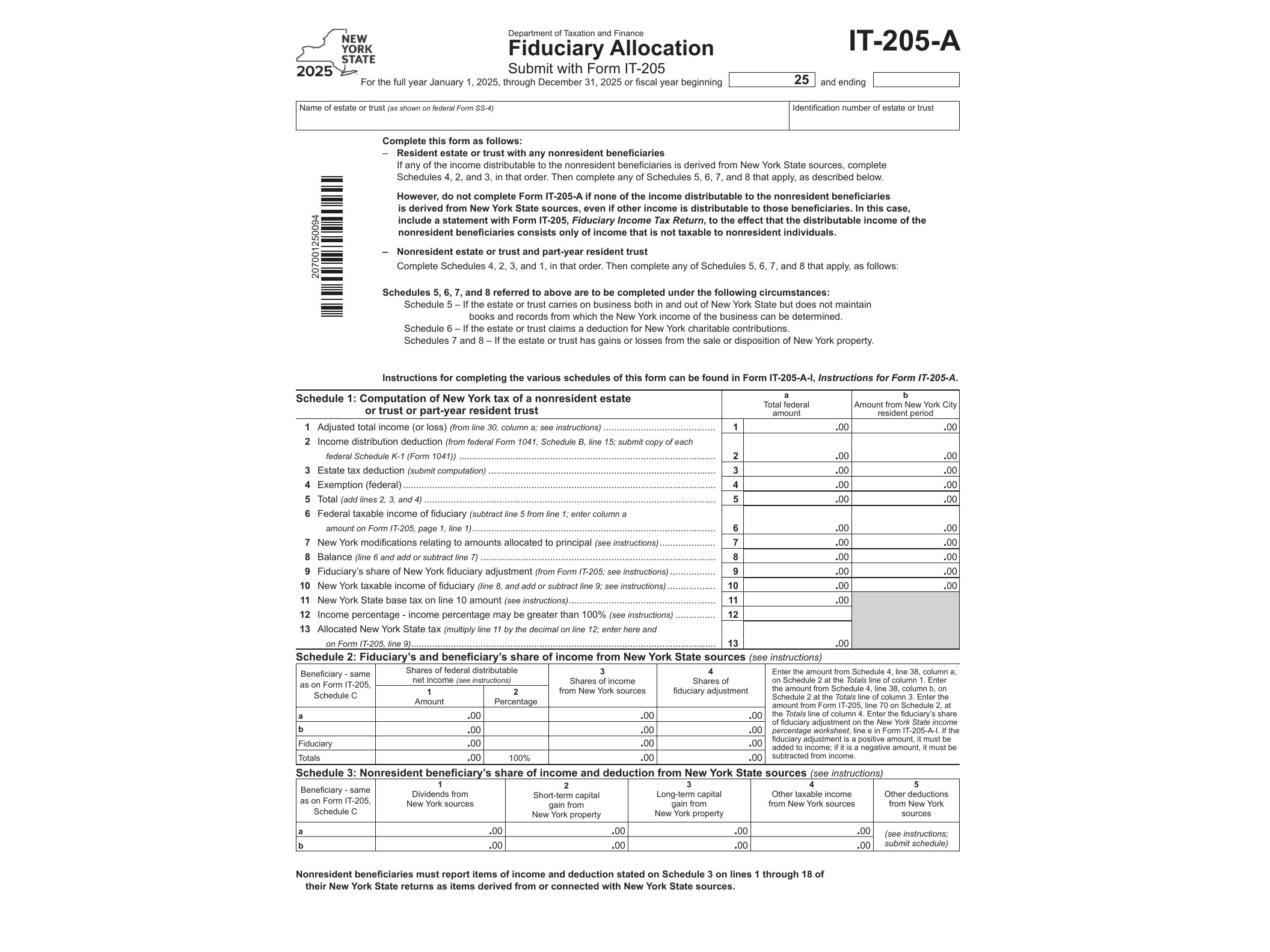
Form IT-205-A, Fiduciary Allocation, is a supporting schedule that estates and trusts file alongside their main New York State fiduciary income tax return, Form IT-205. It’s issued by the New York State Department of Taxation and Finance and covers tax year 2025. Its purpose is narrow but important: it allocates income, gains, losses, and deductions among resident and nonresident beneficiaries, and it separates New York source items from items sourced elsewhere.
If a trust or estate has only New York resident beneficiaries and all its income is New York source income, this form usually isn’t necessary. The moment a fiduciary return involves a nonresident beneficiary, or income that comes from both inside and outside New York State, Form IT-205-A becomes the tool that shows the state how much of each item actually belongs to New York.
Who Needs to File This Form
Fiduciaries handling estates or trusts that meet any of the following conditions typically need to complete IT-205-A:
- The estate or trust has one or more nonresident beneficiaries
- The estate or trust earned income from sources both within and outside New York State
- The fiduciary needs to determine each beneficiary’s share of New York source income for their individual filings
- A resident trust is claiming a credit for taxes paid to another state and needs to document the allocation
Executors, administrators, and trustees are the ones responsible for preparing this schedule, since they’re the parties required to file Form IT-205 in the first place. Accountants who handle multiple fiduciary returns often keep this form on hand every filing season, since allocation issues come up regularly whenever beneficiaries live in different states.
What the Form Actually Asks For
Form IT-205-A breaks income and deductions into categories and then divides them between New York source amounts and other amounts. It also allocates these totals among the beneficiaries listed on the return, showing each person’s share of federal distributable net income alongside their share specifically attributable to New York. This distinction matters because nonresident beneficiaries are only taxed by New York on the portion connected to New York sources, while resident beneficiaries are generally taxed on their full share regardless of where the income originated.
The form also requires basic identifying details: the name of the estate or trust, its EIN, the tax year, and a beneficiary-by-beneficiary breakdown that ties back to the Schedule C information reported on Form IT-205 itself.
When to Use It
Form IT-205-A gets filed with the same due date as Form IT-205, which generally follows the federal fiduciary return deadline. Fiduciaries preparing the return should complete IT-205-A before finishing Form IT-205, since the totals calculated on the allocation schedule feed directly into the main return and into the K-1 equivalents given to beneficiaries.
This kind of allocation work isn’t unique to New York. Other jurisdictions require similar breakdowns for pass-through entities and their owners—New York’s own Form IT-204-CP serves a comparable function for corporate partners in a partnership, showing each partner their share of New York source income. Fiduciaries who also deal with multistate business interests may find themselves handling several allocation forms in a single filing season.
How to Get and Complete the Form
Form IT-205-A is available as a fillable PDF directly from the New York State Department of Taxation and Finance. Because it has AcroForm fields, you can type figures directly into the form on a computer rather than printing it out first and filling it by hand. This makes it easier to double-check that beneficiary allocations add up correctly before printing and submitting the completed return.
Before filling it out, gather the trust’s or estate’s complete accounting of income and deductions for the tax year, along with residency information for each beneficiary. Fiduciaries who aren’t sure whether an item counts as New York source income should consult the instructions that accompany Form IT-205, since sourcing rules vary by income type—rental income tied to New York property is treated differently than interest income, for example.
Fiduciaries dealing with tax matters in other states sometimes need to compare how installment agreements or entity dissolutions work elsewhere; for context on how a different state agency handles a related process, see this overview of requesting an installment agreement with California’s Franchise Tax Board. It’s a useful reminder that allocation and compliance rules differ meaningfully from one state to the next, even when the underlying concepts—residency, source income, beneficiary shares—sound similar on paper.
Download Official Form IT205A (PDF)
Opens the official government PDF in a new tab