
Download Official Form IT631 (PDF)
Opens the official government PDF in a new tab
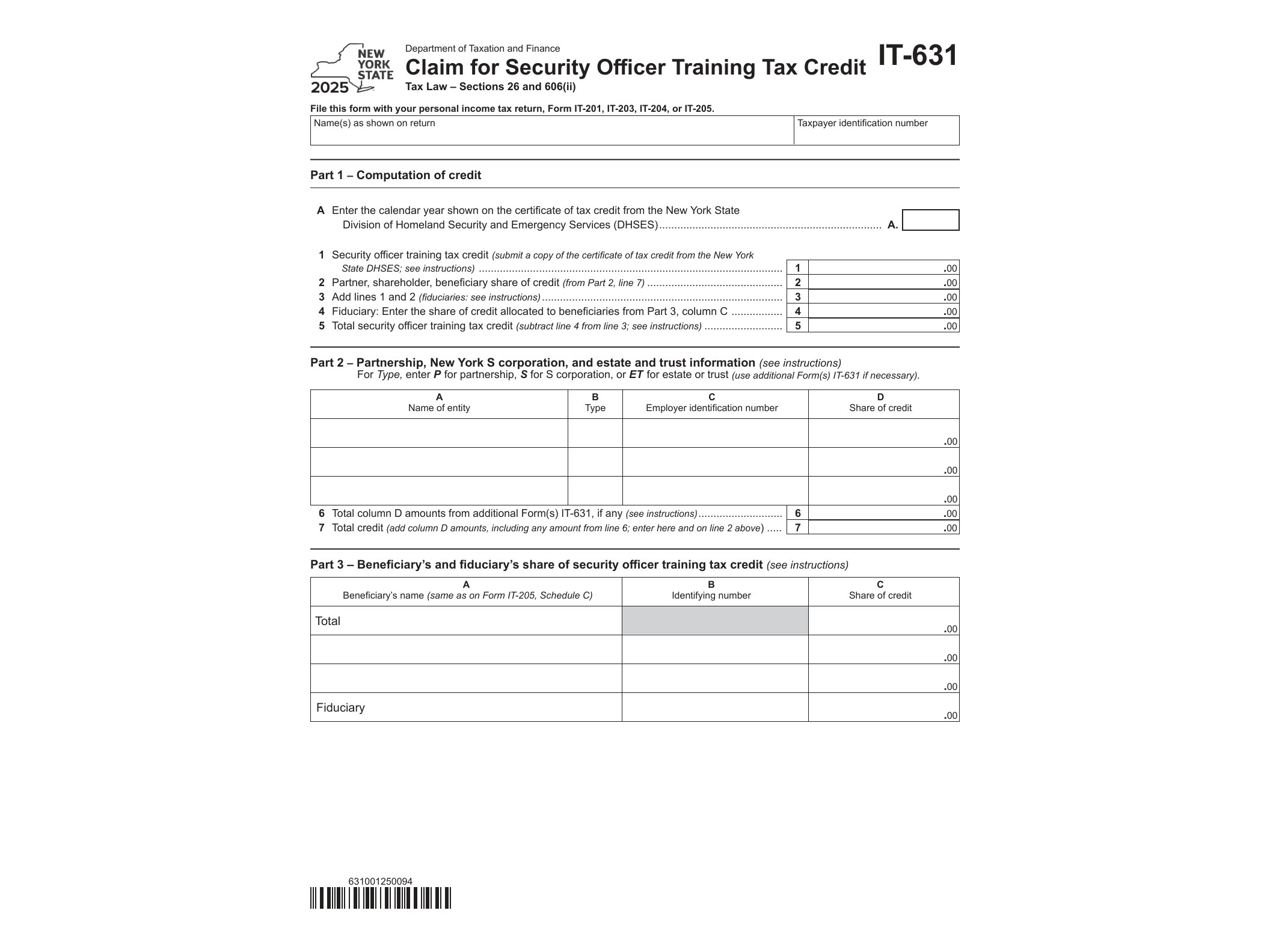
Form IT-631 is issued by the New York State Department of Taxation and Finance for businesses that want to claim the Security Officer Training Tax Credit. This credit rewards employers who cover the cost of training armed and unarmed security officers according to state-approved training requirements. If your business hires security personnel and pays for their required training, this form is how you turn that expense into a dollar-for-dollar reduction of your New York State tax liability.
The credit was created to encourage employers to properly train security staff rather than cut corners on safety education. New York requires security officers to complete a set number of training hours before and after they’re licensed, and the state wants to make sure businesses aren’t discouraged from footing that bill. Form IT-631 lets qualifying employers recover a portion of those training costs directly against their tax bill for the year.
Who Needs to File Form IT-631
This form applies to businesses operating in New York that employ licensed security guards and have paid for their state-mandated training. That includes security guard companies, but also any business that directly employs in-house security officers rather than contracting through an agency. To qualify, the training must meet the standards set by the New York State Division of Criminal Justice Services, and the employer must have actually incurred the training costs — not simply reimbursed an employee after the fact without documentation.
Sole proprietors, partnerships, and corporations can all claim this credit, though the form itself is designed to flow through to your main New York State tax return. Partnerships and S corporations typically complete IT-631 and then pass the credit amount through to individual partners or shareholders, who claim their share on their personal income tax filings.
When You’d Use This Form
You’ll file Form IT-631 for the same tax year in which the qualifying training expenses were paid. For tax year 2025, that means training costs incurred during the 2025 calendar or fiscal year, depending on how your business reports income. The form is filed alongside your regular New York State income or corporate tax return — it’s not a standalone submission you send in separately.
Timing matters here because the credit is nonrefundable in most cases, meaning it can only offset tax you actually owe. If your training expenses were substantial but your tax liability is low, you may want to consult with a tax preparer about how carryforward provisions work, since unused credit amounts sometimes can be applied to future years depending on the specific rules in effect for the credit.
How to Get and Complete the Form
Form IT-631 is a fillable PDF, meaning you can type your information directly into the form using standard PDF software before printing or attaching it to your electronic filing. You’ll need records of the training costs paid, the number of officers trained, and documentation showing the training met state certification standards. The New York Department of Taxation and Finance expects this backup documentation to be available if your return is ever reviewed, even though you don’t submit it with the form itself.
Filling it out generally involves listing your business identification details, calculating the eligible training expenses, and applying the statutory credit rate to determine your total claim. The result then transfers to the credit section of your main state tax form. Businesses juggling multiple New York credits in the same filing year, such as those also claiming benefits under programs like the Brownfield Redevelopment Tax Credit, should keep each credit’s documentation separate since the eligibility rules and calculation methods differ significantly between programs.
If you’re not familiar with New York’s credit forms in general, it helps to understand how state-specific tax credits interact with federal filings and other state paperwork you might already be handling, similar to how fiduciaries track state e-file records or farmers manage estimated tax adjustments. Getting the sequence right — completing IT-631 before finalizing your main return — avoids having to file an amended return later just to add a credit you were otherwise entitled to claim.
Download Official Form IT631 (PDF)
Opens the official government PDF in a new tab