
Download Official Form TP584 (PDF)
Opens the official government PDF in a new tab
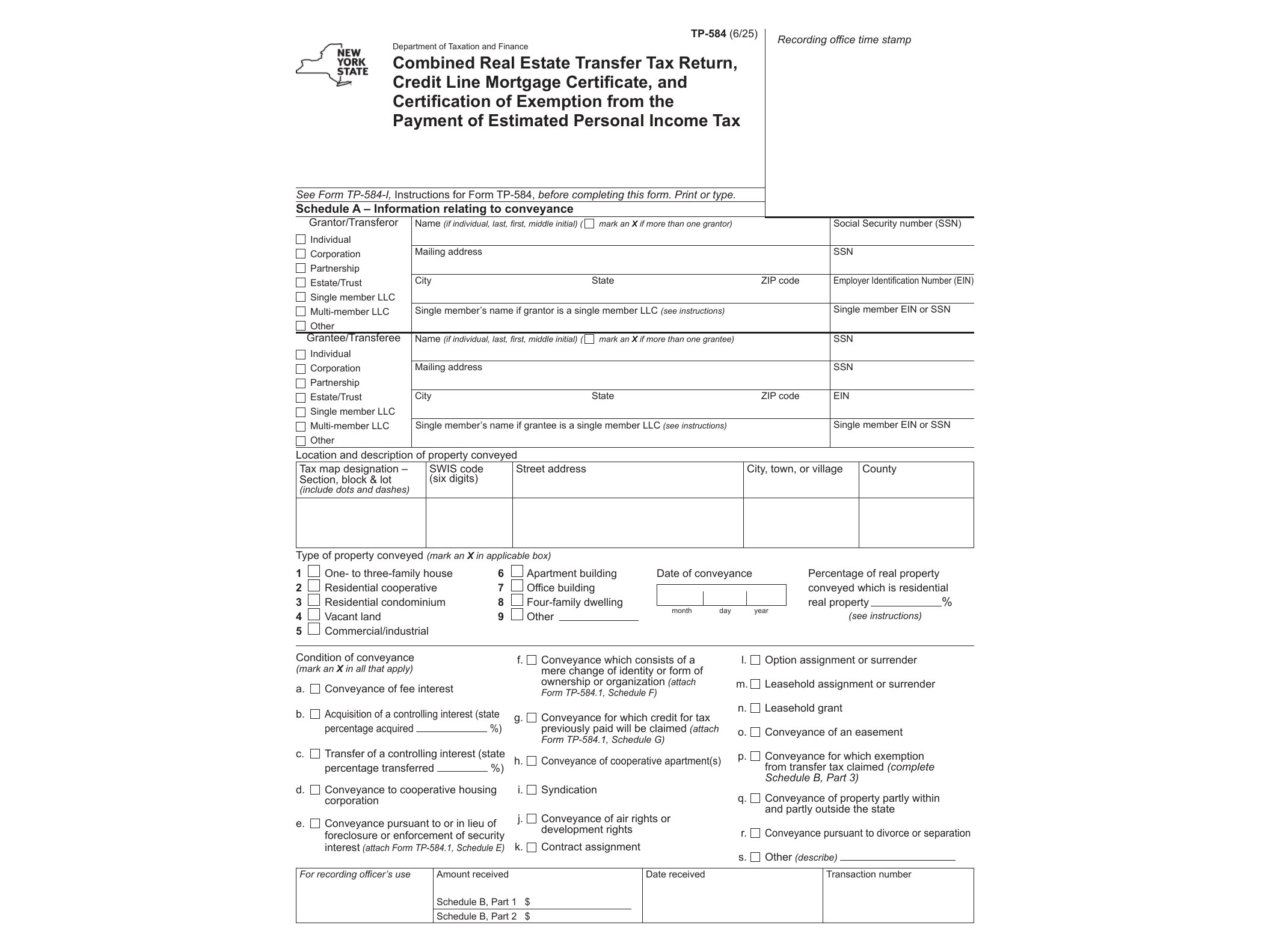
Form TP-584 is the document New York State uses to collect real estate transfer tax whenever property changes hands outside of New York City. Issued by the New York State Department of Taxation and Finance, this form combines three separate functions into a single filing: the real estate transfer tax return, a credit line mortgage certificate, and a certification of exemption from estimated personal income tax withholding. If you’re buying, selling, or closing on property anywhere in New York State (excluding the five boroughs), you’ll almost certainly encounter this paperwork before the deed can be recorded.
What Form TP-584 Actually Covers
The transfer tax return section calculates how much tax is owed based on the sale price or consideration paid for the property. New York imposes a real estate transfer tax rate of $2 for every $500 of consideration, and this form is where the grantor (seller) reports that calculation to the state. The form also asks whether the property is residential, and additional tax may apply for certain high-value residential transfers.
The credit line mortgage certificate portion applies specifically to transactions involving a mortgage that secures a credit line arrangement, such as a home equity line of credit. If the property being transferred is subject to this kind of mortgage, the form requires disclosure of the outstanding principal amount so the county clerk can determine whether additional mortgage tax applies.
Finally, the certification of exemption section lets the seller state whether they qualify for an exemption from the estimated personal income tax payment normally required under New York’s nonresident withholding rules. Sellers who are full-year New York residents, or who otherwise meet specific exemption criteria, use this part of the form to avoid unnecessary withholding at closing.
Who Needs to File This Form
Both the buyer (grantee) and seller (grantor) have responsibilities tied to TP-584, though the grantor is typically the party responsible for paying the transfer tax and signing the certification of exemption. Real estate attorneys, title companies, and closing agents handle most of the actual paperwork, but the parties to the transaction need to understand what they’re signing since the certifications carry legal weight regarding tax liability.
This form applies to virtually every deed transfer recorded in New York State counties outside New York City, including residential sales, commercial property transfers, and even certain transfers between family members or entities where consideration is nominal. If the property sits within the five boroughs, filers instead need Form TP-584-NYC, which covers the same three functions but is tailored to New York City’s specific tax structure and additional local transfer tax requirements.
When Form TP-584 Is Required
The form must be completed and submitted at the time the deed is presented for recording with the county clerk’s office. County clerks generally won’t record a deed without a properly completed TP-584 attached, since the transfer tax payment is tied directly to the recording process. This means the form needs to be prepared before closing, not after, since any delay in getting it right can hold up the entire transaction.
How to Complete and Submit the Form
The current version, revised June 2025, is available as a fillable PDF directly from the New York State Department of Taxation and Finance website. Because it’s an AcroForm, you can fill in the fields digitally using standard PDF software before printing for signatures, which cuts down on errors compared to handwriting the form.
When completing TP-584, you’ll need the property’s tax map designation, the full legal names and addresses of both grantor and grantee, the consideration amount, and details about any existing mortgages on the property. If the seller qualifies for an exemption from estimated tax, that section requires selecting the applicable exemption category and signing under penalty of perjury.
Attorneys and title companies familiar with New York closings typically prepare this form as a matter of routine, but self-represented parties or those handling simpler transfers, such as gifts between relatives, should review the instructions carefully since errors can result in recording delays or tax assessment issues. For sellers dealing with related exemption paperwork on other types of transactions, it’s worth comparing how exemption certificates work generally, similar to how Form ST-119.2 functions for exempt organizations claiming sales tax relief, or how Form FT-123 handles exemption certification for fuel purchases under IDA agreements. Each of these forms follows the same basic principle: certifying eligibility for a tax exemption requires accurate, honest disclosure since the state can audit these claims after the fact.
Download Official Form TP584 (PDF)
Opens the official government PDF in a new tab