
Download Official Form IT203F (PDF)
Opens the official government PDF in a new tab
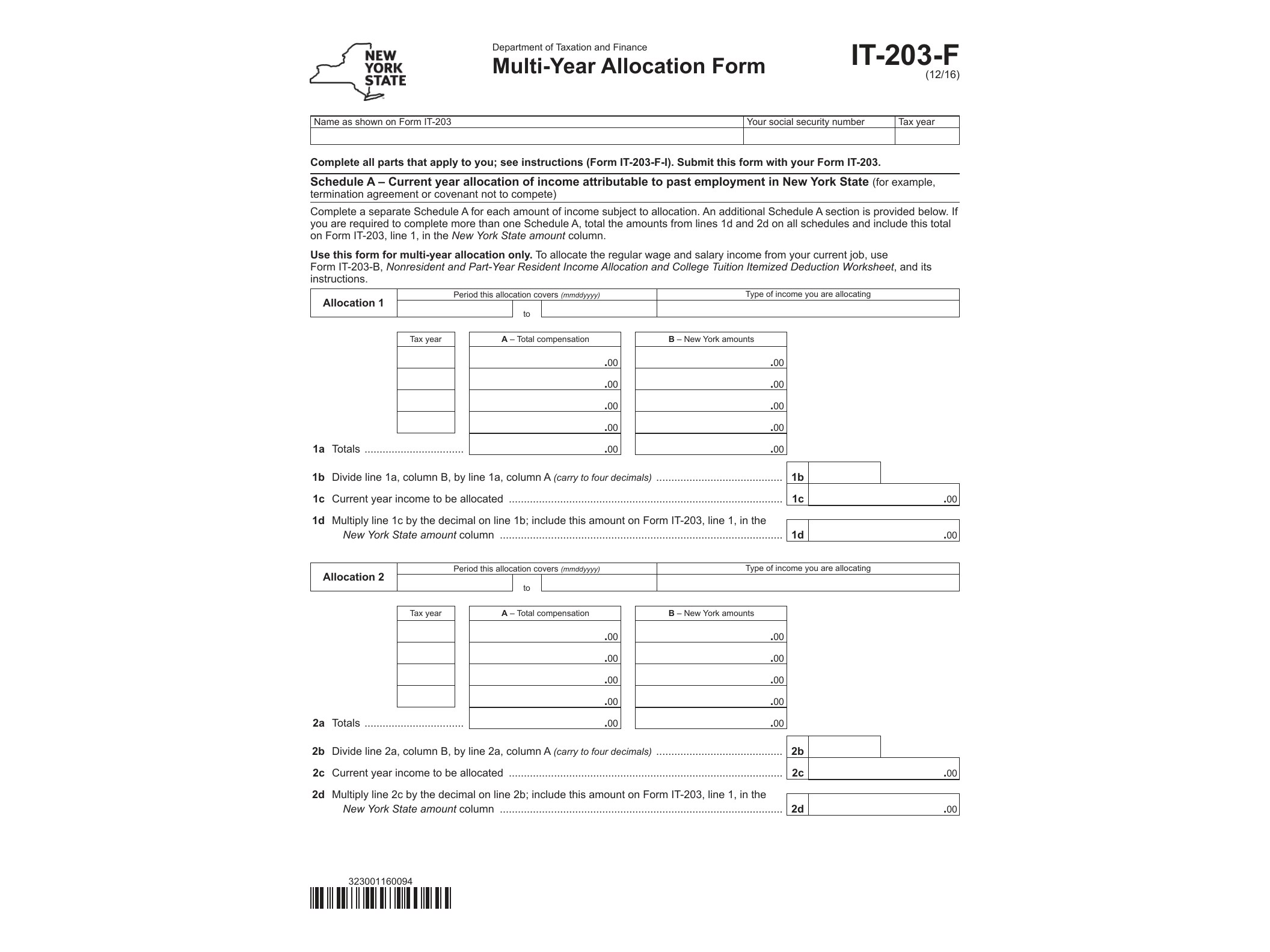
Form IT-203-F, officially called the Multi-Year Allocation Form, is a supporting schedule issued by the New York State Department of Taxation and Finance. It’s used alongside Form IT-203 (the nonresident and part-year resident income tax return) when a taxpayer receives income that was earned over more than one year but paid out in a single tax year. Think stock options, restricted stock, bonuses tied to multi-year performance periods, or deferred compensation that vested after years of work.
The problem this form solves is straightforward: New York only wants to tax the portion of that income that’s actually connected to work performed while you were a New York resident or while you were physically working in New York as a nonresident. Without a mechanism like IT-203-F, the state could end up taxing income tied to years when you lived or worked entirely outside New York, which wouldn’t be fair or accurate.
Who Needs to File IT-203-F
You’ll need this form if you’re filing Form IT-203 as a nonresident or part-year resident and you received compensation during the tax year that was earned over a period spanning multiple years. Common examples include:
- Stock options or restricted stock units (RSUs) that vested or were exercised in the current year but were granted years earlier
- Signing bonuses or retention bonuses tied to a multi-year employment agreement
- Severance pay calculated based on years of service
- Deferred compensation payouts covering several prior tax years
If your work location changed during the earning period, or if you moved into or out of New York State during those years, you’re a strong candidate for needing this allocation. The form essentially asks you to break down the earning period year by year and show where you were working or living during each segment.
When It’s Used
You attach IT-203-F to your IT-203 return for the tax year in which you actually received the income, not the year it was earned. So if you were granted stock options in 2019 but exercised them in 2024 after relocating out of New York partway through that vesting period, the allocation happens on the return you file for 2024, referencing your work history back to 2019.
This is different from a straightforward single-year allocation, which you’d typically handle directly on the IT-203 itself using New York source income percentages. Multi-year situations require the added detail because a single percentage doesn’t capture how your residency or work location shifted over time.
Nonresidents dealing with New York-sourced income often run into other allocation and reporting forms as well. If you’re also involved in a partnership situation, for instance, it’s worth reviewing how New York’s group return works for nonresident partners, since the sourcing rules share some similar logic.
How to Fill It Out
The form asks you to list each year included in the earning or vesting period, along with the number of days (or a reasonable method) you worked in New York versus outside the state during each of those years. You’ll calculate a New York allocation percentage for each year separately, then apply those percentages to the corresponding portion of the total compensation received.
Employers sometimes provide worksheets or year-by-year breakdowns for stock compensation, which can make completing this form considerably easier. Keep records of pay stubs, employment contracts, and any documentation showing your work location during the earning period, since the Department of Taxation and Finance can request support for the allocation method you used.
The form is fillable digitally, so you can enter your figures directly into the PDF before printing and attaching it to your paper return, or before submitting through approved e-file software that supports it.
If you’re unsure whether your income qualifies for multi-year treatment versus a standard single-year allocation, it may help to compare your situation with other state-specific income sourcing forms, like California’s Form 3534, which handles a different kind of authorization but illustrates how states structure these supplemental filings. And if you ever need to pull a prior year’s return to check how income was reported previously, a resource like requesting a copy of a past tax return explains that process for California filers, though New York has its own request procedure through its tax department.
Getting the allocation right on IT-203-F can meaningfully reduce your New York tax liability if a good portion of your earning period happened outside the state, so it’s worth taking the time to document your work history accurately rather than defaulting to a rough estimate.
Download Official Form IT203F (PDF)
Opens the official government PDF in a new tab