
Download Official Form IT203GR (PDF)
Opens the official government PDF in a new tab
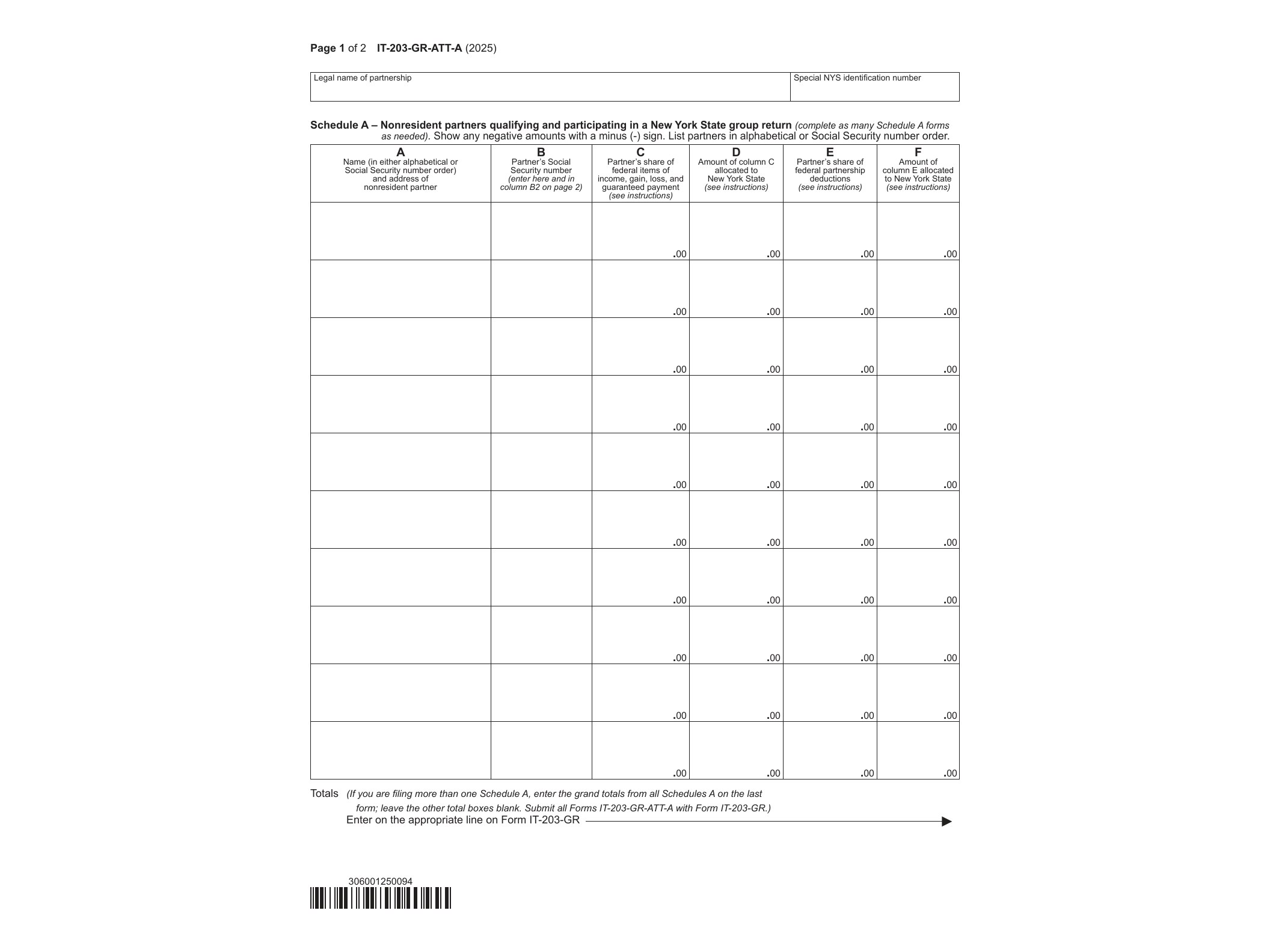
Form IT-203-GR-ATT-A Schedule A is an attachment used alongside New York’s group nonresident tax return for partners who elect to be included in a partnership’s combined filing. It’s issued by the New York State Department of Taxation and Finance and applies specifically to partnerships that choose to file a group return on behalf of eligible nonresident partners rather than requiring each partner to file an individual IT-203.
This schedule is not a standalone form. It works as a supporting attachment to the main group return, providing the detailed, partner-by-partner breakdown of income, deductions, and tax calculations that the state needs to verify each nonresident partner’s share of the group filing. Without this schedule, the group return would lack the itemized data the Tax Department requires to process each partner’s tax liability accurately.
Who Needs to File This Form
Partnerships doing business in New York State that have nonresident partners who qualify and elect to participate in a group return are the ones responsible for preparing this schedule. Individual partners don’t file it themselves — the partnership’s tax preparer or authorized representative completes it as part of the overall group filing package.
Not every nonresident partner is eligible. Generally, partners must meet specific criteria set by New York State, such as having no other New York source income outside the partnership, to qualify for inclusion in a group return. The partnership determines eligibility and lists each qualifying partner’s information on Schedule A.
This form is closely related to other New York group filing attachments. If you’re also dealing with S corporation nonresident shareholders, you’ll want to look at Form IT-203-S-ATT for group nonresident shareholder returns, which serves a similar function but applies to S corporations instead of partnerships. Both forms follow the same general logic: consolidating multiple nonresident filers into a single group submission while still tracking individual tax details.
When to Use Schedule A
Schedule A is used during the annual filing season for tax year 2025, following the same deadlines that apply to New York partnership and personal income tax returns. Partnerships preparing a group return must complete this attachment at the same time they file the main IT-203-GR, since the schedule provides the underlying data the main form summarizes.
If a partnership adds or removes nonresident partners from the group return in a given year, Schedule A needs to reflect those changes accurately. Each partner’s allocated income, New York source income, and tax due must be reported individually, even though the overall filing is submitted as one consolidated return.
What Information You’ll Need
Preparers should have each nonresident partner’s identifying information on hand, along with their distributive share of partnership income, New York source income allocations, and any relevant deductions or credits. Since the form is a fillable AcroForm PDF, you can complete it directly on a computer using Adobe Acrobat or another compatible PDF reader, rather than printing it out and filling it in by hand.
Accuracy matters here more than on many other tax attachments, since errors in individual partner data can affect the entire group return’s validity. Double-check Social Security numbers or ITINs, income allocation percentages, and tax calculations before submitting.
How to Get and Complete the Form
The official fillable version is available directly from the New York State Department of Taxation and Finance website. Because it’s an AcroForm, you can type information into each field, save your progress, and print the completed version for filing or attach it electronically depending on how your partnership submits its group return.
If your practice also handles multi-state filings, it’s worth keeping organized records similar to what’s needed for requesting copies of prior California tax returns or managing tax information authorizations with the California FTB, since group and nonresident filings often require cross-referencing data across states. Keeping consistent partner records year to year makes preparing Schedule A considerably faster in future filing seasons.
Download Official Form IT203GR (PDF)
Opens the official government PDF in a new tab