
Download Official Form 3534 (PDF)
Opens the official government PDF in a new tab
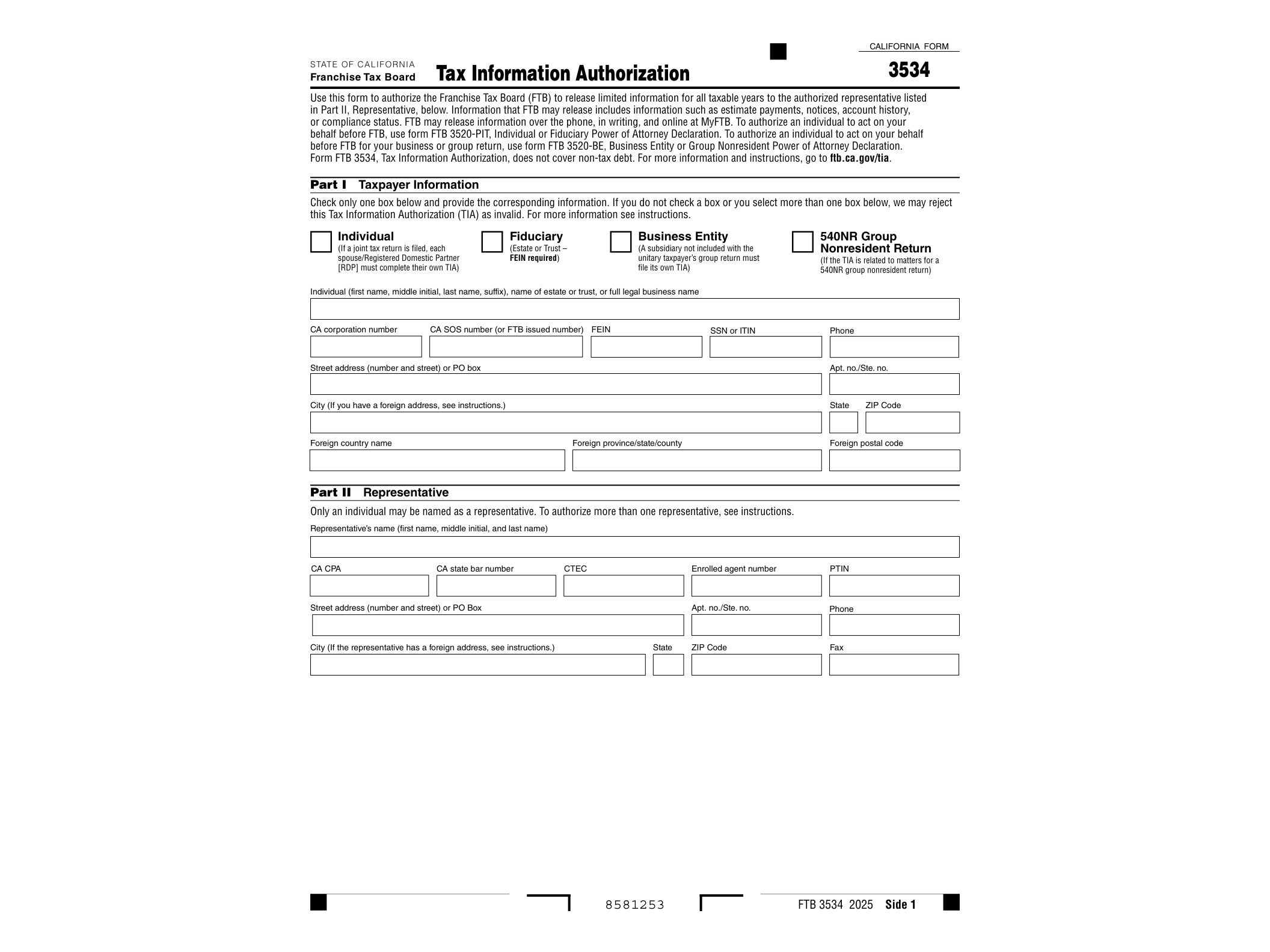
California Form 3534, Tax Information Authorization, is a document issued by the California Franchise Tax Board that lets you grant another person or organization access to your confidential tax information without giving them full power of attorney. If you’ve ever needed a tax preparer, family member, accountant, or business partner to speak with the FTB on your behalf about a specific tax matter, this is the form that makes it legally possible.
Unlike a power of attorney, Form 3534 doesn’t allow the designated person to sign returns, agree to tax adjustments, or represent you in disputes. It simply permits them to receive and discuss your tax account information with the FTB — things like balances due, notices sent, payment history, or the status of a filed return. Think of it as a limited-access key rather than full control over your tax affairs.
Who Needs to File Form 3534
This form is commonly used by individuals who want their accountant or tax preparer to follow up on a return that’s already been filed, especially if there’s a delay in processing or a question from the FTB. Small business owners also use it when they want a bookkeeper or CPA firm to check on entity-level tax matters without having that person take on broader legal authority.
Families dealing with an aging parent’s tax situation, or someone helping a relative sort out old tax notices, often rely on this form as well. It’s a practical solution when you need transparency and communication but not decision-making authority.
When to Use It
You’ll typically submit Form 3534 when:
- You want a third party to obtain copies of notices, transcripts, or account details from the FTB.
- Your tax preparer needs to confirm whether a payment was received or applied correctly.
- You’re authorizing someone temporarily during tax season and don’t want to grant them indefinite authority.
- You need someone to speak with the FTB about a specific tax year or specific type of tax (personal income, business, etc.).
If you later want to end this arrangement, California also provides a separate form for that purpose — FTB Form 3535, which lets you formally revoke a previously granted Tax Information Authorization. It’s worth keeping this in mind if you expect your working relationship with the designated person or firm to change down the line.
How to Fill Out Form 3534
The form is short and fillable digitally as an AcroForm, meaning you can complete it on your computer before printing or submitting it. You’ll need to provide:
- Your name, address, and taxpayer identification number (SSN or ITIN for individuals, or FEIN for businesses).
- The name and contact details of the person or firm you’re authorizing.
- The specific tax years or periods the authorization covers.
- Your signature and the date, confirming you’re granting this limited access voluntarily.
Because the form only grants information-sharing rights, you don’t need to specify complex legal terms or attach supporting documentation in most cases. Just make sure the tax years and identification numbers are accurate, since errors here are the most common reason the FTB rejects or delays processing.
Once completed, the form can be submitted according to the instructions on the FTB’s website, either by mail or through their online authorization system, depending on your preference and the urgency of the request.
If your situation involves broader documentation needs — for instance, if you or your authorized representative eventually need a full copy of a prior year’s return — you might also want to look at FTB Form 3516, which covers requesting copies of personal income or fiduciary tax returns directly from the state.
For taxpayers dealing with multi-state situations, such as nonresident partners filing group returns, comparing how different states handle authorization and reporting can also be useful — see how New York handles similar group filings in the IT-203-GR-ATT-A Schedule A guide.
Keeping a clear paper trail of who has access to your tax information, and for how long, is one of the simplest ways to avoid confusion or unauthorized disclosures later on. Form 3534 gives you that control while keeping the process straightforward.
Download Official Form 3534 (PDF)
Opens the official government PDF in a new tab