
Download Official Form 3537 (PDF)
Opens the official government PDF in a new tab
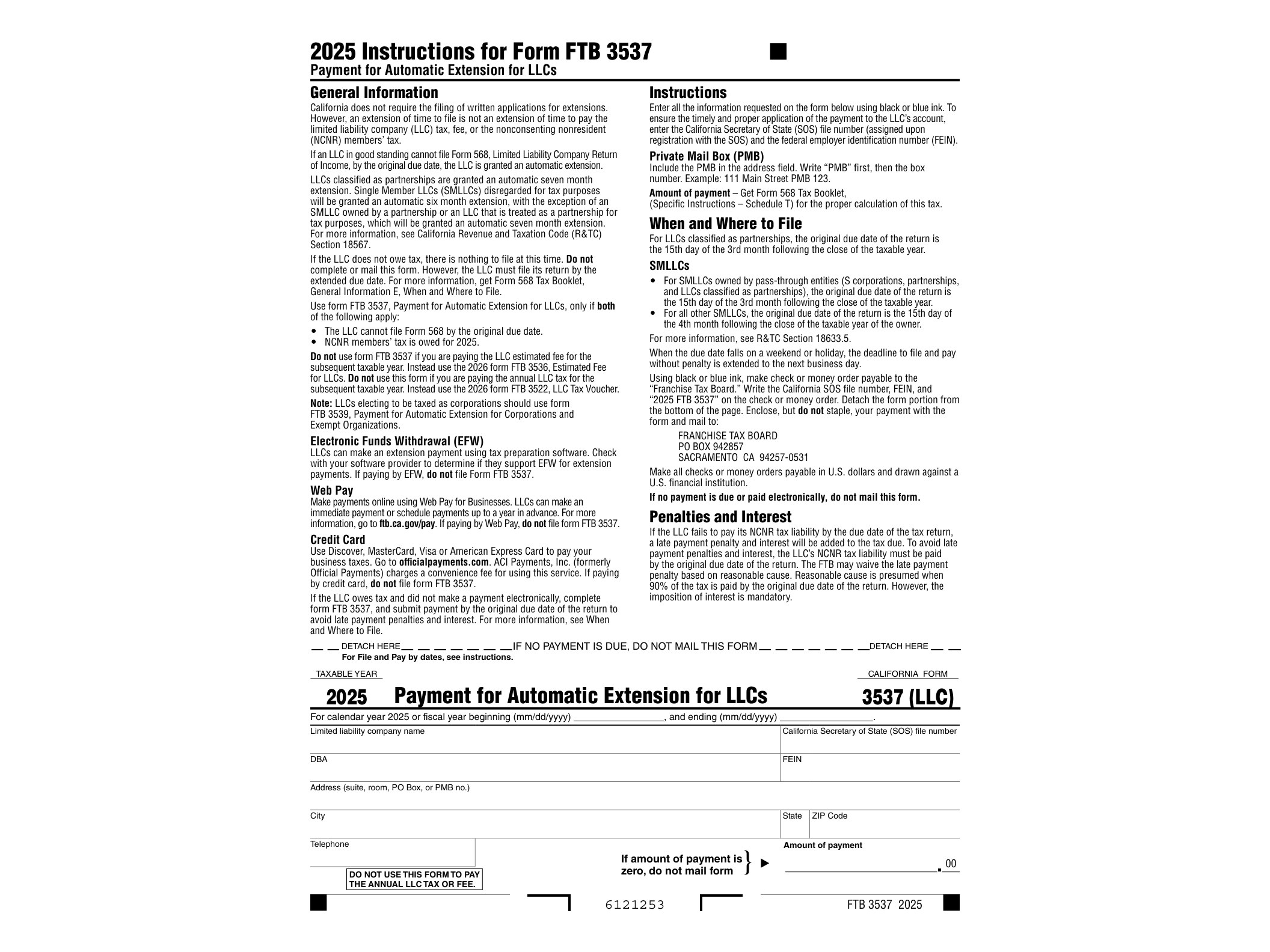
California Form 3537 is the payment voucher that limited liability companies use to send money to the Franchise Tax Board (FTB) when they need extra time to file their state tax return. It’s officially titled “Payment for Automatic Extension for LLCs,” and despite the word “extension” in the name, it’s not actually an extension request form itself — California grants LLCs an automatic six-month extension to file without having to ask for it. Form 3537 exists purely to accompany any payment that’s still owed by the original due date.
This distinction trips up a lot of business owners. The extension to file is automatic, but the extension to pay is not. If your LLC owes California franchise tax, the LLC fee, or any other amount, that money is still due by the 15th day of the fourth month after the close of your tax year (typically April 15 for calendar-year LLCs). Form 3537 is simply the voucher that tells the FTB how much you’re sending and which entity the payment belongs to.
Who Needs to File Form 3537
Any LLC classified as a partnership or disregarded entity for tax purposes that is registered or doing business in California and owes a balance beyond what’s already been paid should use this form. That includes single-member LLCs and multi-member LLCs that haven’t elected corporate taxation. If your LLC is taxed as a corporation, you’d typically use a different extension payment voucher tied to the corporate franchise tax filings, similar to the process outlined for California Form 100.
If your LLC has already paid its full tax liability through estimated payments during the year — including the annual $800 minimum franchise tax and any LLC fee based on total income — you generally don’t need to submit Form 3537 at all. The voucher is only necessary when there’s an outstanding balance to send in along with the extension period.
When to Use It
Form 3537 should be submitted by the original filing deadline for your LLC’s California return, which lines up with the federal deadline for most businesses. Missing this payment deadline, even though the filing deadline itself is automatically extended, can result in penalties and interest charged on the unpaid amount. The extension buys you time to file the paperwork, not to pay what you owe.
This is a common point of confusion for owners who also handle partnership filings. LLCs taxed as partnerships eventually need to file Form 565, and it’s easy to assume the extension covers everything, including tax due. It doesn’t. Form 3537 is what keeps you compliant on the payment side while your actual return gets finished later in the year.
How to Fill Out and Submit Form 3537
The form itself is short. You’ll need to provide your LLC’s name, California Secretary of State entity number or FEIN, address, and the payment amount being submitted. Because it’s an AcroForm, you can fill in the fields digitally on your computer before printing, which cuts down on handwriting errors and makes the numbers easier to read when the FTB processes it.
Once completed, the voucher is mailed along with a check or money order to the address specified in the form instructions, unless you’re paying electronically through the FTB’s online payment system, in which case a physical form usually isn’t required. If your LLC has out-of-state members or partners who need documentation of tax treatment, it may also be worth reviewing related nonresident withholding paperwork, such as Form IT-2658-E, though that one applies to New York rather than California.
Keeping a copy of the submitted voucher and proof of payment is good practice. If the FTB later questions whether a payment was made on time, having that documentation on hand makes resolving the issue much simpler.
Download Official Form 3537 (PDF)
Opens the official government PDF in a new tab