
Download Official Form 565 (PDF)
Opens the official government PDF in a new tab
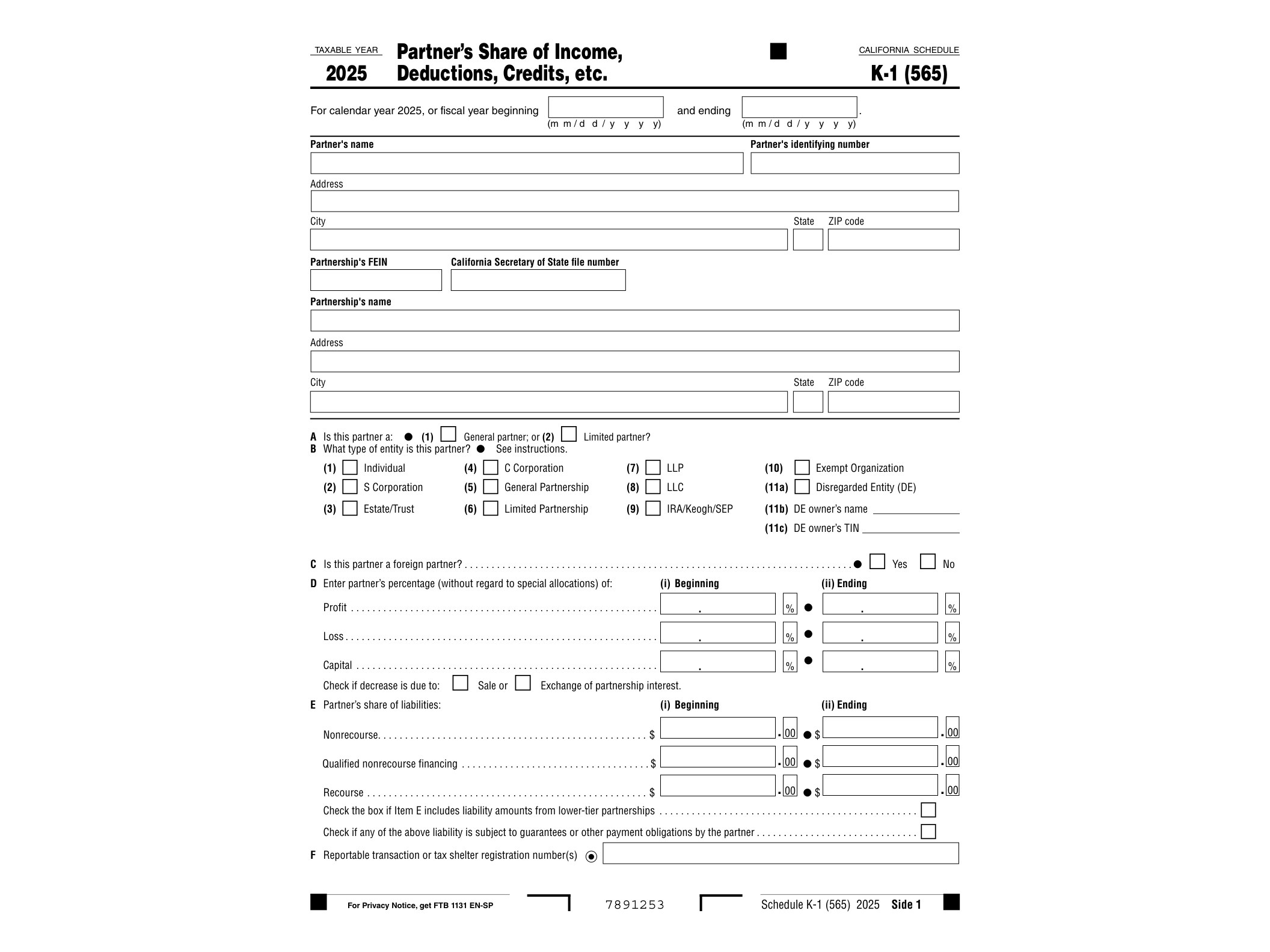
Form 565, Partnership Return of Income, is the tax return that partnerships doing business in California must file each year with the Franchise Tax Board. It reports the partnership’s income, deductions, credits, and other tax items, and it also serves as the basis for issuing Schedule K-1 (565) to each partner so they can report their share of income on their own returns.
Unlike a corporation, a partnership itself generally doesn’t pay income tax on its profits. Instead, income and losses pass through to the individual partners, who report their share on their personal or business tax returns. Form 565 exists so the state can track that pass-through activity, verify that each partner’s allocated share matches what’s reported elsewhere, and apply the California-specific rules that differ from federal partnership taxation.
Who Needs to File Form 565
Any partnership that is doing business in California, or that has income from California sources, is generally required to file Form 565. This includes general partnerships, limited partnerships, and limited liability partnerships that haven’t elected to be taxed as corporations. Real estate investment partnerships, professional services partnerships, and joint ventures organized as partnerships also fall under this requirement.
There’s an important distinction worth noting: limited liability companies (LLCs) classified as partnerships for tax purposes typically file Form 568 instead of Form 565. Form 565 is specifically for entities organized and taxed as partnerships, not LLCs. If your business is structured as an LLC, you’ll want to confirm which form applies before submitting anything to the FTB.
Partnerships that are exempt from the annual tax, or that have no California source income and no California partners, may have different filing obligations. It’s worth reviewing your specific situation, since the rules around nexus and California-source income can get complicated for multi-state partnerships.
When Form 565 Is Due
For most partnerships operating on a calendar year, Form 565 is due on the 15th day of the third month following the close of the taxable year — typically March 15. Partnerships operating on a fiscal year follow the equivalent deadline based on their year-end. An automatic extension of six months is available, but that extension applies to filing the paperwork, not to paying any tax owed, which is still due by the original deadline.
Along with the return, partnerships must also prepare and distribute Schedule K-1 (565) to every partner, showing their individual share of income, deductions, and credits for the year. Partners need this document to complete their own state returns accurately, so timing matters for everyone involved, not just the entity filing.
How to Get and Fill Out Form 565
The 2021 Form 565 is available as a fillable PDF (AcroForm) directly from the Franchise Tax Board, which means you can type your entries directly into the form fields on a computer before printing or submitting it, rather than filling it out by hand. This makes it easier to keep the return legible and reduces transcription errors.
When completing the form, you’ll need the partnership’s federal return information as a starting point, since many of the entries mirror or adjust federal figures for California purposes. You’ll report total income, deductions, and any California adjustments, along with information about each partner and their ownership percentage. If your partnership has apportionment considerations because it operates in multiple states, that section requires particular attention.
Partnerships that also have corporate partners might find it useful to compare how pass-through income interacts with corporate filings — the California Form 100 corporate return guide covers some of that overlap. And if your partnership is facing financial difficulties that affect its ability to pay California taxes, it may be worth reviewing the FTB Form 9310X PC financial condition statement, which some entities use when negotiating payment issues. Businesses with partners or operations spanning into New York might also want to check how unincorporated business taxes work there, covered in this guide to Form IT-219.
Because partnership taxation involves multiple moving parts — allocations, basis calculations, and partner-level reporting — many partnerships work with a tax professional familiar with California rules, especially in years with ownership changes or significant income shifts.
Download Official Form 565 (PDF)
Opens the official government PDF in a new tab