
Download Official Form IT2658E (PDF)
Opens the official government PDF in a new tab
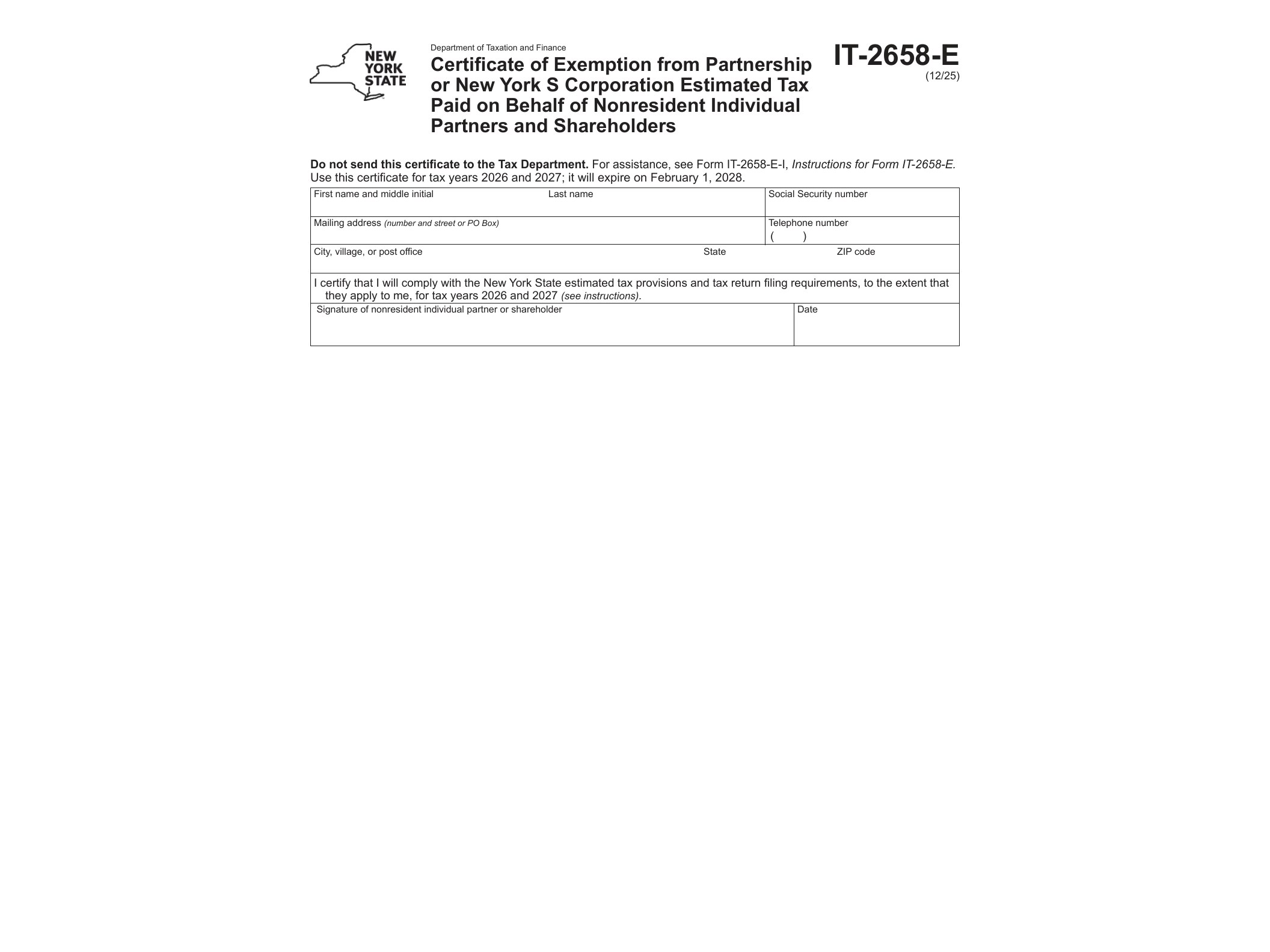
Form IT-2658-E is a certificate issued by the New York State Department of Taxation and Finance that lets a nonresident individual partner or shareholder claim exemption from the estimated tax payments a partnership or New York S corporation would otherwise have to make on that person’s behalf. Instead of the entity withholding and remitting quarterly estimated tax to New York, the nonresident individual files this certificate to confirm they will report and pay their own New York-source income tax directly.
Under New York tax law, partnerships and S corporations doing business in the state generally must make estimated tax payments on behalf of nonresident partners and shareholders who have New York-source income allocated to them. This rule exists because the state wants to collect tax on income earned within its borders even when the individual receiving that income lives elsewhere. Form IT-2658-E is the mechanism that allows a qualifying individual to opt out of that mandatory prepayment, provided they meet certain conditions set by the tax department.
Who Needs This Form
This certificate applies specifically to nonresident individuals who are partners in a partnership or shareholders in a New York S corporation. It is not for corporate partners, trusts, or other entity types, which have separate rules. To qualify for the exemption, the individual typically must certify that they will timely file all required New York personal income tax returns and pay any tax due, or that they meet other specific criteria the Department of Taxation and Finance outlines in the form instructions, such as having no New York filing requirement in a given year.
Business owners who structure operations through pass-through entities often deal with a mix of state filings. If your business also operates in other states, it helps to understand how similar entity-level returns work elsewhere, such as the California Form 565 Partnership Return of Income, since multistate partnerships frequently need to track differing state rules for nonresident partners.
When the Certificate Is Used
A nonresident partner or shareholder completes and submits Form IT-2658-E to the partnership or S corporation, not directly to the tax department. The entity keeps this certificate on file to document why it did not make estimated tax payments for that particular individual during the tax year. The form generally needs to be renewed annually, since the exemption is tied to conditions that can change from year to year, such as income levels or filing history.
Timing matters here. The certificate should be filed before the partnership or S corporation calculates and submits its estimated tax payments for the year, since the whole point is to prevent an unnecessary prepayment. Filing it late, after payments have already been made, won’t help recover money already remitted to New York on the partner’s behalf.
How to Get and Complete It
The current version of Form IT-2658-E, revised for the 12/25 tax period, is available as a fillable PDF directly from the New York State Department of Taxation and Finance website. Because it includes AcroForm fields, you can type information directly into the document using standard PDF software rather than printing it out and filling it by hand.
Completing the form requires basic identifying information: the nonresident individual’s name, address, Social Security number or taxpayer identification number, and the name and identification number of the partnership or S corporation involved. The individual then certifies which exemption condition applies to them and signs the certificate under penalty of perjury. Once signed, it goes to the entity’s tax records rather than being mailed to the state.
Entities that manage multiple owners’ exemption certificates each year should keep a clear filing system, since state auditors can request these documents to verify why estimated payments were skipped for specific individuals. If you’re also managing entity-level income tax filings for a related business, it’s worth reviewing resources like the California Form 100 Corporation Franchise or Income Tax Return guide for comparison, or checking financial condition disclosure requirements similar to those in the FTB Form 9310X PC Business Entity Financial Condition Statement when your business faces broader compliance questions across states.
Getting this certificate right matters for both sides: the nonresident individual avoids having cash tied up in estimated payments they’d rather manage themselves, and the partnership or S corporation avoids penalties for failing to document why it didn’t withhold on that partner’s behalf.
Download Official Form IT2658E (PDF)
Opens the official government PDF in a new tab