
Download Official Form MT38 (PDF)
Opens the official government PDF in a new tab
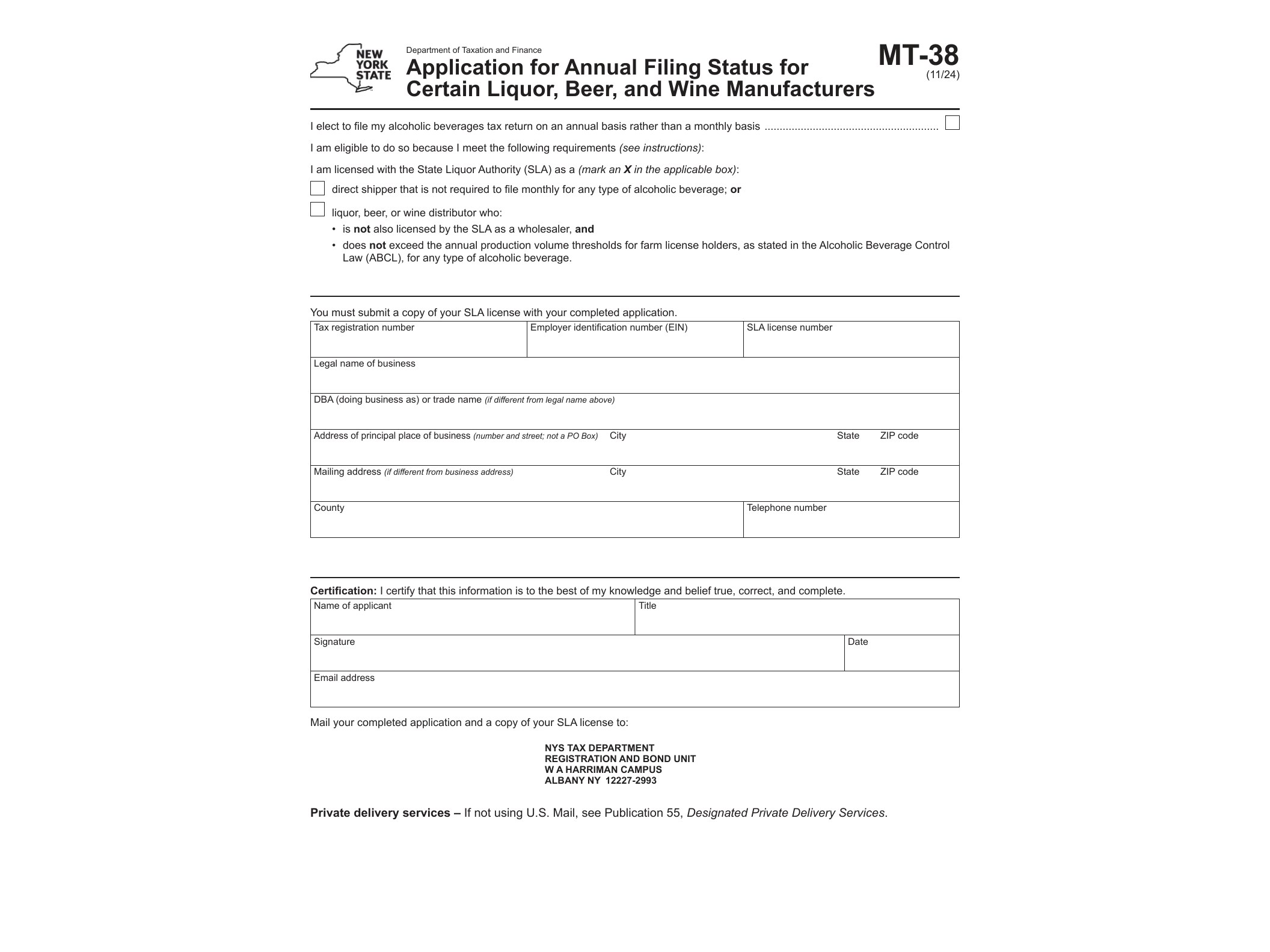
Form MT-38, Application for Annual Filing Status for Certain Liquor, Beer, and Wine Manufacturers, is issued by the New York State Department of Taxation and Finance. It lets qualifying small-scale alcoholic beverage producers switch from the standard monthly or quarterly excise tax filing schedule to an annual one. For a small distillery, brewery, or winery, that change can mean a lot less paperwork over the course of a year.
New York taxes liquor, beer, and wine production and sale, and most manufacturers are required to file excise tax returns on a regular monthly or quarterly basis. That works fine for larger operations with steady cash flow and dedicated accounting staff, but it’s a burden for small producers whose tax liability barely justifies the filing frequency. The state recognized this and created an annual filing option specifically for manufacturers who fall under certain production or tax liability thresholds.
Who Should File Form MT-38
This form is meant for licensed liquor, beer, or wine manufacturers in New York State whose annual tax liability is low enough to qualify for reduced filing frequency. If you run a small craft brewery, a boutique winery, or a small-batch distillery and your total excise tax due each year stays under the threshold set by the Department of Taxation and Finance, you may be eligible to file just once a year instead of monthly or quarterly.
Not every manufacturer qualifies. The Department reviews each application based on production volume and prior tax history, so a producer with a spotty compliance record or one that recently crossed into a higher liability tier may not be approved. It’s also worth noting that this status isn’t automatic — you have to apply for it and receive confirmation before you can stop filing on the standard schedule.
When to Submit This Application
Manufacturers typically submit Form MT-38 at the start of a filing period, before the annual cycle they want approved would begin. If you’re currently filing monthly or quarterly and want to switch to annual filing going forward, you need to apply in advance rather than after the fact. The Department reviews the application and notifies the manufacturer whether the request is approved, so timing matters if you want the change to take effect for the upcoming tax year rather than the one after.
Existing annual filers may also need to reapply periodically if their circumstances change, such as an increase in production that pushes them near or above the eligibility threshold. It’s the manufacturer’s responsibility to monitor whether they still qualify, since continuing to file annually without proper approval can create compliance problems down the line.
How to Complete and Submit the Form
Form MT-38 is a fillable PDF, so you can complete it on your computer rather than printing it out and filling it in by hand. The form asks for standard identifying information — your business name, license number, address, and the type of beverage manufacturing license you hold — along with details about your production volume and prior tax filing history that support your eligibility for annual status.
Because this involves a tax classification change with the state, accuracy matters. Double-check your license number and production figures before submitting, since discrepancies can delay approval or trigger a request for additional documentation. Once completed, the form is submitted directly to the New York State Department of Taxation and Finance for review.
If you’re new to dealing with New York State tax forms, it helps to get familiar with how the state’s excise and specialty tax filings work in general. For instance, businesses dealing with tobacco products face a similar kind of specialized filing requirement described in our overview of the New York Cigarette Tax Floor Tax Return, which shows how the state structures these niche excise tax obligations. Corporate entities with pass-through structures might also want to review our explanation of Form CT-2658 for corporate partners, since many liquor and wine manufacturers operate under partnership or LLC structures that trigger related estimated tax obligations.
What Happens After You Apply
Once the Department reviews Form MT-38, they’ll notify you of their decision. If approved, you’ll start filing your excise tax return annually rather than monthly or quarterly, which simplifies your bookkeeping considerably. If your application is denied, you’ll continue on your existing filing schedule and can reapply later if your production or liability numbers change.
Keep a copy of the approval notice for your records, since you may need to show it if the Department or another agency ever questions why you’re filing on an annual rather than standard schedule. Small business owners juggling multiple state filings, similar to how out-of-state sellers handle nonresident withholding through forms like California’s Form 588, know that keeping documentation organized saves headaches at audit time.
Download Official Form MT38 (PDF)
Opens the official government PDF in a new tab