
Download Official Form CT2658 (PDF)
Opens the official government PDF in a new tab
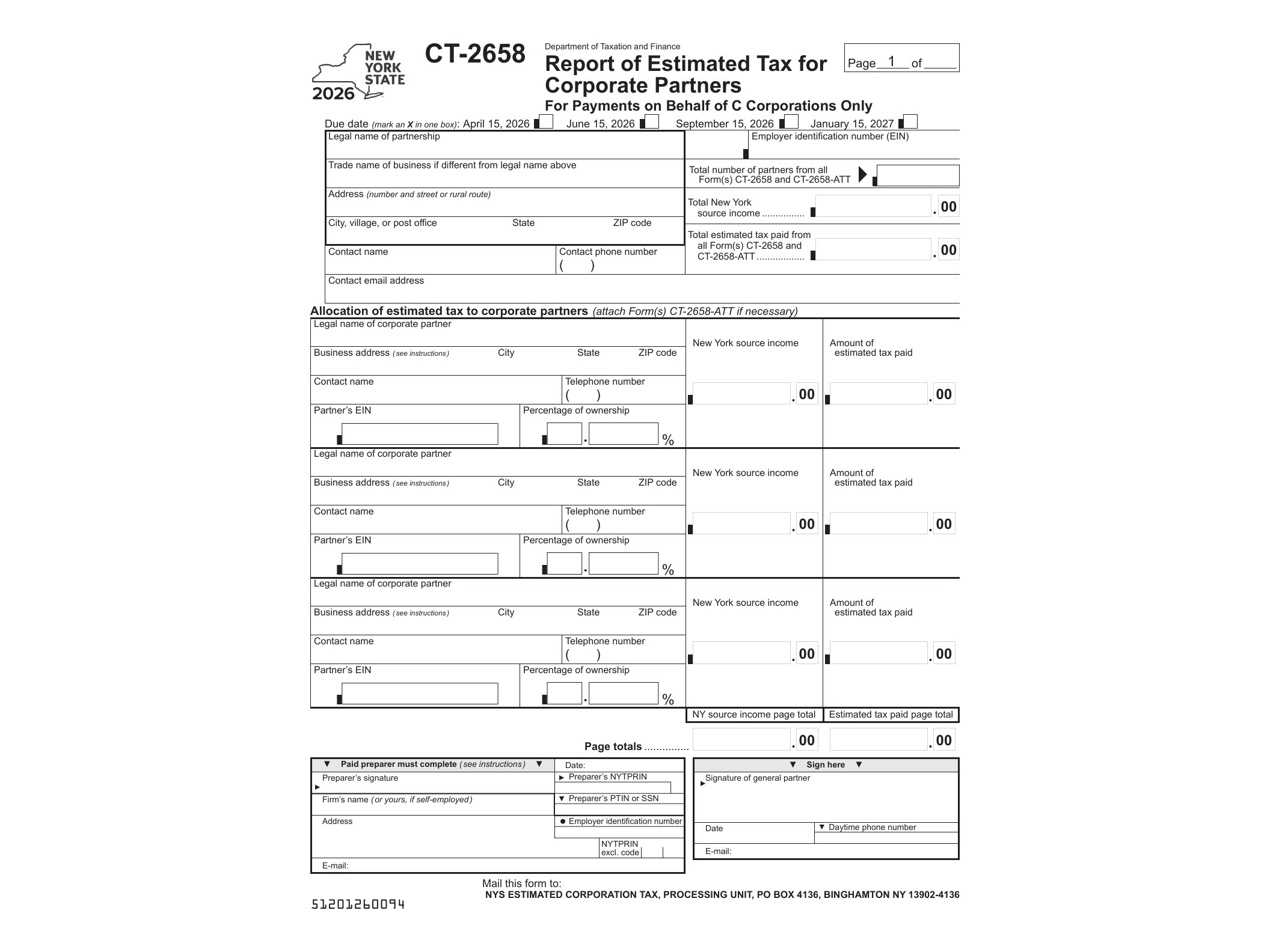
Form CT-2658 is used by partnerships and limited liability companies doing business in New York State to report and pay estimated tax on behalf of their corporate partners. Rather than each corporate partner filing its own estimated tax vouchers with New York, the responsibility shifts to the partnership itself, which collects the required payments and remits them quarterly to the New York State Department of Taxation and Finance.
This form applies specifically to C corporation partners that are not themselves New York residents or that don’t otherwise have a filing presence recognized by the state. If a partnership has income sourced to New York and includes one or more corporate partners subject to Article 9-A (the state’s corporate franchise tax), the partnership generally must make these estimated payments rather than leave the burden to each corporation individually.
Who Needs to File Form CT-2658
Any partnership or LLC treated as a partnership for tax purposes, with income allocated to New York State, must file this form if it has one or more corporate partners that are:
- Subject to New York’s corporate franchise tax under Article 9-A
- Not otherwise exempt from estimated tax withholding requirements
- Receiving a distributive share of partnership income sourced to New York
The partnership acts as a withholding and remitting agent in this scenario. It doesn’t matter whether the corporate partner is based in another state or even another country — if there’s New York-source income flowing through the partnership structure, the estimated tax obligation typically applies.
When Estimated Payments Are Due
Form CT-2658 follows a quarterly payment schedule tied to the partnership’s tax year. For calendar-year filers, payments are generally due in April, June, September, and January of the following year, mirroring the standard estimated tax deadlines used elsewhere in the federal and state tax systems. Partnerships operating on a fiscal year need to adjust these dates according to their specific tax year start.
Each quarterly submission includes a separate voucher along with payment, and the cumulative total paid throughout the year gets reconciled when the corporate partner files its own New York franchise tax return. If the partnership overpays or underpays on behalf of a partner, that gets sorted out at the annual filing stage — this form itself is strictly about the estimated payments made during the year.
How the Form Is Structured
Form CT-2658 is a fillable AcroForm PDF, meaning you can complete it directly on a computer without printing it first. The form asks for basic identifying information about the partnership, the tax year covered, and details for each corporate partner subject to the estimated tax requirement. There’s space to calculate the estimated tax due based on each partner’s distributive share of New York-source income, and the payment voucher itself gets submitted alongside a check or through New York’s online payment system.
Because multiple corporate partners might be involved, larger partnerships sometimes need to complete supplemental schedules listing each partner separately. It’s worth double-checking the instructions that accompany the form each tax year, since New York periodically adjusts thresholds and specific line items.
Getting and Filing the Form
The New York State Department of Taxation and Finance updates Form CT-2658 annually, so it’s important to use the version specific to the 2026 tax year rather than an older copy. The fillable PDF is available directly from the Department’s website, and since it’s an AcroForm, most PDF readers will let you type directly into the fields, save your entries, and print or submit electronically depending on the payment method chosen.
Partnerships that also deal with multi-state withholding situations might find it useful to compare how other states handle similar pass-through withholding rules. For example, Form 592-B serves a comparable function in California, documenting withholding for nonresident payees. While the mechanics differ between states, the underlying goal is the same: making sure tax gets collected upstream when income crosses jurisdictional lines through pass-through entities.
Filing this form correctly and on time helps partnerships avoid penalties tied to underpayment of estimated tax, and it keeps corporate partners’ New York tax accounts properly credited when their own annual returns come due.
Download Official Form CT2658 (PDF)
Opens the official government PDF in a new tab