
Download Official Form 2282PC (PDF)
Opens the official government PDF in a new tab
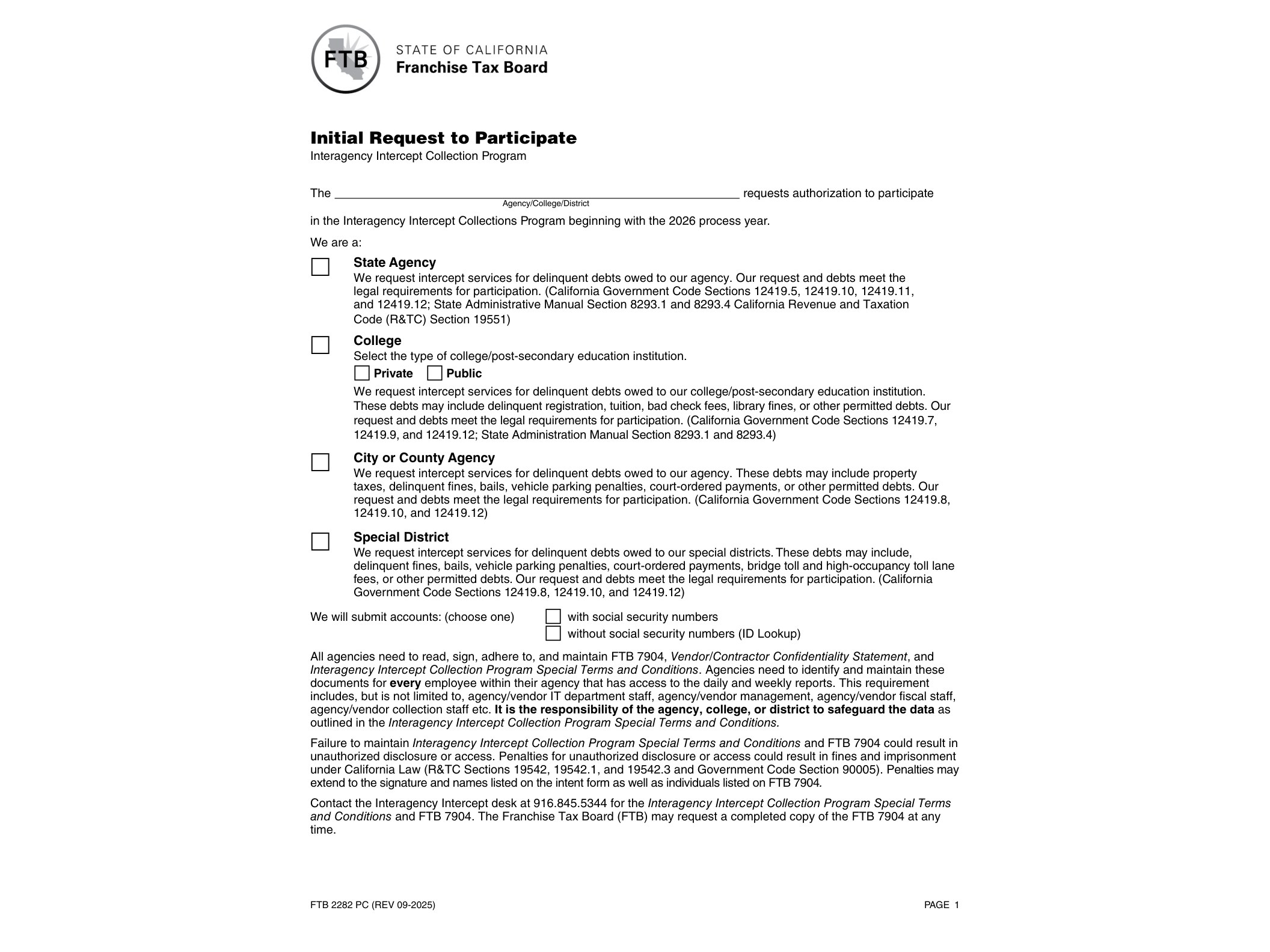
FTB 2282 PC is not a form individual taxpayers fill out when they owe money. It’s an administrative application used by California state agencies, local governments, and certain other public entities that want to join the Franchise Tax Board’s Interagency Intercept Collection (IIC) Program. If your agency has outstanding debts owed by individuals or businesses — unpaid fees, fines, court-ordered amounts, overpayments, or similar obligations — this program lets you intercept a debtor’s state tax refund or lottery winnings to satisfy that debt.
The IIC program works as a centralized collection tool. Rather than each department chasing debtors individually, participating agencies submit debtor information to the FTB, which then matches those records against tax refunds and lottery payouts processed through the state system. When a match occurs, the refund or winnings get intercepted and applied toward the debt, minus any required processing fee. FTB 2282 PC is the gateway document: it’s how an agency formally asks to be enrolled as a participant so it can start submitting claims through this system.
Who Actually Needs to File This Form
This form is for government entities, not private citizens. Typical filers include county courts, city finance departments, state boards, special districts, and other public agencies authorized under California law to collect debts through intercept. If you’re an individual who owes back taxes, child support, or a court fine, you won’t submit this form yourself — you may instead be on the receiving end of an intercept action initiated by an agency that already participates in the program.
Agencies considering enrollment usually have a recurring need to collect from the same pool of debtors — parking violations, unpaid rent on public housing, restitution orders, or fee-based licensing debts are common examples. If your agency’s current collection methods (letters, phone calls, internal collections staff) aren’t recovering enough, intercept through the FTB can be a more reliable channel because it taps directly into state-issued refunds.
When to Submit the Initial Request
FTB 2282 PC is used at the onboarding stage — before your agency has ever submitted a debtor file to the IIC program. It’s not a recurring annual filing; it’s a one-time application to establish your agency as an authorized participant. Once approved, your agency will follow separate procedures (often outlined in a participation agreement or program manual issued by the FTB) for submitting debtor records, updating balances, and receiving intercepted funds on an ongoing basis.
Because this is a formal request between government bodies, expect the FTB to review your agency’s legal authority to collect the type of debt you’re referencing, along with any data-sharing or confidentiality requirements tied to using taxpayer information for this purpose. Getting these details right at the application stage tends to speed up approval.
How to Complete and Submit FTB 2282 PC
The current revision (Rev 09-2025) is available as a fillable PDF directly from the FTB’s forms library, so you can complete it digitally rather than printing and handwriting the entries. The form typically asks for your agency’s legal name, contact information for the person managing the intercept relationship, the statutory authority under which your agency collects debts, and basic details about the type and volume of debt you intend to submit for interception.
Accuracy matters here since the FTB uses this information to set up your agency’s account structure within the IIC system. Missing or vague answers about your legal collection authority are one of the more common reasons a request gets sent back for clarification, so it helps to have your agency’s enabling statute or ordinance on hand when filling out the form.
If your agency also handles matters that occasionally intersect with FTB appeals or resident credit claims, other administrative forms may come up in parallel — for instance, disputes handled through FTB 1037 PC’s appeal request process, or cross-state credit situations similar to what’s addressed in New York’s resident credit form for lump-sum distributions. While unrelated in subject matter, these examples show how tax agencies across states maintain their own specialized forms for narrow administrative functions — FTB 2282 PC fits that same mold, just on the collections side rather than the filing side.
Once submitted, agencies should expect follow-up communication from the FTB’s collections division rather than an instant approval, since setting up intercept access involves internal verification on the state’s end before your agency can start submitting debtor records.
Download Official Form 2282PC (PDF)
Opens the official government PDF in a new tab