
Download Official Form IT112 (PDF)
Opens the official government PDF in a new tab
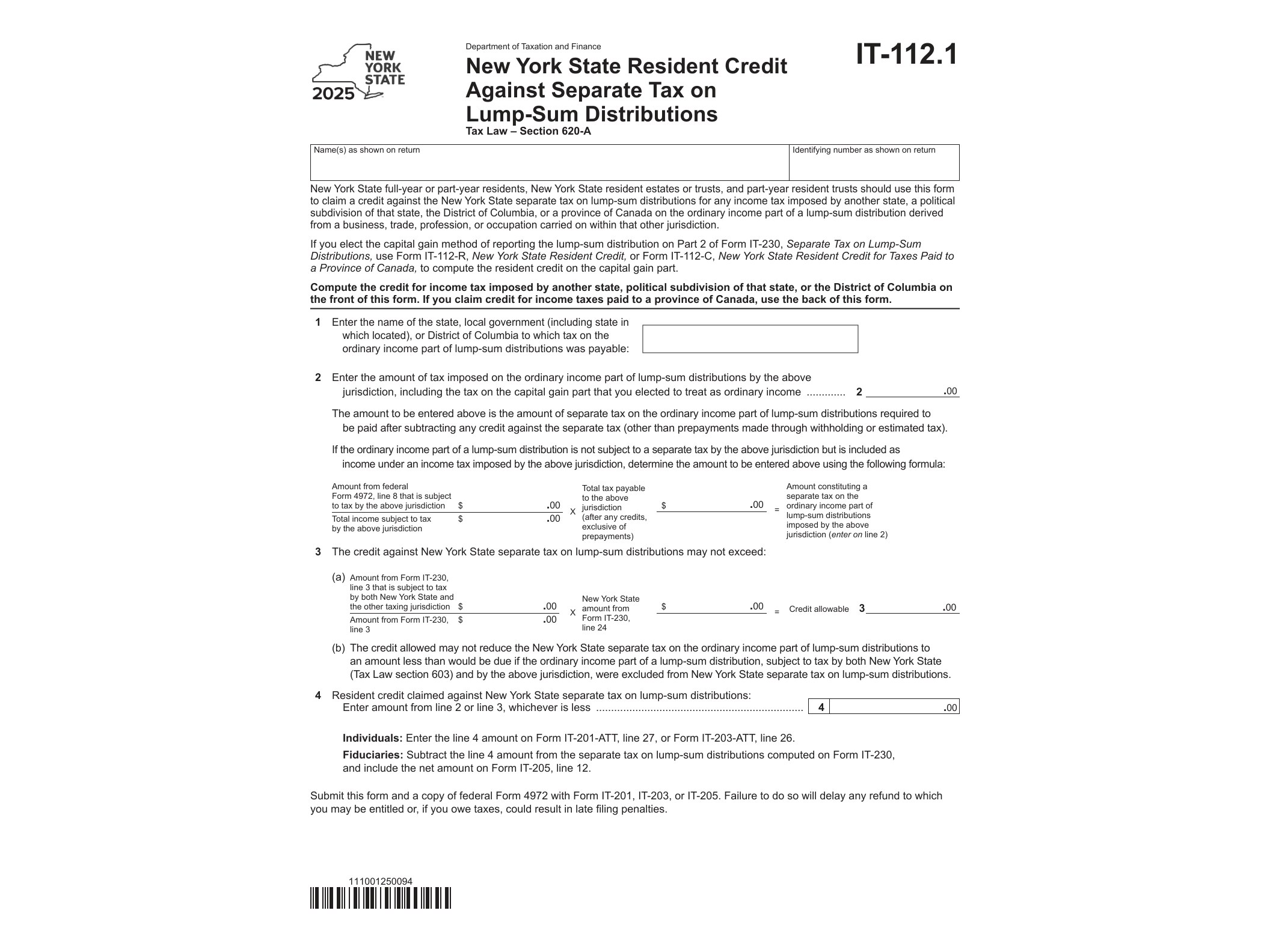
Form IT-112.1 is a New York State tax form that lets full-year and part-year residents claim a credit against the separate tax New York imposes on lump-sum distributions from retirement plans. If you received a lump-sum distribution and paid tax on it to another state, a local government outside New York, or the District of Columbia, this form prevents you from being taxed twice on the same income.
The credit works alongside the regular resident tax credit, but it applies specifically to the separate New York tax on lump-sum distributions computed under Tax Law section 606(d). If you already file Form IT-201 or IT-203 and also owe New York’s separate tax on a lump-sum distribution (usually calculated using the 10-year averaging method on federal Form 4972), Form IT-112.1 is the piece that reconciles the double taxation issue.
Who Needs to File This Form
You generally need Form IT-112.1 if all of the following apply:
- You were a New York State resident (or part-year resident) for the tax year.
- You received a lump-sum distribution from a qualified retirement plan, pension, or profit-sharing plan.
- You used the special averaging method on federal Form 4972 to calculate tax on that distribution.
- You paid income tax on that same distribution to another state, a political subdivision of another state, or Washington D.C.
This situation is fairly narrow. Most taxpayers who take a lump-sum distribution simply roll it over or report it as ordinary income, and never touch this form. It becomes relevant mainly for people who worked or lived in more than one jurisdiction during the year the distribution was received, or who moved to New York and later realized another state had already taxed part of that retirement payout.
It’s worth noting the distinction between this form and Form IT-112-C, which covers credits for taxes paid to a Canadian province rather than another U.S. state. If your lump-sum distribution was taxed by a Canadian jurisdiction instead of a U.S. state, that’s the form you’d use instead.
When to Use Form IT-112.1
You file this form for the same tax year in which you report the lump-sum distribution on your New York return. For tax year 2025, that means attaching Form IT-112.1 to your IT-201 (resident) or IT-203 (part-year resident) return when you file, typically in early 2026. The credit reduces the separate New York tax calculated on the distribution, not your regular income tax liability, so it only matters if you actually owe that separate tax in the first place.
Keep in mind this credit is different from the general resident credit for taxes paid to other states, which is claimed on Form IT-112-R for ordinary income tax purposes. Form IT-112.1 exists specifically because lump-sum distributions get their own separate tax calculation, and without this form, that separate calculation wouldn’t account for tax already paid elsewhere.
How to Fill Out and Submit the Form
Form IT-112.1 is available as a fillable PDF directly from the New York State Department of Taxation and Finance. You’ll need documentation showing the amount of tax paid to the other state or locality on the lump-sum distribution, along with the figures from your federal Form 4972.
The form walks through calculating the portion of the distribution taxed by the other jurisdiction, comparing it to New York’s separate tax calculation, and determining the allowable credit amount. Because the math involves cross-referencing figures from multiple returns, it helps to have your out-of-state return and your federal Form 4972 on hand before starting.
Once completed, attach the form to your New York State income tax return when filing, whether you’re submitting electronically or by mail. If your situation involves a dispute over how New York calculated your tax or credit, and you need to challenge an assessment down the line, resources like the appeal process guide for tax disputes can offer useful context, though that particular process applies to California rather than New York and shouldn’t be confused with New York’s own protest procedures.
Given how specific the qualifying circumstances are, most people only need this form once, if ever. Double-check with a tax preparer familiar with multi-state retirement distributions if you’re unsure whether your situation qualifies for the credit.
Download Official Form IT112 (PDF)
Opens the official government PDF in a new tab