
Download Official Form 3815 (PDF)
Opens the official government PDF in a new tab
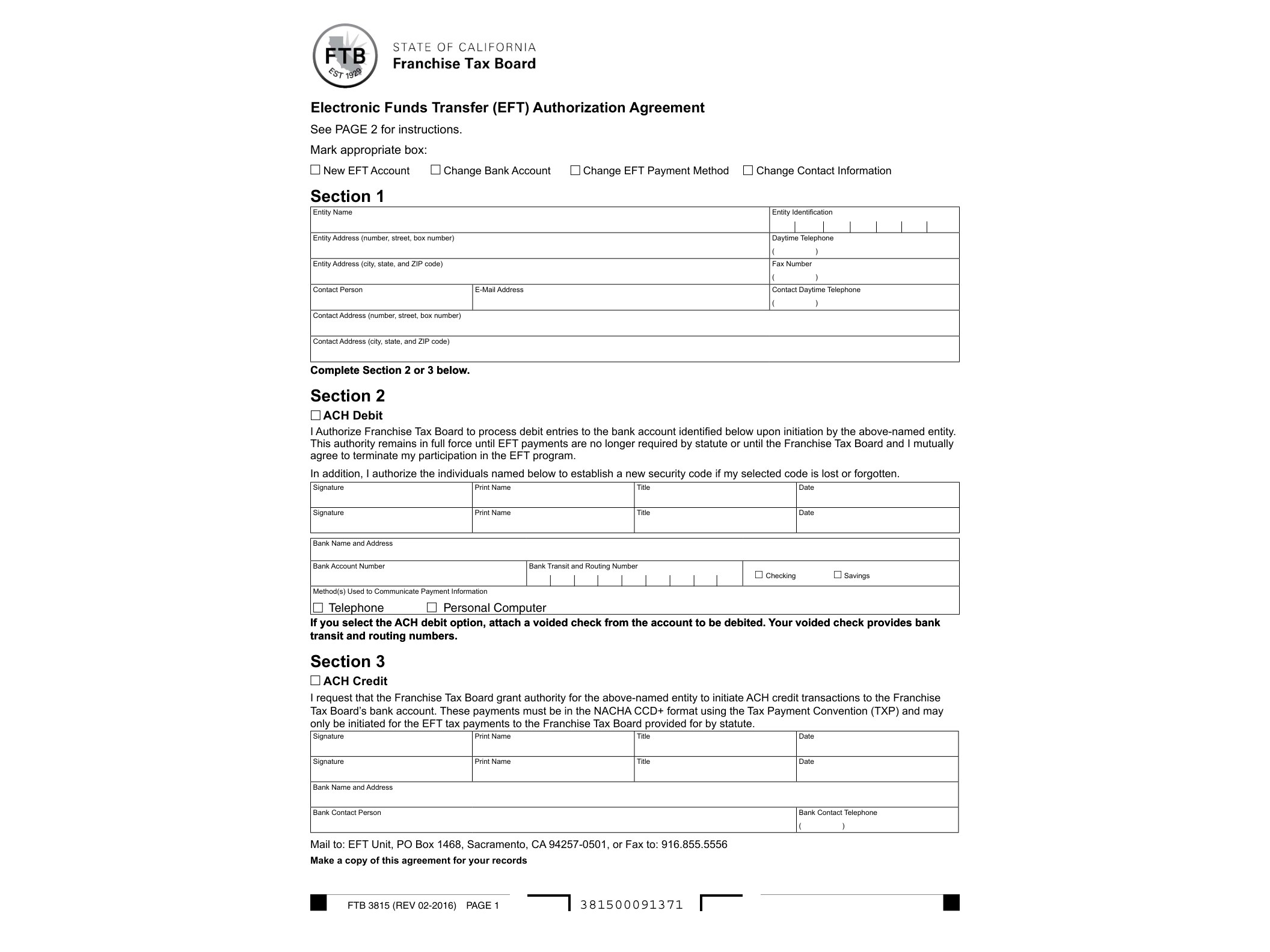
FTB Form 3815 is the Electronic Funds Transfer (EFT) Authorization Agreement issued by the California Franchise Tax Board. It’s the document businesses use to register for the state’s mandatory EFT program, which requires certain corporations and other entities to pay their California franchise and income taxes electronically instead of by check.
Once the FTB notifies a business that it’s required to participate in EFT, or once a business voluntarily chooses to pay this way, Form 3815 is what establishes the account details and payment method the FTB will use going forward. It’s an administrative setup form rather than a tax return, but skipping it when required can trigger penalties.
Who Needs to File Form 3815
California requires mandatory EFT participation for corporations whose estimated tax or extension payment exceeds $20,000, or whose total tax liability exceeded $80,000 in any taxable year beginning on or after January 1, 1995. Once a corporation meets either threshold, it must remain in the EFT program for all future payments, even in years when the liability drops below that amount, unless the FTB grants a waiver.
Partnerships, LLCs treated as corporations for tax purposes, and other entities that receive a written notice from the FTB requiring EFT participation also need to complete this authorization. Some businesses opt into EFT voluntarily because it simplifies recordkeeping and avoids the risk of lost or delayed mail payments, and Form 3815 is the vehicle for that election too.
If your entity is going through a different kind of compliance process, such as winding down operations, this form isn’t relevant. For example, LLCs that are dissolving rather than continuing to pay taxes should instead look at FTB Form 3716 for voluntary administrative cancellation, which addresses closing out an LLC’s registration entirely.
When to Use Form 3815
Businesses typically submit this form when they first receive notice from the FTB that they’re mandated to pay by EFT, when they want to switch payment methods within the EFT system (for instance, moving from ACH debit to ACH credit), or when banking details on file need to be updated. It’s also used when a business voluntarily enrolls before hitting the mandatory thresholds.
Timing matters here. The FTB expects the authorization to be in place before the first required electronic payment is due, so waiting until a payment deadline is close can create unnecessary risk of a late or failed transaction. Businesses that ignore mandatory EFT requirements can face a 10% noncompliance penalty on payments that should have been made electronically.
How to Fill Out and Submit the Form
Form 3815 is a fillable PDF, so it can be completed on a computer before printing and signing. The form asks for basic identifying information: the entity’s name, California corporation number or FEIN, contact details, and the banking information needed to process EFT payments, including whether the business is choosing the ACH debit or ACH credit method.
ACH debit allows the FTB to pull the payment directly from the business’s bank account on the date specified, while ACH credit means the business’s bank initiates the transfer to the state’s account. The form also requires an authorized signature confirming that whoever signs has the authority to set up electronic payments on behalf of the business.
After completing the form, it gets mailed or faxed to the FTB’s EFT unit rather than submitted online, since this is one of the setup documents that still relies on paper processing even though the payments themselves are electronic. Processing typically takes a few weeks, so businesses should plan ahead of any upcoming payment deadline.
Entities managing more complex filing obligations, such as fiduciary returns with multiple beneficiaries, may also want to review related state filing requirements. Fiduciaries dealing with allocation issues in other states, for instance, can find relevant guidance in resources like the IT-205-T allocation of estimated tax payments or the IT-205-A fiduciary allocation form, though those apply to New York rather than California filings.
Keeping a copy of the completed and submitted Form 3815 is worth doing, since it documents when the EFT authorization was set up and what payment method was chosen, which can be useful if a payment dispute or processing error comes up later.
Download Official Form 3815 (PDF)
Opens the official government PDF in a new tab