
Download Official Form IT633I (PDF)
Opens the official government PDF in a new tab
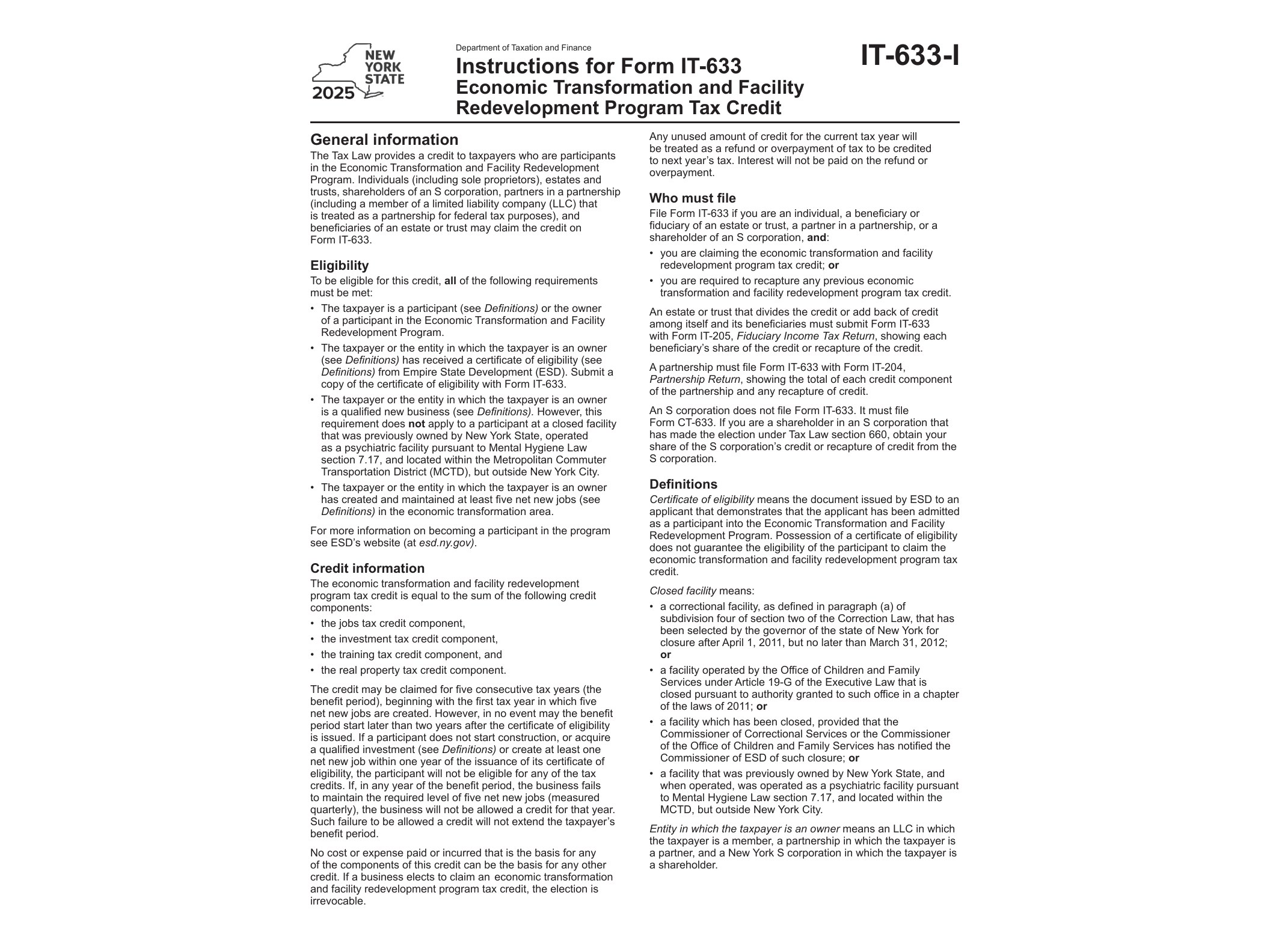
Form IT-633I is the instruction booklet the New York State Department of Taxation and Finance publishes to accompany Form IT-633, Economic Transformation and Facility Redevelopment Program Tax Credit. If your business took part in redeveloping a former correctional facility, youth facility, or similar decommissioned state property under this program, IT-633I is what walks you through claiming the credit correctly on your tax year 2025 return.
The Economic Transformation and Facility Redevelopment Program was created to encourage private investment in communities that lost jobs and economic activity when the state closed certain facilities. Businesses that relocate, expand, or create new jobs in these designated areas can qualify for a multi-part tax credit covering things like job creation, job training, and real property investment. Because the credit has several components with different eligibility rules, the instructions in IT-633I are essential reading before you attempt to fill out the actual claim form.
Who Needs This Form
IT-633I is meant for businesses certified by Empire State Development as participants in the Economic Transformation and Facility Redevelopment Program. That typically means a company operating in or near a designated closed facility that has met specific investment or hiring benchmarks. If you haven’t received certification from Empire State Development, this credit doesn’t apply to you, and you won’t need this form.
Corporations, partnerships, and individual business owners who are certified participants all use these instructions, though the actual credit is claimed through Form IT-633 and then applied against the appropriate tax return—whether that’s a corporate franchise tax return, a personal income tax return for a partner or shareholder, or another applicable New York filing.
When You’d Use It
You’ll turn to IT-633I when you’re preparing to file for tax year 2025 and your business has documentation showing certified participation in the program during the relevant period. The instructions clarify how to calculate each component of the credit, including the job creation credit, job training credit, and real property tax credit, and they specify what supporting documentation you need to retain in case the Department requests it later.
Since the credit involves multiple calculation steps tied to employment numbers, wages, and property investments, timing matters. You should gather your certification paperwork and employment records well before the filing deadline so you’re not scrambling to reconstruct figures at the last minute.
How to Get and Fill Out the Form
Form IT-633I isn’t fillable online—you’ll need to download the PDF, print it, and read through it manually since it doesn’t have interactive fields. The official version is available directly from the New York State Department of Taxation and Finance website. Once you have it printed, use it as a reference guide while completing the separate IT-633 credit form itself, following each line-by-line explanation for the job creation, training, and property components.
Because this credit shares some conceptual DNA with other New York economic development incentives, it can help to compare notes with similar programs. For instance, businesses that invested in cleaning up contaminated sites often work with Form IT-611I for the Brownfield Redevelopment Tax Credit, which follows a similar certification-based structure. Companies operating in Qualified Empire Zones might also be familiar with Form IT-604I for the QEZE Tax Reduction Credit, another economic incentive tied to state-designated zones. Reviewing how these programs handle certification and recordkeeping can make it easier to understand what New York expects from Economic Transformation Program participants as well.
Keep in mind that this credit is nonrefundable in most cases but can often be carried forward if it exceeds your tax liability for the year—IT-633I spells out the specific carryforward rules that apply. If your business also qualifies for local credits like the one covered in Form IT-270I, it’s worth checking whether claiming multiple credits in the same filing year affects your overall calculations, since New York sometimes coordinates how various credits interact on a single return.
Given the complexity of the eligibility criteria and multi-part calculations involved, many businesses find it worthwhile to work with a tax professional familiar with New York’s economic development credits when preparing this claim, particularly in the first year they’re eligible to file.
Download Official Form IT633I (PDF)
Opens the official government PDF in a new tab