
Download Official Form TP832 (PDF)
Opens the official government PDF in a new tab
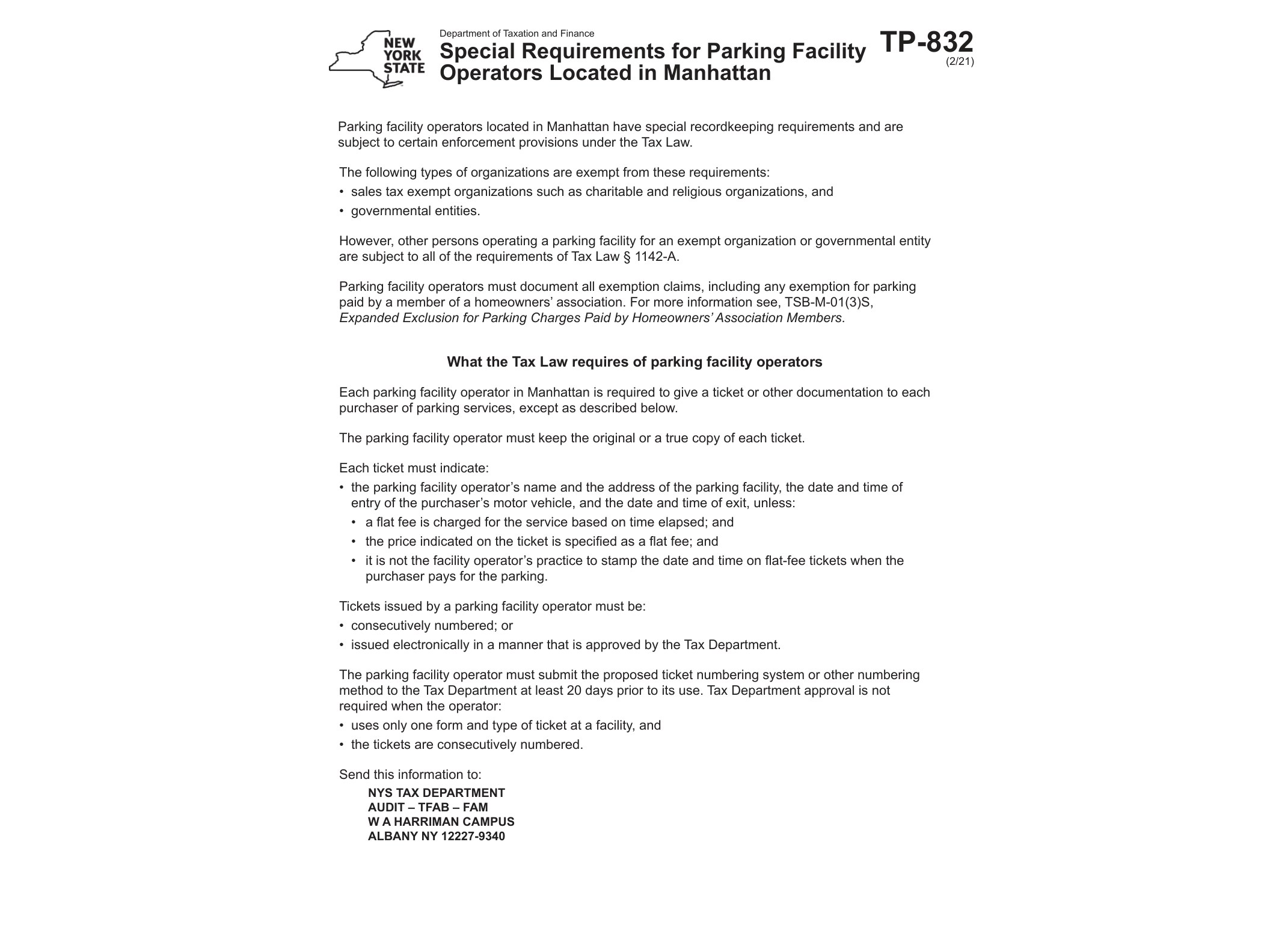
Form TP-832, issued by the New York State Department of Taxation and Finance, lays out the special registration and reporting requirements that apply specifically to parking facility operators located in Manhattan. This form isn’t a standard tax return you file every month or quarter — it’s a notice and reference document that explains the additional rules Manhattan operators face because of the higher sales tax rate on parking services within that borough.
New York applies a unique sales tax structure to parking, garaging, and storing of motor vehicles in Manhattan. Because the tax treatment differs from the rest of the state, the Tax Department uses TP-832 to spell out exactly who falls under these special rules, what registration steps are required, and how operators should handle recordkeeping and exemption certificates tied to Manhattan parking transactions.
Who Needs Form TP-832
This form is aimed at anyone operating a parking lot, parking garage, or vehicle storage facility physically located in Manhattan. That includes:
- Owners and operators of commercial parking garages
- Businesses running parking lots as part of a larger property or commercial complex
- Operators who lease or manage parking facilities on behalf of a property owner
- Valet or attended parking services based in Manhattan
If your parking facility sits outside Manhattan, these special requirements generally don’t apply to you, since the rest of New York State follows the standard sales tax rules for parking services. TP-832 exists precisely because Manhattan has its own additional tax layer on top of the regular state and local sales tax.
When TP-832 Comes Into Play
Operators typically need to review this form when they’re first registering a Manhattan parking facility for sales tax purposes, or when they want to confirm they’re handling exemption certificates and tax collection correctly under the borough’s special rules. It’s also a useful reference during an audit or when a facility changes ownership, since new operators need to understand these requirements before they start collecting tax from customers.
Because Manhattan parking tax involves both the standard state/local sales tax and an additional surcharge, operators who misunderstand the rules risk under-collecting tax or mishandling exemption documentation — both of which can create problems down the line with the Tax Department.
How to Get and Use Form TP-832
Form TP-832 is only available as a non-fillable PDF. That means you can’t type your information directly into it on a computer. Instead, you’ll need to download the PDF, print it out, and read through the special requirements it describes, or fill in any applicable fields by hand if the form calls for specific operator information. There’s no digital submission option tied to this particular document, since it functions primarily as a compliance guide rather than a return filed with a payment.
Once you’ve reviewed the requirements, make sure your registration paperwork and internal recordkeeping match what TP-832 describes. This often means coordinating with other sales tax filings and certificates your business already handles. For example, operators dealing with exemption documentation on vehicle-related transactions may find it helpful to compare procedures with related sales tax forms, such as the instructions for Form ST-131, which cover casual sales reporting under New York’s sales tax framework.
Businesses that work with third-party booking platforms for parking reservations should also be familiar with Form ST-155, which addresses how booking services certify tax collection on behalf of operators. And if your parking operation is part of a larger business that also deals with fuel tax reporting, reviewing Form FT-945/1045-W can give you a sense of how New York structures its specialized tax reporting across different industries.
Keep a printed copy of TP-832 on file along with your other sales tax registration records. Since the form isn’t digitally fillable, treat it as reference documentation rather than paperwork you’ll submit directly to the state — the actual registration and tax remittance happen through your regular sales tax filings, guided by the special rules this form describes.
Download Official Form TP832 (PDF)
Opens the official government PDF in a new tab