
Download Official Form DTF621I (PDF)
Opens the official government PDF in a new tab
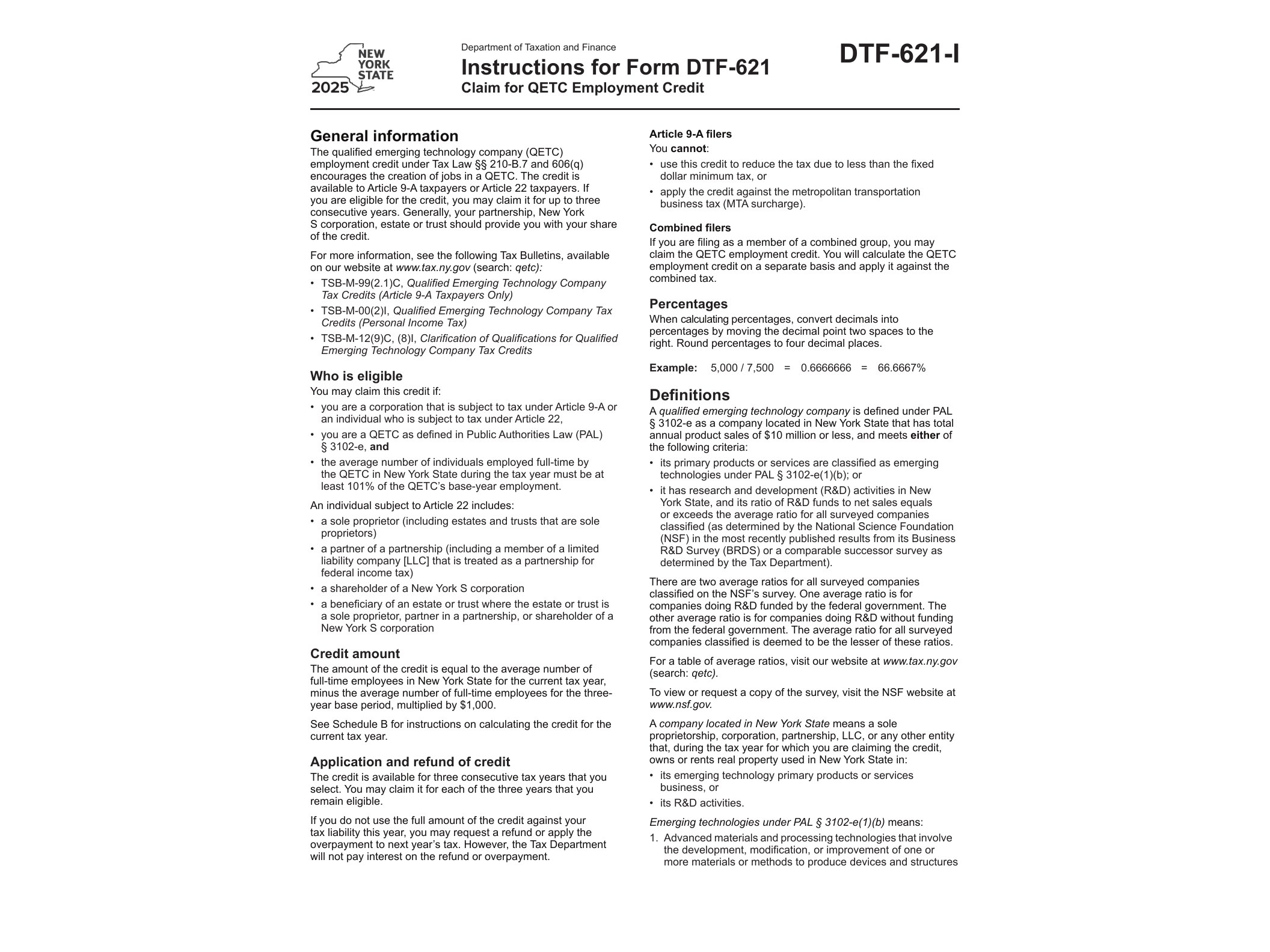
Form DTF-621I is the instruction booklet that accompanies Form DTF-621, Claim for QETC Employment Credit, issued by the New York State Department of Taxation and Finance. If your business qualifies as a Qualified Emerging Technology Company (QETC), this credit rewards you for growing your workforce in New York State. The instructions walk you through eligibility rules, how to calculate the credit, and which supporting schedules need to be attached to your return.
The credit itself is claimed on Form DTF-621, but that form makes little sense without the accompanying instructions. DTF-621I explains the definitions the state uses, the base employment calculations, and the specific line-by-line guidance needed to avoid errors that could delay processing or trigger a request for more documentation.
Who Needs This Form
This form is relevant to corporations, partnerships, and other business entities operating in New York State that meet the statutory definition of a Qualified Emerging Technology Company. Generally, this means the business is primarily engaged in developing or commercializing emerging technologies (biotechnology, advanced materials, information technology, and similar fields) and meets certain gross revenue and employment thresholds set by New York State law.
If your company doesn’t fall into the QETC category, this form and its instructions don’t apply to you. But for those that do qualify, the instructions clarify exactly how many new jobs must be created, over what period, and how those new hires compare to a base year of employment to determine credit eligibility.
When You Use Form DTF-621I
You’ll reference this instruction booklet when preparing your tax year 2025 New York State return if you’re claiming the QETC Employment Credit for that tax year. The instructions are updated periodically to reflect current statutory rules, so it’s worth confirming you’re using the version tied to the correct tax year rather than an older release, since credit calculation details and eligibility thresholds can shift from year to year.
Businesses typically use this form annually as long as they continue to meet the QETC criteria and maintain or grow employment levels above their established base. First-time filers should pay close attention to how the base employment number is established, since that figure carries forward and affects future years’ credit calculations as well.
How to Get and Complete the Form
The instructions are available directly from the New York State Department of Taxation and Finance website as a PDF. This form is not fillable digitally, meaning you’ll need to print it out and complete Form DTF-621 by hand using the guidance in DTF-621I. There’s no online fill-in version at this time, so plan to have a printer handy and use black ink when filling in your figures.
Before you start filling anything out, read through the entire instruction booklet first. It explains the specific worksheets needed to calculate your average number of employees, how to handle part-time versus full-time staff, and what documentation you should keep on hand in case the Department of Taxation and Finance requests verification. Skipping ahead to the form itself without reading the instructions is a common mistake that leads to miscalculated credits or missing attachments.
Once Form DTF-621 is completed according to the instructions, it gets attached to your applicable New York State business or personal income tax return, depending on your entity type. Partnerships and S corporations often need to pass the credit through to individual partners or shareholders, and the instructions detail how that allocation should be reported.
If you’re also dealing with other New York State tax filings this season, it’s worth checking whether other specialized forms apply to your situation. For instance, businesses managing multiple employee filings sometimes need to reference Form TR-99 if they’re filing a group return. Similarly, if your business has employees working in Yonkers, the Form Y-203I instructions cover a separate nonresident earnings tax situation that sometimes intersects with corporate filings. And if your business filing involves an estate or a deceased shareholder’s refund, Form DTF-281 addresses that specific scenario.
Because the QETC Employment Credit involves multiple calculations tied to your company’s employment history, many businesses find it useful to work with a tax professional familiar with New York State’s emerging technology incentives, especially in the first year of filing when the base employment figures are established.
Download Official Form DTF621I (PDF)
Opens the official government PDF in a new tab