
Download Official Form DTF664 (PDF)
Opens the official government PDF in a new tab
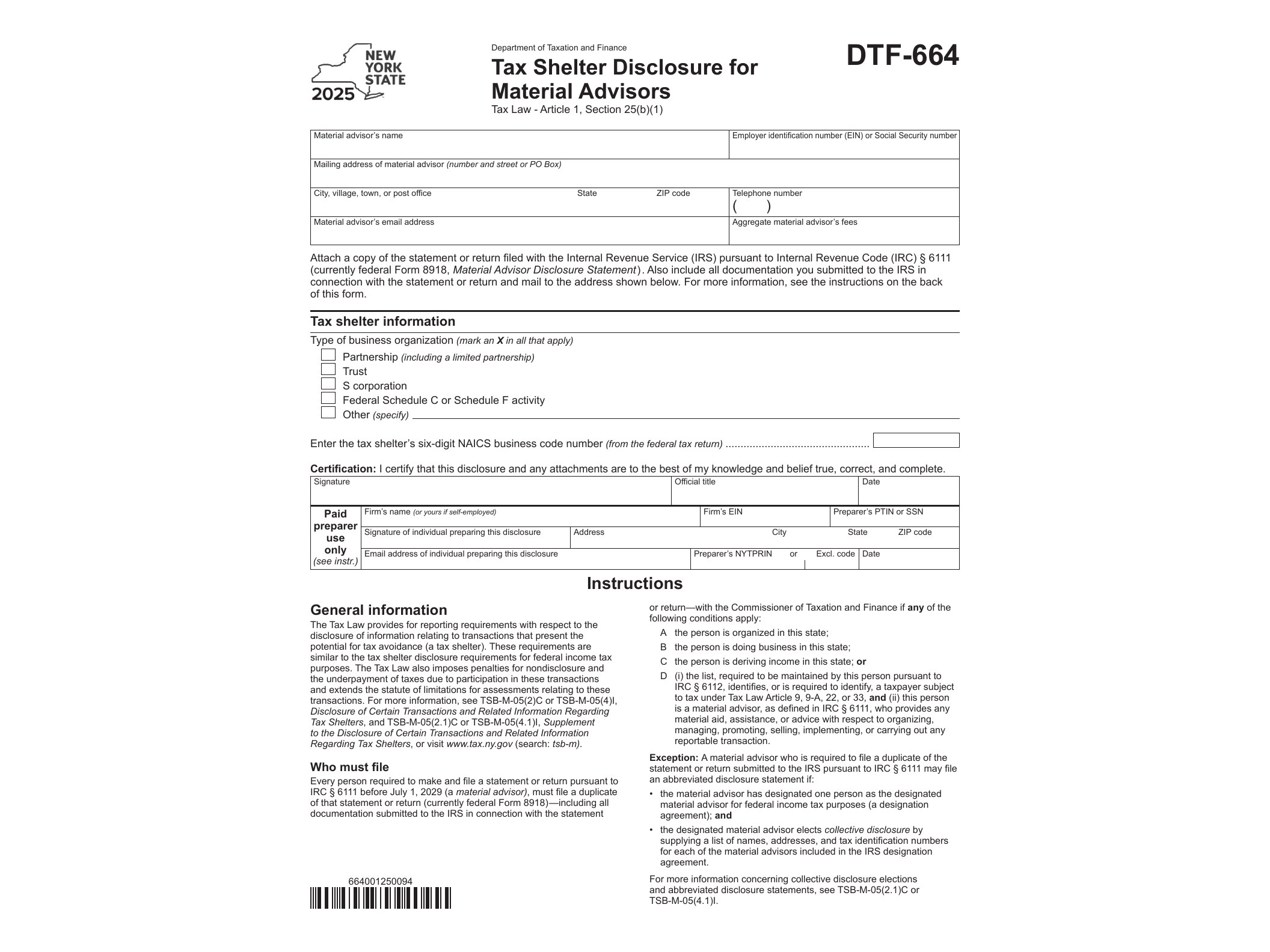
Form DTF-664, Tax Shelter Disclosure for Material Advisors, is issued by the New York State Department of Taxation and Finance for material advisors who need to report their involvement with reportable transactions or tax shelters. This form aligns New York’s disclosure requirements with certain federal rules under the Internal Revenue Code, but it carries its own filing obligations that material advisors operating in or connected to New York cannot ignore.
A material advisor, in this context, is generally someone who provides tax advice regarding a reportable transaction and receives a minimum threshold of gross income from that activity. If you organize, promote, or advise on a tax shelter arrangement that meets the definition of a listed transaction, a transaction of interest, or another type of reportable transaction under New York tax law, you likely fall into this category and need to file DTF-664.
Who Needs to File This Form
The obligation to file DTF-664 falls on material advisors, not on the individual taxpayers who ultimately use the tax shelter. If you’re a tax professional, accounting firm, or financial advisor who structured or promoted a transaction later identified as a tax shelter, New York expects a disclosure from you directly, separate from any federal disclosure you may have already submitted to the IRS.
This matters because state and federal reporting requirements don’t always overlap perfectly. A transaction that triggers federal disclosure rules doesn’t automatically satisfy New York’s requirements, and vice versa. Material advisors working across multiple states should treat DTF-664 as an independent filing obligation tied specifically to New York State tax law.
When to Use Form DTF-664
Material advisors must file this disclosure within the timeframe set by New York State tax regulations, typically tied to when the transaction was entered into or when the advisor became aware it qualified as reportable. Because these deadlines can shift depending on the type of transaction involved, it’s worth reviewing the specific instructions attached to the form rather than assuming a blanket deadline applies to every situation.
Keep in mind that failing to disclose a reportable transaction when required can result in penalties, so material advisors should treat this filing as a priority rather than an afterthought once they identify that a transaction meets the reporting threshold.
How to Complete and Submit the Form
Form DTF-664 is not available as a fillable PDF. You’ll need to download the document, print it, and complete it by hand using black ink, then mail it to the address specified in the form’s instructions. This is common for several New York tax disclosure forms that require original signatures or supporting documentation attached in physical form.
When filling it out, you’ll need to provide identifying information about your firm, details about the reportable transaction, and information about the taxpayers involved to the extent required. Because these disclosures often involve sensitive financial arrangements, accuracy matters. Double-check names, identification numbers, and transaction descriptions before mailing the form, since corrections after submission can complicate the review process.
If your practice also handles other New York State filings, it helps to keep track of related forms that might apply to your clients. For instance, businesses claiming credits under different programs may need to reference Form DTF-621I instructions for the QETC Employment Credit, while firms managing multiple related tax returns for a group of taxpayers might need to look into Form TR-99 for group return permissions. Advisors working with clients who have nonresident earnings tied to Yonkers may also find it useful to review the Form Y-203I instructions for a related but distinct filing scenario.
Because DTF-664 deals with tax shelter disclosures rather than routine income reporting, it’s a good idea to consult with a tax attorney or compliance specialist familiar with New York’s material advisor rules before submitting the form, particularly if the transaction in question is complex or involves multiple advisors. Getting the disclosure right the first time avoids follow-up correspondence from the Department of Taxation and Finance and reduces the risk of penalties tied to incomplete or late reporting.
Download Official Form DTF664 (PDF)
Opens the official government PDF in a new tab