
Download Official Form 589 (PDF)
Opens the official government PDF in a new tab
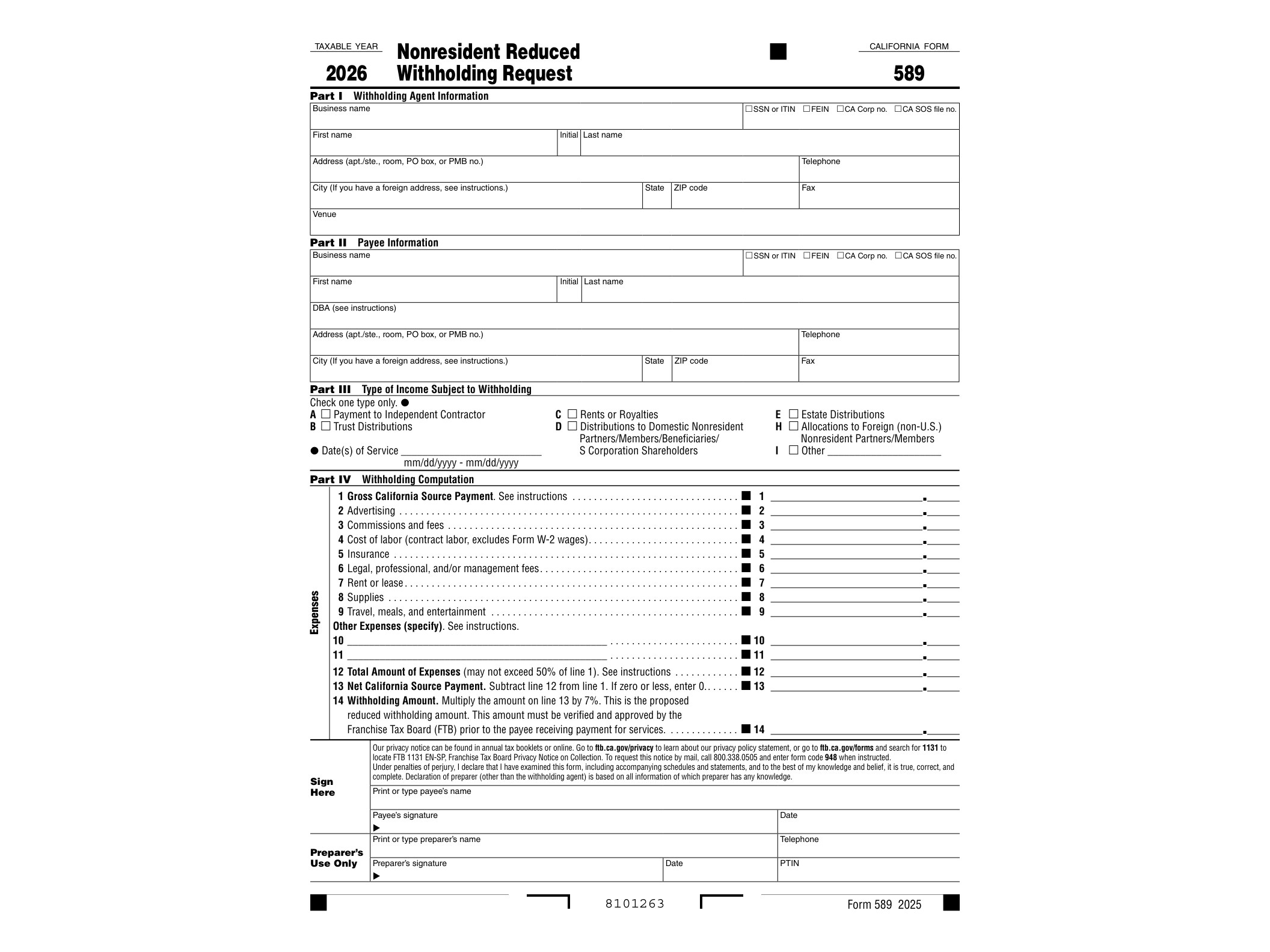
Form 589, issued by the California Franchise Tax Board (FTB), is the document nonresident payees use to request a reduction in the standard 7% state withholding normally applied to California source income. Instead of accepting the default withholding rate, a payee can use this form to show the FTB that their actual California tax liability will be lower than what standard withholding would collect, and ask for a reduced amount to be withheld instead.
This form matters because California generally requires withholding agents — businesses, partnerships, or individuals making payments to nonresident vendors, independent contractors, entertainers, or other service providers — to withhold 7% on payments for services performed in the state, rents, royalties, and certain other California source income. That withholding is meant to cover the nonresident’s eventual state tax bill. But in many cases, the payee’s actual tax liability, after deductions and expenses, ends up much lower than 7% of gross payments. Form 589 exists to correct that mismatch before the money is even withheld, rather than forcing the payee to wait for a refund after filing their annual California return.
Who Needs to File Form 589
The form is filed by the nonresident payee — not the withholding agent — although the payee must submit it to the FTB before payment is made, and the withholding agent needs a copy for their records. Typical filers include out-of-state contractors doing project work in California, nonresident owners of California rental property, performers or athletes with California engagements, and nonresident partners or shareholders receiving distributions tied to California income. Anyone who expects their real California tax obligation to be significantly less than what standard withholding would take is a good candidate for this request.
It’s worth noting that Form 589 is different from a full withholding exemption certificate. It doesn’t eliminate withholding altogether — it asks the FTB to approve a reduced rate based on projected income, expenses, and estimated tax liability for the year. The FTB reviews the submitted numbers and either approves the reduced rate, denies the request, or approves a different rate than what was requested.
When to Use It
Form 589 should be submitted before the withholding agent makes the payment, since the whole point is to adjust the withholding amount in advance. The FTB typically needs processing time — often several weeks — so nonresident payees who know they’ll be receiving California source income should file as early as possible, ideally as soon as a contract or engagement is confirmed. Waiting until the FTB Franchise Tax Board payment date is imminent can mean the reduced rate isn’t approved in time, and standard withholding gets applied regardless.
The 2026 version of Form 589 reflects updated instructions and income thresholds for that tax year, so payees should use the current version rather than an older one, since prior-year forms may reference outdated rates or filing procedures.
How to Get and Complete Form 589
The form is available directly from the Franchise Tax Board’s website as a fillable PDF, and it includes AcroForm fields, meaning it can be completed digitally on a computer before printing or submitting. Filers need to provide identifying information for both the payee and the withholding agent, details about the type of income involved, a projected calculation of California tax liability, and supporting documentation showing why the standard 7% rate would over-withhold relative to actual tax owed.
Once completed, the form is mailed to the FTB’s Withholding Services and Compliance section, not to the withholding agent directly — though a copy typically needs to go to the agent as well, since they need documentation on file if audited about their withholding decisions. Errors or missing calculations are common reasons for rejection, so it helps to double check projected income figures and expense deductions before submitting.
For payees who also deal with multi-state tax situations, it can help to compare how other states handle withholding exemptions — for example, New York’s Form IT-2104-E certificate of exemption follows a similar logic but with different thresholds and procedures. Those who eventually need proof of withholding already paid may also want to look at how Form IT-2102.6 documents income tax withheld in New York, since California doesn’t issue an identical certificate but the underlying concept — reconciling withholding against actual liability — is the same. And for California residents or preparers looking for broader FTB resources, the FTB Form 4595 PIT guide covers where to find free filing assistance across the state.
Download Official Form 589 (PDF)
Opens the official government PDF in a new tab