
Download Official Form 914 (PDF)
Opens the official government PDF in a new tab
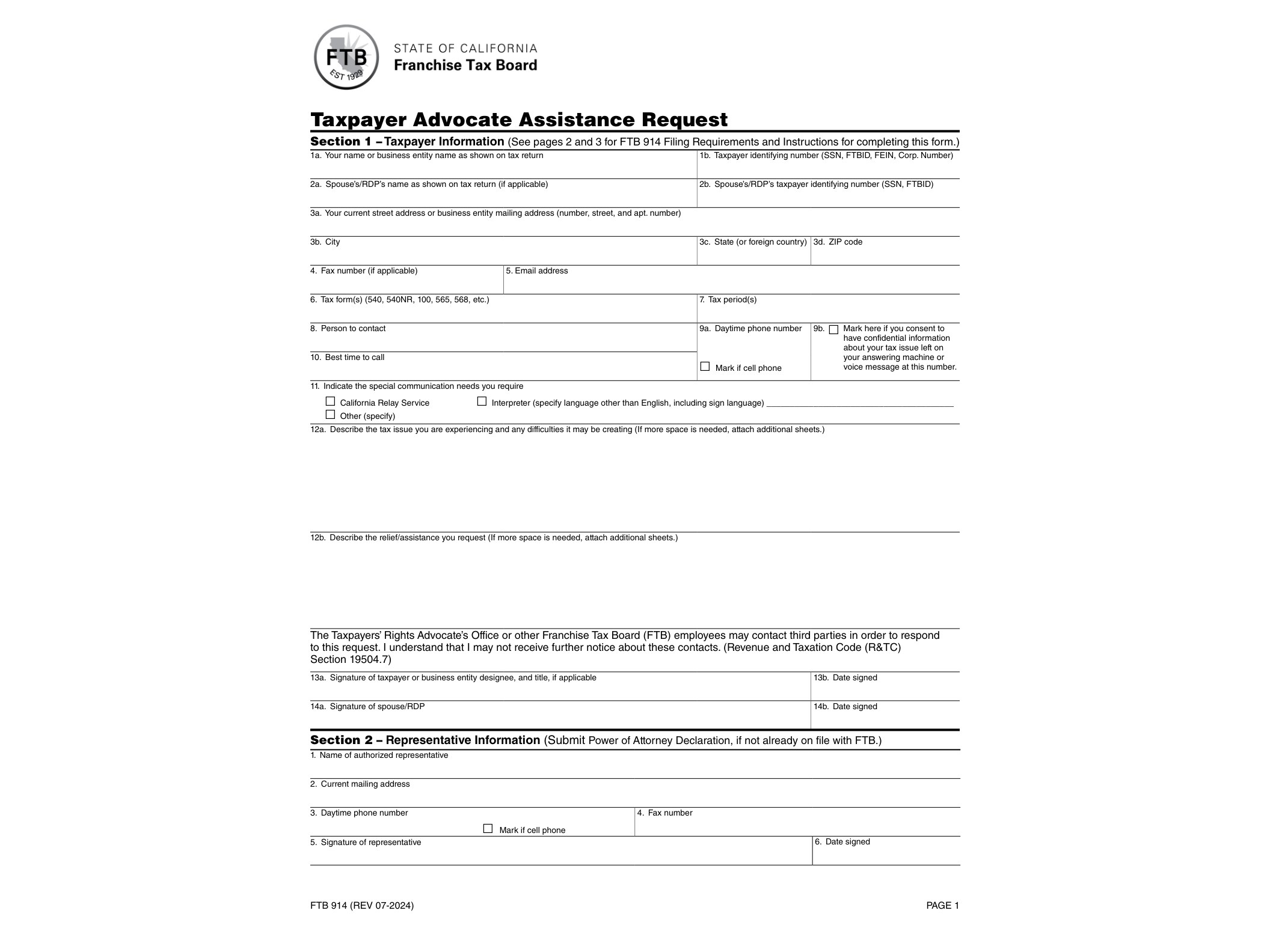
FTB Form 914, officially titled the Taxpayer Advocate Assistance Request, is a document issued by the California Franchise Tax Board that lets taxpayers ask for help when a routine problem with the FTB has not been resolved through normal channels. It’s not a tax return and it doesn’t report income or claim a credit. Instead, it’s an administrative request form used when someone is stuck dealing with the agency and needs a dedicated advocate to step in.
The FTB’s Taxpayer Advocate’s Office exists specifically for situations where a taxpayer has tried to resolve an issue through standard department contacts — collections, audits, or account management — and the problem still hasn’t been fixed, or the taxpayer is facing a significant hardship because of it. Form 914 is the formal way to bring that situation to the advocate’s attention.
Who Needs to File Form 914
This form is generally for individuals or businesses who meet at least one of the following situations:
- They are experiencing (or about to experience) economic harm because of how the FTB is handling their case, such as an imminent levy or lien that would create a serious financial burden.
- They have made repeated attempts to resolve an issue with the FTB and haven’t received a response within the expected timeframe.
- A system or procedure at the FTB failed to work as intended, causing an unresolved problem.
- They believe the situation calls for a fair and equitable resolution that hasn’t happened through standard processes.
Tax professionals filing on behalf of a client can also submit Form 914, provided they include proper authorization to represent the taxpayer.
When to Use This Form
Form 914 isn’t meant to be a first step. The FTB expects taxpayers to try resolving disputes through the usual channels first — calling the department, responding to notices, or working with the specific unit handling their account. Only when those efforts stall out, or when the taxpayer is facing genuine hardship, does it make sense to escalate through the Taxpayer Advocate’s Office using this form.
Common scenarios include unresolved refund delays, confusion over penalty assessments that were never clarified despite multiple calls, or collection actions moving forward despite an open dispute. If none of the standard contact points have produced results, Form 914 is the next step.
How to Get and Complete Form 914
The form is available directly from the Franchise Tax Board as a fillable PDF, which means it can be completed digitally on a computer before printing or submitting it. This makes it easier to fill in accurately compared to a paper-only form, since fields for name, taxpayer identification number, description of the issue, and contact information can all be typed directly.
When completing the form, be as specific as possible about the issue: include relevant dates, notice numbers, prior contact attempts with the FTB, and a clear description of the hardship or delay involved. Vague descriptions slow down the review process, since the advocate’s office needs enough detail to understand exactly what went wrong and what resolution is being requested.
Once completed, the form can be submitted by mail or fax to the Taxpayer Advocate’s Office, following the instructions printed on the form itself. Keep a copy of everything submitted, along with any supporting documents such as prior notices or correspondence with the FTB, since these help establish the timeline of the dispute.
Filing Form 914 doesn’t guarantee an outcome in the taxpayer’s favor, but it does guarantee that the case gets a dedicated review outside of the standard process. For anyone who has already dealt with state-level credits or modifications — similar to how New York taxpayers navigate forms like the state modifications form or credit-specific filings such as the Child and Dependent Care Credit — the takeaway is the same: state tax agencies each have their own procedural forms, and knowing which one applies to your situation saves time. California’s Form 914 fills a specific gap: it’s the formal channel when normal communication with the FTB isn’t producing results.
Download Official Form 914 (PDF)
Opens the official government PDF in a new tab