
Download Official Form 3840 (PDF)
Opens the official government PDF in a new tab
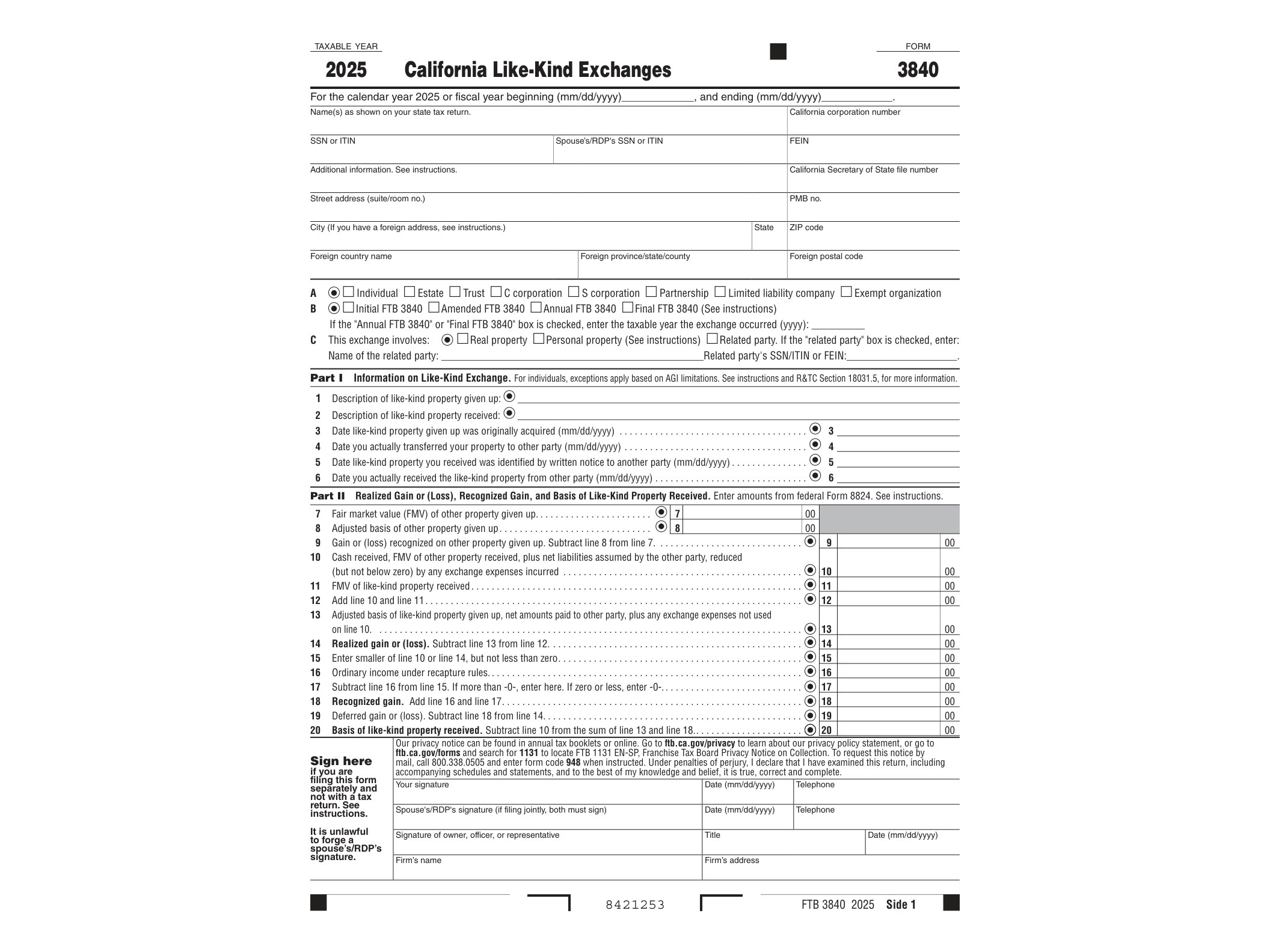
California Form 3840, California Like-Kind Exchanges, is the form the Franchise Tax Board uses to track property swaps that qualify for deferred gain treatment under Internal Revenue Code Section 1031, when at least one property involved is located in California and the other is located outside the state. If you sold California real estate and rolled the proceeds into an out-of-state replacement property through a 1031 exchange, this form keeps California in the loop on the deferred gain even after the property leaves the state’s tax jurisdiction.
California generally conforms to federal like-kind exchange rules, but it doesn’t let go of its claim on the deferred gain just because the replacement property sits in another state. Once you exchange a California property for one located elsewhere, California requires you to file Form 3840 every year until you recognize the deferred or partially deferred gain through a sale, disposition, or other taxable event. This annual filing obligation continues even in years when nothing happens with the replacement property—you still have to report that the exchange remains open.
Who Needs to File Form 3840
Any taxpayer—individual, corporation, partnership, LLC, trust, or estate—that completes a like-kind exchange involving California property exchanged for property outside California must file this form. This applies whether you’re a California resident who moved out-of-state proceeds into another property, or a nonresident who owned California real estate and exchanged it for property in another state. The filing requirement follows the property and the deferred gain, not necessarily the residency of the taxpayer.
If both properties in the exchange are located in California, you don’t need Form 3840. The form exists specifically to address the situation where California loses direct oversight of a replacement property because it’s no longer within the state, yet the deferred gain originated from California-sourced real estate.
When and How Often to File
You file Form 3840 for the tax year in which the exchange took place, and then continue filing it annually with your California tax return for as long as the gain remains deferred. The moment you sell the replacement property, exchange it again for a property inside California, or otherwise trigger recognition of the gain, you report that gain on your California return and your Form 3840 filing obligation for that specific exchange ends.
Missing a required annual filing doesn’t erase the deferred gain, but it can create complications with the FTB down the road, particularly if the agency later questions whether the exchange was properly reported from the start. Keeping consistent annual filings creates a clean paper trail that supports your original exchange treatment.
What Information Goes on the Form
Form 3840 asks for details about both properties involved in the exchange—descriptions, dates, and fair market values—along with the computation of realized and deferred gain. You’ll also need to identify the California source of the original property and track how much gain remains unrecognized as of the current tax year. Because the form carries this information forward year after year, keeping your prior years’ filings on hand makes each subsequent filing faster since much of the property history and gain calculation stays the same.
The form is an AcroForm, meaning it has fields you can fill in directly using standard PDF software before printing or attaching it to your electronically filed return. Since the FTB updates the form periodically, always use the current year’s version rather than reusing an old copy, even though the substance of what you’re reporting may not change from year to year.
Taxpayers dealing with multi-state real estate transactions often run into other state-specific credit and reporting forms as well. If you also handle California business credits, the process for assigning credits within a combined reporting group follows a similarly detailed FTB structure. And if you split time between states, comparing how New York handles specific tax credits or how it treats lump-sum distributions can help clarify how differently each state approaches deferred income and credit reporting compared to California’s like-kind exchange rules.
Because Form 3840 filings can stretch across many years for a single exchange, it’s worth setting a reminder to review your open exchanges each filing season, confirm whether the replacement property was sold or exchanged again, and update your gain calculation accordingly before submitting your California return.
Download Official Form 3840 (PDF)
Opens the official government PDF in a new tab