
Download Official Form IT242 (PDF)
Opens the official government PDF in a new tab
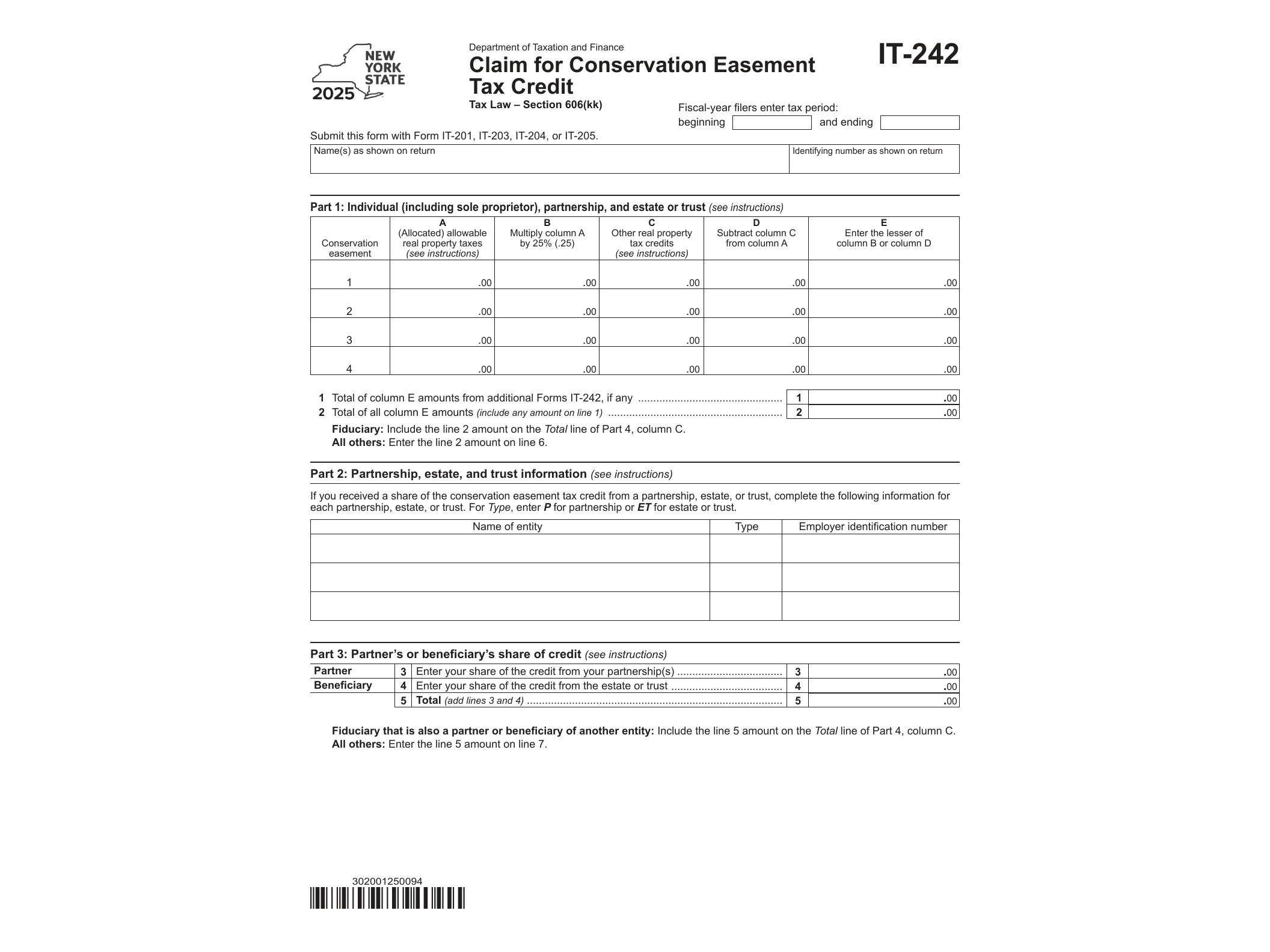
Form IT-242, Claim for Conservation Easement Tax Credit, is issued by the New York State Department of Taxation and Finance for landowners who donate a qualified conservation easement on land located in New York State. If you’ve placed a permanent restriction on your property to protect its natural, agricultural, or scenic value, this form lets you claim a state tax credit based on the property taxes you paid on that eligible land.
The credit is separate from any federal charitable deduction you might claim for the same easement donation. New York created this credit specifically to offset the ongoing property tax burden that landowners continue to carry even after they’ve given up development rights on their land. In other words, the credit isn’t a one-time reward for donating the easement — it’s an annual benefit tied to the property taxes paid on the restricted parcel, year after year, as long as the easement stays in place.
Who Needs Form IT-242
You’ll need this form if you’re a New York State resident, part-year resident, or nonresident individual (or a fiduciary, partnership, or S corporation passing the credit through to owners) who holds land subject to a qualified conservation easement. The easement must meet the definition under Environmental Conservation Law and must be held by a qualified organization, such as a land trust or a government conservation agency.
Farmers, ranch owners, and owners of large rural parcels are the most common filers, since conservation easements are frequently used to preserve farmland, wetlands, forests, and open space from future development. If you’re unsure whether your easement qualifies, check with the organization that holds the easement — they typically issued or reviewed the original agreement and can confirm it meets state requirements.
When to File It
Form IT-242 is filed along with your New York State personal income tax return for the year in which you’re claiming the credit. Since the credit is based on property taxes paid annually, you’ll generally need to file this form every year you continue to pay taxes on the eased land and want to claim the corresponding credit, not just in the year the easement was originally granted.
The credit equals 25% of the school district, county, and town property taxes paid during the tax year on the land under the easement, up to a maximum credit of $5,000 per year. Any credit amount that exceeds your tax liability is refundable, which makes this one of the more valuable credits available to New York landowners engaged in conservation efforts.
How to Fill Out and Submit the Form
Form IT-242 is a fillable PDF, meaning you can type your information directly into the form fields using a PDF reader before printing or submitting it electronically with your return. You’ll need to provide details about the property, including its location, the tax map number, the date the easement was recorded, and a breakdown of the property taxes paid during the year. If you’re claiming the credit as a partner, shareholder, or beneficiary receiving a pass-through share, you’ll also need the entity’s information and your allocated share of the credit.
Keep supporting documentation on hand — property tax bills, the recorded easement deed, and any correspondence from the holding organization — in case the Department of Taxation and Finance requests verification. While you don’t submit these documents with the form itself, they’re essential if your return is reviewed.
If you’re also claiming credits related to historic property improvements on the same or a different property, it may be worth reviewing Form IT-238 for the Rehabilitation of Historic Properties Credit, since both credits target property owners investing in long-term preservation, though for different purposes. Landowners dealing with multi-state tax situations involving property transactions might also find it useful to compare how other states handle similar reporting, such as California’s Form 3840 for like-kind exchanges, or review guidance like FTB Publication 1067 if you have filing obligations across state lines.
Once completed, Form IT-242 gets attached to your New York State income tax return (Form IT-201, IT-203, or the appropriate fiduciary or business return) when you file, whether that’s electronically through approved tax software or by mail with a paper return.
Download Official Form IT242 (PDF)
Opens the official government PDF in a new tab