
Download Official Form IT237 (PDF)
Opens the official government PDF in a new tab
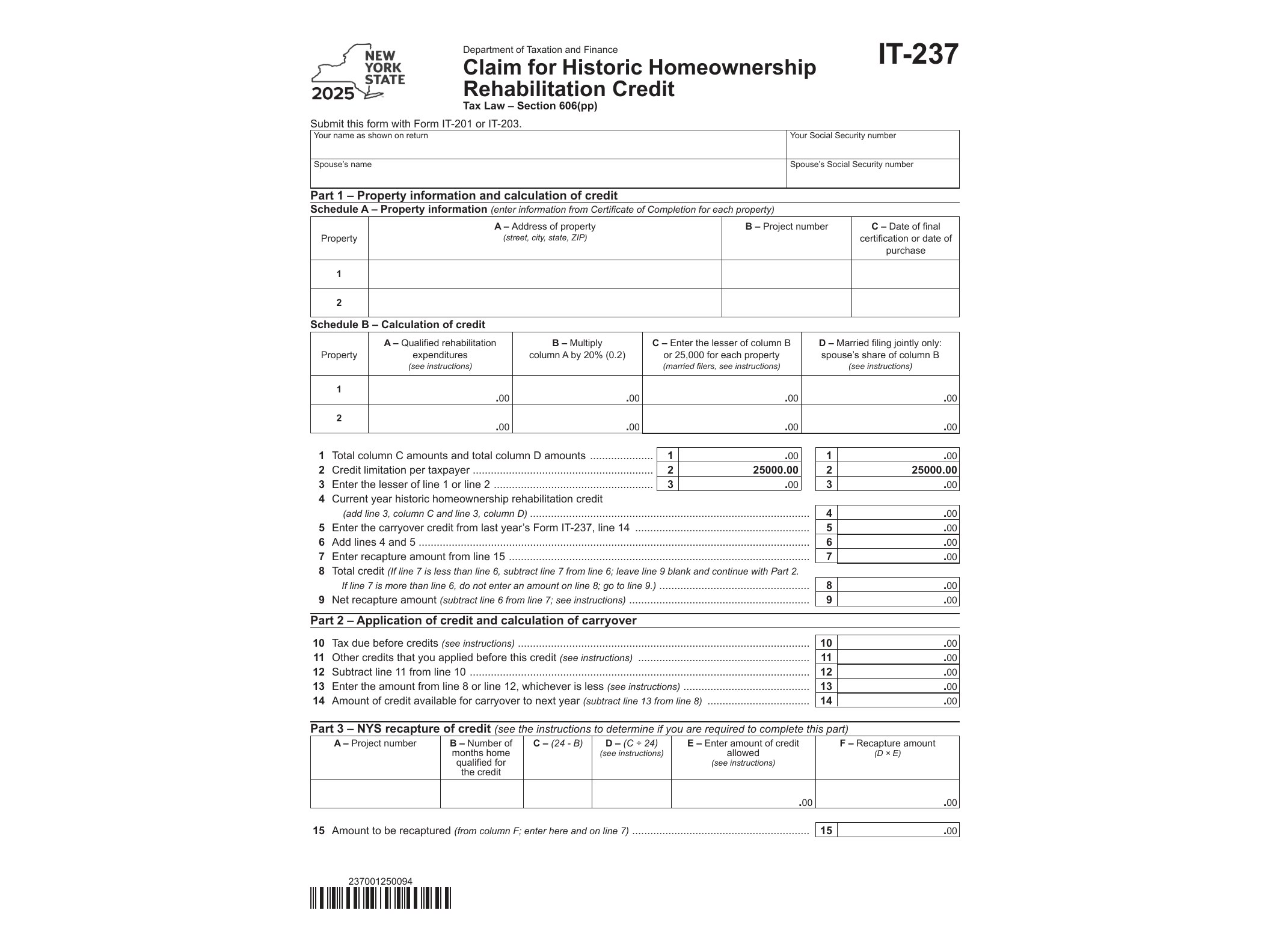
Form IT-237, issued by the New York State Department of Taxation and Finance, lets homeowners claim the Historic Homeownership Rehabilitation Credit. This credit rewards owners who invest in rehabilitating a historic residence located within a designated area, offsetting a portion of the qualified rehabilitation costs against their New York State personal income tax liability for tax year 2025.
The credit exists to encourage preservation of older homes that sit within state or federally recognized historic districts. Rather than letting these properties fall into disrepair, New York offers a financial incentive tied to approved renovation work. If you own and live in a certified historic home and you’ve paid for qualified rehabilitation, this form is how you turn that spending into a tax credit rather than just a cost you absorbed out of pocket.
Who Needs Form IT-237
This form is for individual homeowners, not businesses or income-producing property owners. To qualify, your home generally needs to be located in a designated historic district, listed on the State or National Register of Historic Places, or otherwise recognized as historic under New York’s certification rules. The rehabilitation work itself typically needs prior certification from the appropriate state historic preservation office confirming the project meets the standards required for the credit.
Homeowners who complete exterior repairs, structural updates, or restoration work consistent with historic preservation guidelines are the primary users of this form. If your property doesn’t carry historic designation, or if the renovations weren’t certified before or during the work, you won’t be able to claim this particular credit no matter how extensive the project was.
It’s worth noting the distinction between this credit and the one covered by Form IT-238, Claim for Rehabilitation of Historic Properties Credit. That form applies more broadly to income-producing historic properties, while IT-237 is specifically scoped to owner-occupied homes. Homeowners sometimes confuse the two, so checking which credit actually applies to your situation before filing saves time down the line.
When to Use This Form
You’ll file Form IT-237 alongside your New York State personal income tax return for the year in which the qualified rehabilitation was completed, or in some cases across the years the project spanned if costs were incurred over multiple tax periods. The credit is calculated as a percentage of qualified rehabilitation expenditures, subject to a cap, so the form walks you through documenting those costs and applying the appropriate percentage.
Homeowners planning a historic renovation should think about this credit before starting work, not after. Certification requirements often mean coordinating with preservation authorities during the planning phase, since retroactive approval for completed work isn’t guaranteed. If you’re weighing multiple state credits tied to property improvements, it’s also worth comparing this against options like the Conservation Easement Tax Credit under Form IT-242, which applies to a different kind of property commitment entirely but is sometimes relevant for owners of larger historic properties with land components.
How to Get and Fill Out Form IT-237
The form is available directly from the New York State Department of Taxation and Finance as a fillable PDF, meaning you can enter your information digitally before printing or submitting it with your return. You’ll need documentation of your qualified rehabilitation expenses, the certification confirming the historic status of your property and the approval of the work performed, and your calculation of the credit amount based on the current percentage allowed for tax year 2025.
Fill in your identifying information first, then work through the expenditure and credit calculation sections using your supporting documents. Keep copies of all certification paperwork and receipts, since the state can request substantiation of the claimed amounts. Once completed, the form gets attached to your New York State income tax return rather than filed separately.
For those handling multiple state filings or comparing residency and credit rules across jurisdictions, resources like FTB Publication 1067 can offer useful context, even though it addresses California filing groups rather than New York credits directly, since it illustrates how supplementary guidance documents work alongside primary tax forms.
Download Official Form IT237 (PDF)
Opens the official government PDF in a new tab