
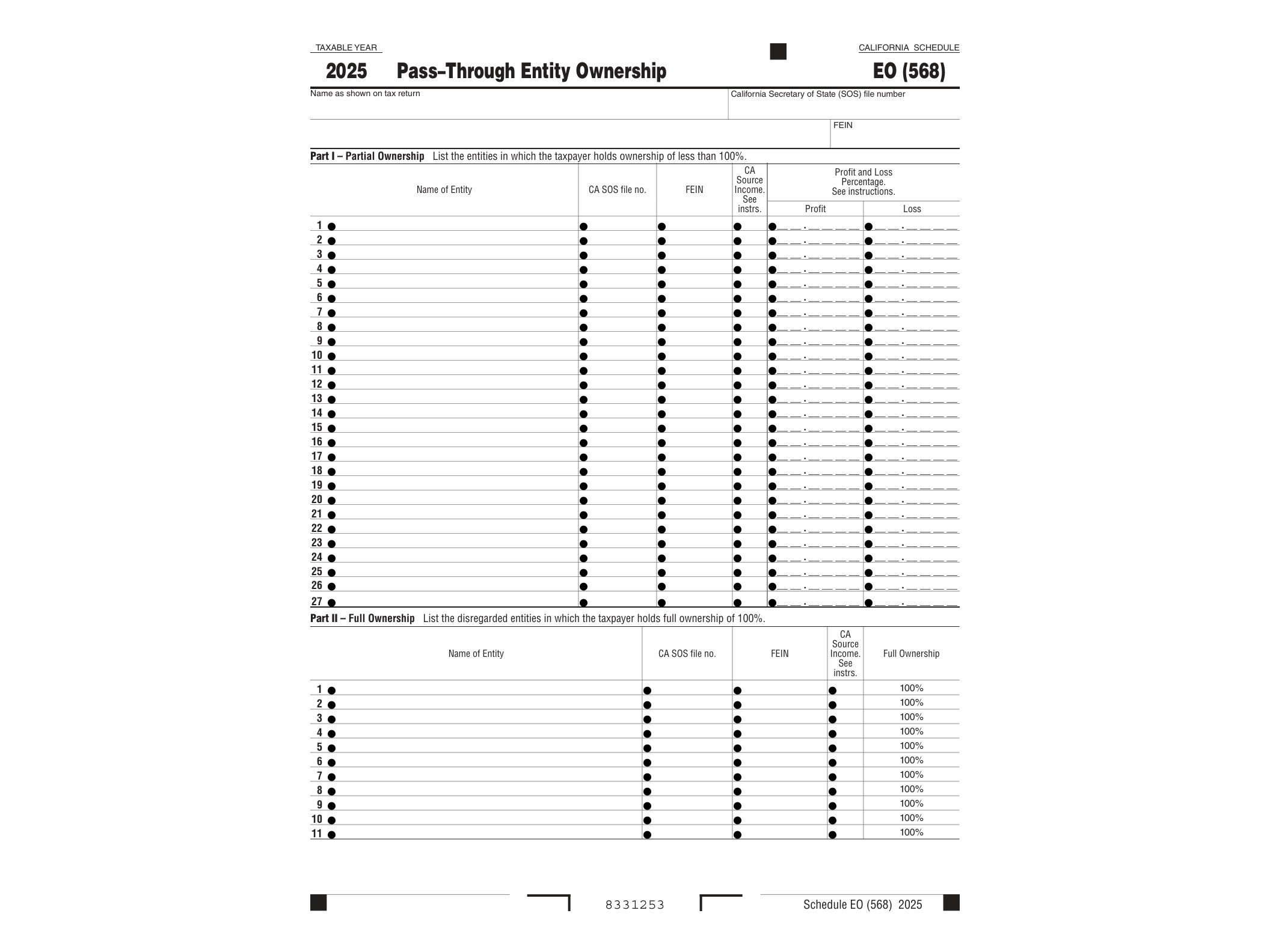
Download Official Form 568 (PDF)
Opens the official government PDF in a new tab
Form 568, issued by the California Franchise Tax Board (FTB), is the state’s Limited Liability Company Return of Income. Any LLC that is organized in California, registered to do business in California, or classified as doing business in the state for tax purposes generally has to file this return each year, regardless of whether the company made a profit, lost money, or was inactive for part of the year.
This form is separate from the LLC’s federal tax filing. The IRS treats most single-member LLCs as disregarded entities and multi-member LLCs as partnerships unless an election is made, but California still wants its own accounting of income, deductions, and the LLC fee owed to the state. That’s the core purpose of Form 568: it reconciles federal taxable income with California adjustments and calculates the annual LLC tax and fee.
Who Needs to File Form 568
You need this form if your LLC meets any of these conditions during the tax year:
- It’s registered with the California Secretary of State, even if it operates mostly out of state.
- It’s doing business in California, meaning it has sales, property, or payroll connected to the state above certain thresholds.
- It’s a single-member LLC owned by a California resident or entity, even when the LLC itself is disregarded for federal purposes.
- It elected to be taxed as a partnership or is a foreign LLC registered to transact business in California.
LLCs that elected corporate tax treatment file different forms (Form 100 or 100S), so Form 568 applies specifically to those taxed as partnerships or disregarded entities.
What the Form Covers
Form 568 asks for the LLC’s total income, deductions, and the calculation of the annual tax (a flat $800 minimum franchise tax for most LLCs) plus the LLC fee, which is based on total income from California sources and can range from a few hundred dollars to over $11,000 for LLCs with high revenue. The form also includes Schedule K and K-1s, which report each member’s share of income, deductions, and credits, similar to how a federal partnership return works.
Because the LLC fee is tied to gross receipts rather than net profit, even LLCs that lost money during the year may still owe a substantial fee if their revenue was high. This trips up a lot of first-time filers who assume no profit means no fee.
When Form 568 Is Due
For calendar-year LLCs, the return is due by the 15th day of the fourth month after the close of the taxable year, which typically lines up with the standard April tax deadline. The $800 annual tax, however, is often due earlier in the year through a separate estimated payment voucher (Form 3522), and the LLC fee estimate is paid via Form 3536 by the 15th day of the sixth month if the LLC expects total income over $250,000.
Missing these deadlines triggers penalties and interest, so LLC owners generally want to track both the annual tax payment and the return filing separately rather than assuming one covers the other.
Filling Out and Filing the Form
The version referenced here is the 2021 revision, though the FTB updates the form annually with only minor changes to line items and instructions. The document is a fillable PDF, so you can type directly into the fields using Adobe Reader or similar software before printing or saving a digital copy for your records. Many LLCs file through tax software or a preparer who handles the electronic submission directly with the FTB, since e-filing is required in many cases once you’re set up with a professional preparer.
If your business also has income tax obligations in states like New York, you may be juggling a different set of state-specific forms and credits altogether. For entities with mixed multistate filings, it can help to review guides like the Form IT-249 long-term care insurance credit or the Form IT-245 volunteer firefighters’ credit to understand how other states structure their own entity-level or individual credits, since the logic behind supporting schedules is often similar even when the forms themselves look completely different.
Keeping a copy of the completed Form 568 alongside your federal partnership or disregarded entity documentation makes it much easier to respond to any FTB notices later, since California frequently cross-checks these returns against federal filings for consistency.
Download Official Form 568 (PDF)
Opens the official government PDF in a new tab