
Download Official Form IT255 (PDF)
Opens the official government PDF in a new tab
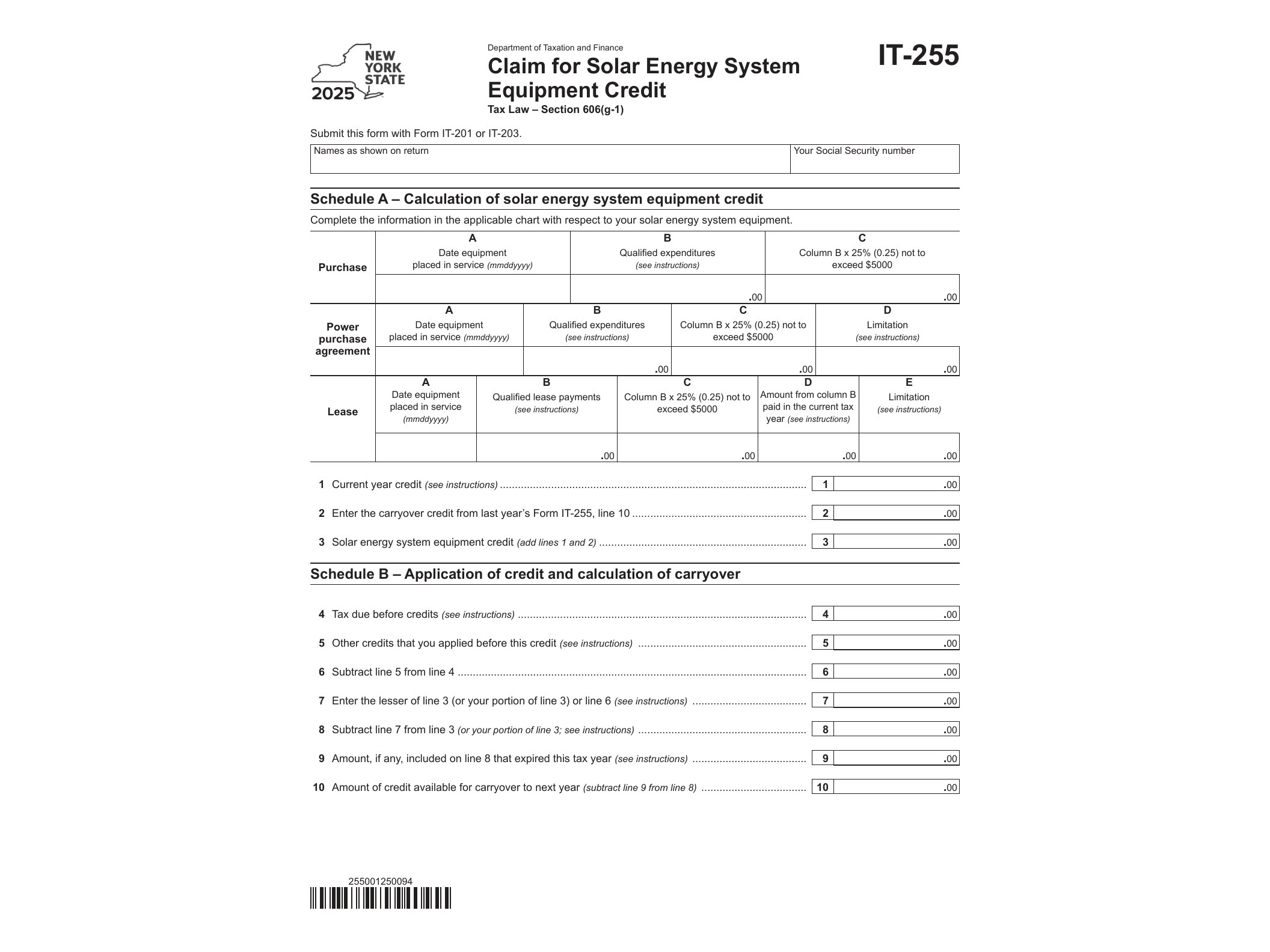
Form IT-255 is the document New York State residents use to claim the Solar Energy System Equipment Credit on their state income tax return. If you installed solar panels or other qualifying solar equipment at your New York home during 2025, this is the form that lets you recover a portion of that cost through a nonrefundable state tax credit.
The credit is administered by the New York State Department of Taxation and Finance and applies to solar energy systems that generate electricity or heat for residential use. It’s separate from the federal solar tax credit, so homeowners who install solar equipment can typically claim both the federal credit on their federal return and the state credit using Form IT-255 on their New York return, as long as the property meets the state’s eligibility requirements.
Who Needs Form IT-255
You need this form if you’re a New York State resident (or part-year resident) who purchased and installed solar energy system equipment on residential property you own and use as your principal residence, or in some cases a secondary residence, located in New York State. The equipment must meet certain technical requirements, generally tied to systems that use solar radiation to produce energy for heating, cooling, hot water, or electricity.
Renters generally don’t qualify unless they’ve entered into a qualifying solar lease or power purchase agreement that meets the state’s specific criteria. Landlords who install solar equipment on rental property they don’t personally occupy typically cannot claim this particular credit, since it’s designed around residential use by the taxpayer.
When to Use This Form
Form IT-255 is filed with your New York State personal income tax return for the year in which the solar equipment was placed in service, not necessarily the year you paid for it if those dates differ. For tax year 2025, that means attaching it to your 2025 IT-201 or IT-203 return when you file, typically by the April 2026 deadline unless you request an extension.
If you didn’t install new equipment this year but you’re still carrying forward unused credit from a prior year’s solar installation, you’ll also use this form to claim that carryover amount. The credit is nonrefundable, so any portion that exceeds your tax liability in the current year can generally be carried forward to future years until it’s used up.
How the Credit Is Calculated
The credit equals a percentage of your qualified solar energy system equipment expenditures, subject to a maximum dollar cap per residence. The form walks you through entering your total costs, applying the applicable percentage, and comparing that figure against the statutory cap to determine your allowable credit for the year. If you share ownership of the residence with someone who isn’t your spouse, you’ll need to allocate the expenditures accordingly, and the form includes space for that calculation.
Because the math involves multiple steps, including any carryforward amounts from prior years, it helps to have your installation invoices and any prior-year IT-255 forms on hand before you start filling this one out. Keeping organized records is a habit that pays off with other New York credits too, similar to how documentation matters when preparing something like Form IT-251 for the employment of persons with disabilities credit, where supporting records determine what you can actually claim.
Getting and Filing the Form
Form IT-255 is a fillable PDF, so you can type your information directly into the form fields on your computer before printing it for submission or attaching it to an electronically filed return, depending on how you file. The New York State Department of Taxation and Finance updates this form annually, so make sure you’re using the version specifically marked for tax year 2025 rather than an older revision, since credit caps and instructions can shift from year to year.
Once completed, the form attaches to your main New York income tax return rather than being filed separately. If you’re comparing how different states handle residential tax breaks and credits, it’s worth noting that not every state approaches things the same way, much like the differences you’ll find between New York’s credit structure and California filing references such as the California 2EZ tax table for Head of Household filers. Each state sets its own rules, caps, and qualifying criteria, so relying on New York-specific instructions when completing IT-255 is essential rather than assuming rules from another state’s form apply.
Download Official Form IT255 (PDF)
Opens the official government PDF in a new tab