
Download Official Form 3579 (PDF)
Opens the official government PDF in a new tab
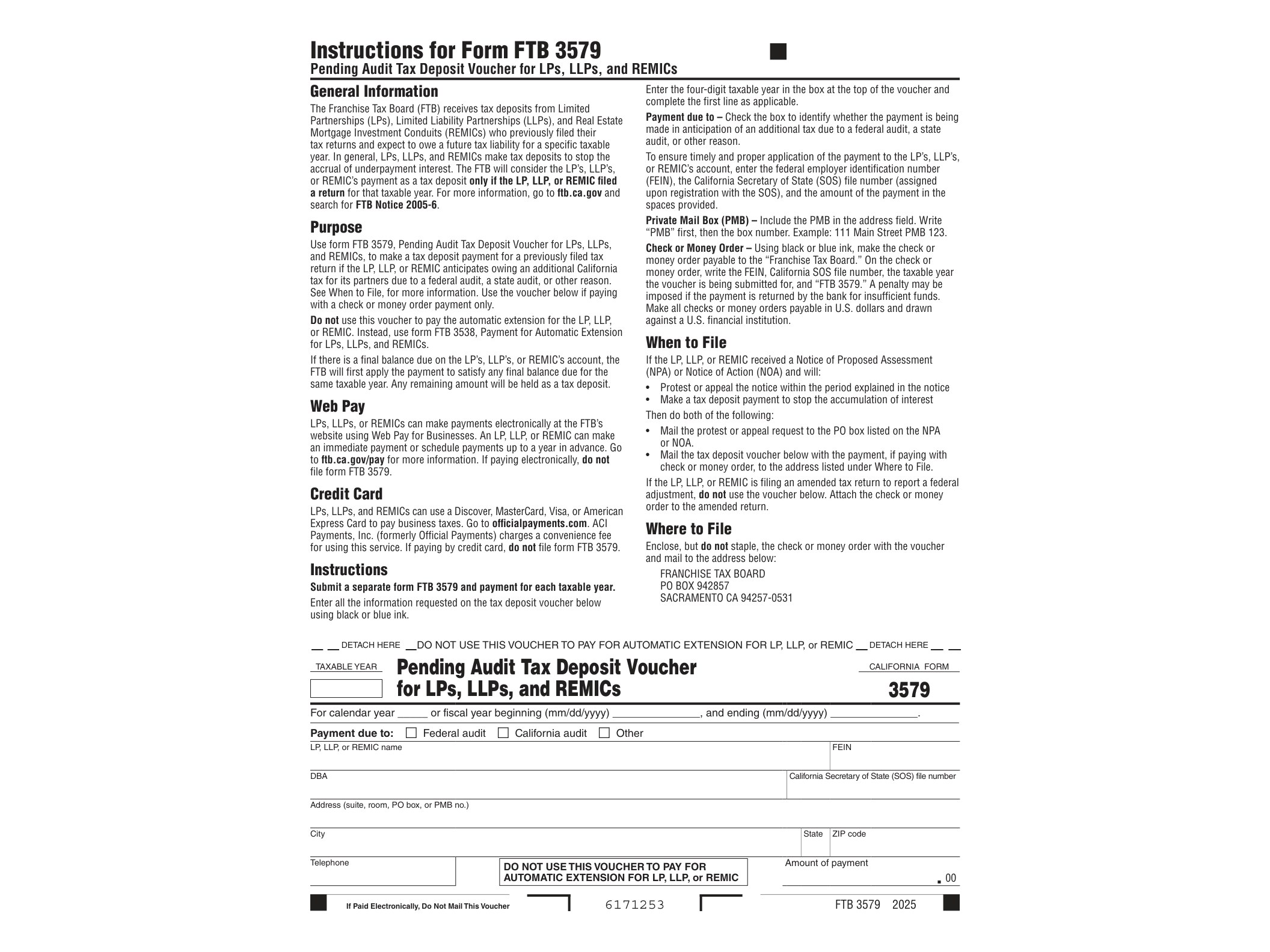
Form FTB 3579 is a California Franchise Tax Board voucher used by limited partnerships (LPs), limited liability partnerships (LLPs), and real estate mortgage investment conduits (REMICs) to make a tax deposit while an audit or protest is pending. Rather than paying a disputed liability outright, an entity can deposit funds with the FTB to stop interest from accruing on the amount in question, without conceding that the tax is actually owed.
This mechanism matters because California law allows interest to keep building on unpaid tax during the entire audit and appeals process. If the entity eventually wins its case, the deposit is refunded. If it loses, the deposited funds are applied to the final liability. Either way, using Form FTB 3579 protects the entity from additional interest charges while the dispute works its way through the FTB’s review process.
Who needs to file Form FTB 3579
This voucher is specifically designed for three types of California business entities:
- Limited partnerships (LPs)
- Limited liability partnerships (LLPs)
- Real estate mortgage investment conduits (REMICs)
These entities are subject to California’s annual tax and, in some cases, additional fees based on income. When the FTB proposes an assessment that the entity disagrees with — whether through an audit finding, a notice of proposed assessment, or a similar action — the entity can choose to deposit the disputed amount using this voucher instead of waiting for the dispute to resolve while interest accumulates.
It’s worth noting that this form is distinct from the standard estimated tax or annual tax payment vouchers these entities normally use. Form FTB 3579 only applies when there’s an active or anticipated dispute with the FTB over a specific assessment.
When to use this voucher
An LP, LLP, or REMIC typically submits Form FTB 3579 after receiving a notice from the FTB proposing additional tax, penalties, or fees that the entity intends to contest. Common scenarios include:
- The entity has filed a protest against a Notice of Proposed Assessment and wants to stop interest from accruing while the protest is pending.
- The entity anticipates a dispute and wants to preemptively deposit funds to limit future interest exposure.
- The entity is in the middle of an administrative appeal and wants to demonstrate good faith while preserving its right to contest the underlying liability.
Depositing funds does not waive the entity’s right to dispute the assessment. It simply changes how interest is calculated going forward. This is a useful distinction for entities managing cash flow while also fighting a tax determination they believe is incorrect.
How to complete and submit the form
The voucher itself is short and requires basic identifying information: the entity’s name, California corporation or SOS file number, FEIN, the taxable year involved, and the amount being deposited. Because the form is a fillable AcroForm PDF, entities can type the required information directly into the document before printing it for mailing, since the FTB does not currently accept this voucher through electronic submission.
Once completed, the voucher should be mailed along with the deposit payment to the address specified in the instructions accompanying the 2024 version of Form FTB 3579. It’s a good idea to keep a copy of the completed voucher and proof of mailing, since this documentation may be needed later if there’s a question about when the deposit was made relative to the audit or protest timeline.
Entities that are unfamiliar with California’s protest and appeals procedures may find it helpful to review how other states handle disputed liabilities and extensions, since the underlying logic — stopping interest while a dispute is pending — shows up in various forms across jurisdictions. For instance, individual taxpayers dealing with extended filing deadlines might look at New York’s automatic extension request for a sense of how states structure temporary relief mechanisms. Similarly, entities juggling depreciation adjustments alongside a pending audit may want to cross-reference documentation like New York’s depreciation schedule for Section 168(k) property, since audit disputes often touch multiple filings at once.
Before submitting Form FTB 3579, double-check the taxable year and entity identification details against the original notice from the FTB. Mismatched information can delay processing and, in some cases, affect how the deposit is applied once the audit or protest concludes.
Download Official Form 3579 (PDF)
Opens the official government PDF in a new tab