
Download Official Form IT59 (PDF)
Opens the official government PDF in a new tab
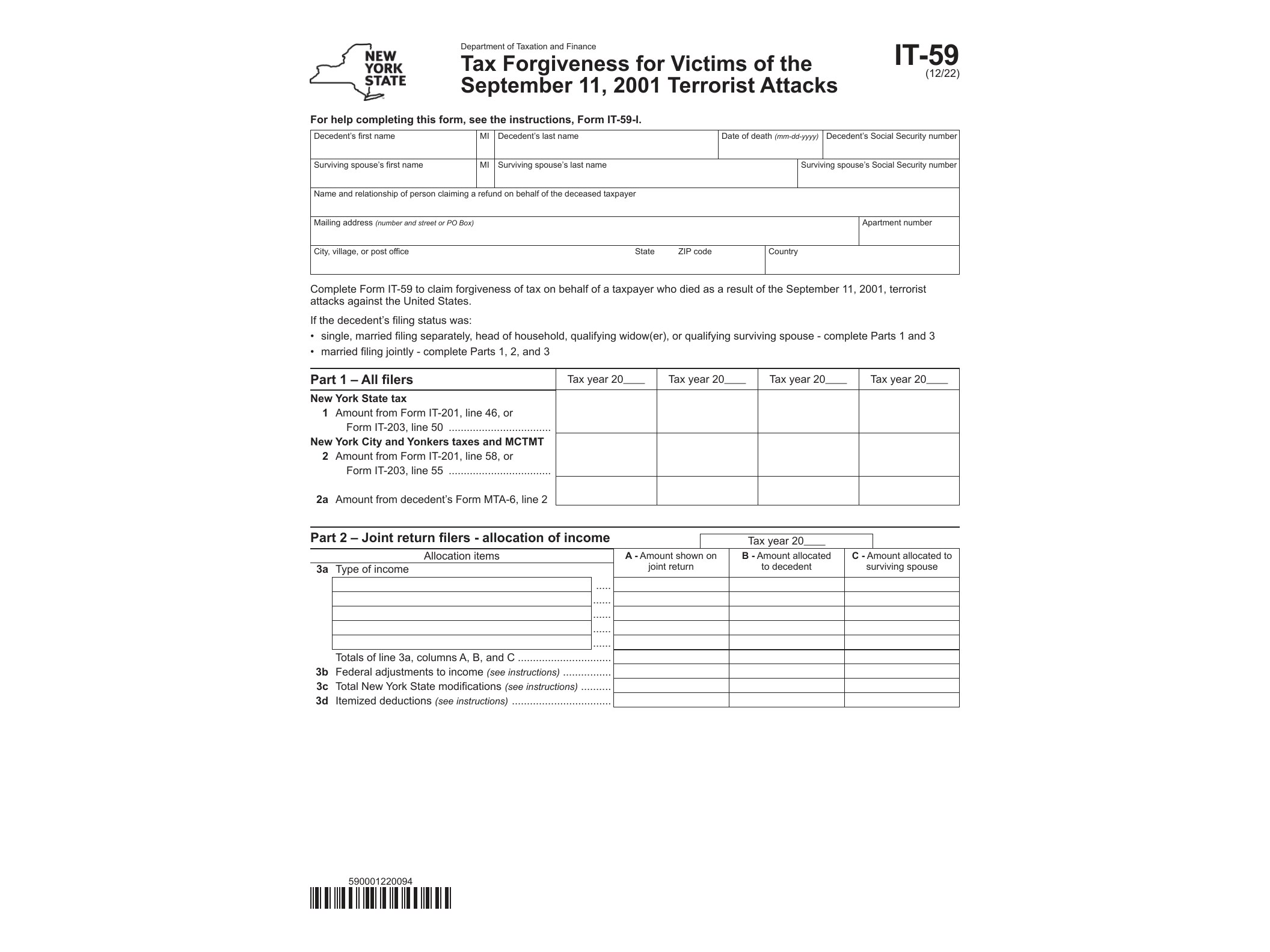
Form IT-59 is a New York State tax form that provides tax forgiveness to victims of the September 11, 2001 terrorist attacks and their families. It was created under a state law designed to ease the tax burden on households affected by that day, and the New York State Department of Taxation and Finance still processes these claims decades later because eligible estates and survivors sometimes only become aware of the relief years after a death or injury occurred.
The form itself is short, but its purpose is significant. It allows a qualifying individual, or the representative of a deceased victim’s estate, to request that New York State income tax be forgiven for specific tax years connected to the attacks. This isn’t a deduction or a credit you calculate against income — it’s a full forgiveness of tax liability for the years the law specifies, which can mean a meaningful refund or an offset against other tax debt owed to the state.
Who Needs to File Form IT-59
This form applies to a narrow but clearly defined group of people. You may need to file IT-59 if you are:
- The spouse, or the executor/administrator of the estate, of someone who died as a result of the September 11, 2001 attacks at the World Trade Center, the Pentagon, or the Flight 93 crash site in Pennsylvania.
- A victim of the attacks who survived but suffered injuries connected to the events of that day, and who qualifies for the associated federal tax relief under the Victims of Terrorism Tax Relief Act.
- A personal representative handling a decedent’s final New York State income tax filings and seeking forgiveness of tax for the applicable years.
Because eligibility hinges on documentation — death certificates, medical records, or federal determinations tied to the attacks — this form is often filed alongside amended returns or as part of settling an estate, sometimes years after the fact when heirs or executors realize the relief was never claimed.
When and How the Form Is Used
Form IT-59 is typically submitted with an original or amended New York State income tax return for the relevant tax year, or on its own if you’re requesting forgiveness of tax already assessed or paid. The state allows forgiveness for the year of death and, in many cases, the preceding tax year, mirroring the structure of the federal relief provisions. If tax was already paid for those years, filing this form correctly can lead to a refund.
The form asks for basic identifying information about the taxpayer or decedent, the tax years being claimed, and a description of how the individual qualifies under the terrorist attack provisions. Supporting documentation isn’t always attached directly to the form, but the Department of Taxation and Finance can request it during processing, so keeping records like death certificates or federal tax relief notices on hand is a good idea before submitting.
Getting and Completing the Form
The current version of Form IT-59, revised 12/22, is a fillable PDF, meaning you can type your information directly into the form on a computer before printing it for signature and mailing. There’s no online e-filing option for this particular form — it needs to be submitted on paper along with whatever return or amended return it accompanies.
When filling it out, double-check names, Social Security numbers, and tax year entries against the original returns being amended, since mismatches are one of the most common reasons these claims get delayed. If you’re also dealing with other New York State filings for the same estate or tax year, it’s worth reviewing related guidance, such as how depreciation schedules work under Form IT-398 if business property is involved, or how wage credits are claimed on Form IT-601 if the decedent had business income tied to an empire zone.
Estates dealing with tax matters across multiple jurisdictions may also find it helpful to understand how other states handle similar deposit and audit procedures, as outlined in resources like the FTB Form 3579 instructions, particularly when an estate has assets or filings outside New York.
Once completed, the form should be mailed to the address specified in the accompanying return instructions, and it’s advisable to keep a copy along with proof of mailing, since these claims can take time to process given the documentation review involved.
Download Official Form IT59 (PDF)
Opens the official government PDF in a new tab