
Download Official Form 626 (PDF)
Opens the official government PDF in a new tab
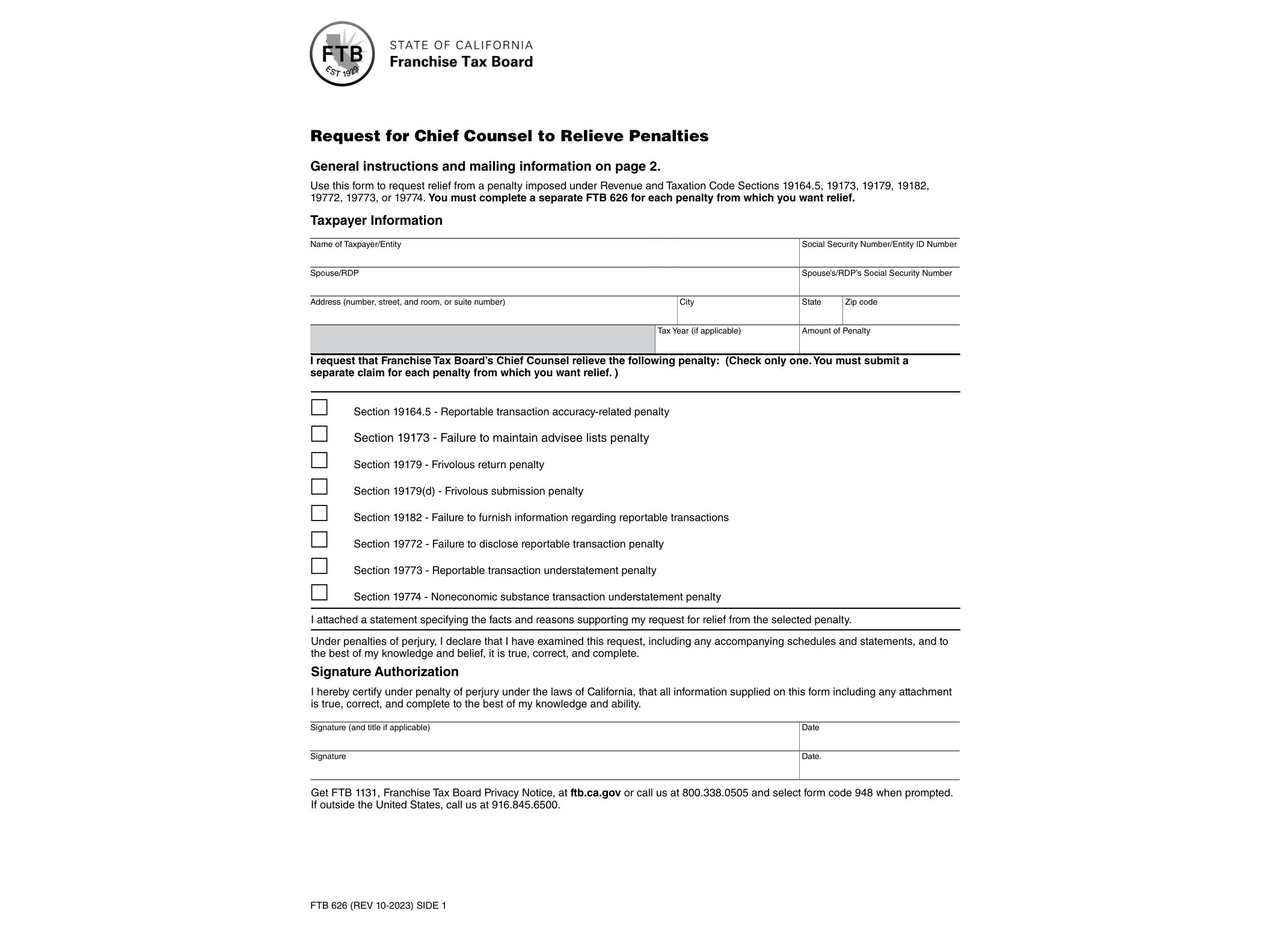
FTB Form 626, officially titled Request for Chief Counsel to Relieve Penalties, is a California Franchise Tax Board form used to formally ask the FTB’s Chief Counsel to waive or abate certain penalties that don’t qualify for relief through the standard reasonable cause process handled by regular FTB staff. This is a more specialized route reserved for specific penalty types where only the Chief Counsel has the authority to grant relief.
Unlike a routine penalty abatement request, which most taxpayers submit through a letter or phone call citing reasonable cause, Form 626 targets a narrower category of situations. California law gives the Chief Counsel discretion to relieve penalties tied to things like the accuracy-related penalty for understatements attributable to a reportable transaction, or other penalties where statute specifically assigns the relief authority to Chief Counsel rather than to line examiners or collections staff. If your penalty falls into one of these categories, going through normal channels won’t work — you need this specific form.
Who Needs This Form
This form is relevant to individuals, corporations, partnerships, and LLCs that have been assessed a penalty by the FTB and believe they meet the legal criteria for Chief Counsel relief. It’s most commonly used by:
- Taxpayers hit with penalties related to reportable transactions or listed transactions under California tax law
- Businesses facing penalties that fall outside the scope of standard reasonable cause determinations
- Tax professionals and CPAs representing clients who received a penalty notice specifying that relief must come through Chief Counsel review
If you’re unsure whether your penalty qualifies for this process, check the notice you received from the FTB. It should indicate whether reasonable cause relief through normal channels is available or whether Chief Counsel review is the only path. Many penalty notices explicitly reference this distinction.
When to Use Form 626
You should submit this form after you’ve received a penalty assessment and confirmed that it falls under Chief Counsel’s exclusive relief authority. There’s no benefit to filing it preemptively before an assessment, since the request needs to reference the specific penalty, tax year, and legal basis for relief. Timing matters here — submit the request as soon as possible after the assessment to avoid complications with any accruing interest or collection actions while your request is under review.
Keep in mind this process is separate from an appeal. Filing Form 626 doesn’t pause the standard appeal deadlines, so if you’re also considering disputing the underlying tax liability, you’ll want to track both processes independently and not let one clock run out while waiting on the other.
How to Get and Complete the Form
Form 626 is available directly from the FTB’s forms library as a fillable PDF, which means you can type your information directly into the document using Adobe Reader or similar software before printing or submitting it. You’ll typically need to provide:
- Your name, taxpayer identification number (SSN or FEIN), and contact information
- The specific tax year and penalty type at issue
- A detailed explanation of why you believe the penalty should be relieved, including any supporting facts or circumstances
- Signature and date, along with authorization details if a representative is filing on your behalf
Be thorough in the explanation section. Chief Counsel review tends to be more document-heavy than a standard reasonable cause request, so attaching supporting documentation — correspondence, prior notices, or relevant filings — strengthens your case considerably.
Businesses dealing with this kind of penalty relief request often also handle other California-specific compliance forms. If your business claims depreciation deductions, for example, you might already be familiar with Form 3885L for LLCs or its counterpart Form 3885P for partnerships, both of which affect how income and deductions are reported and can sometimes tie into penalty situations if amended returns are involved.
Once completed, mail the form to the address specified in the instructions or notice you received — Chief Counsel requests generally go to a different unit than standard correspondence, so don’t send it to the general FTB mailing address used for regular tax filings. Processing times can run longer than standard penalty abatement requests since these cases require legal review rather than a straightforward administrative check.
Download Official Form 626 (PDF)
Opens the official government PDF in a new tab