
Download Official Form IT653 (PDF)
Opens the official government PDF in a new tab
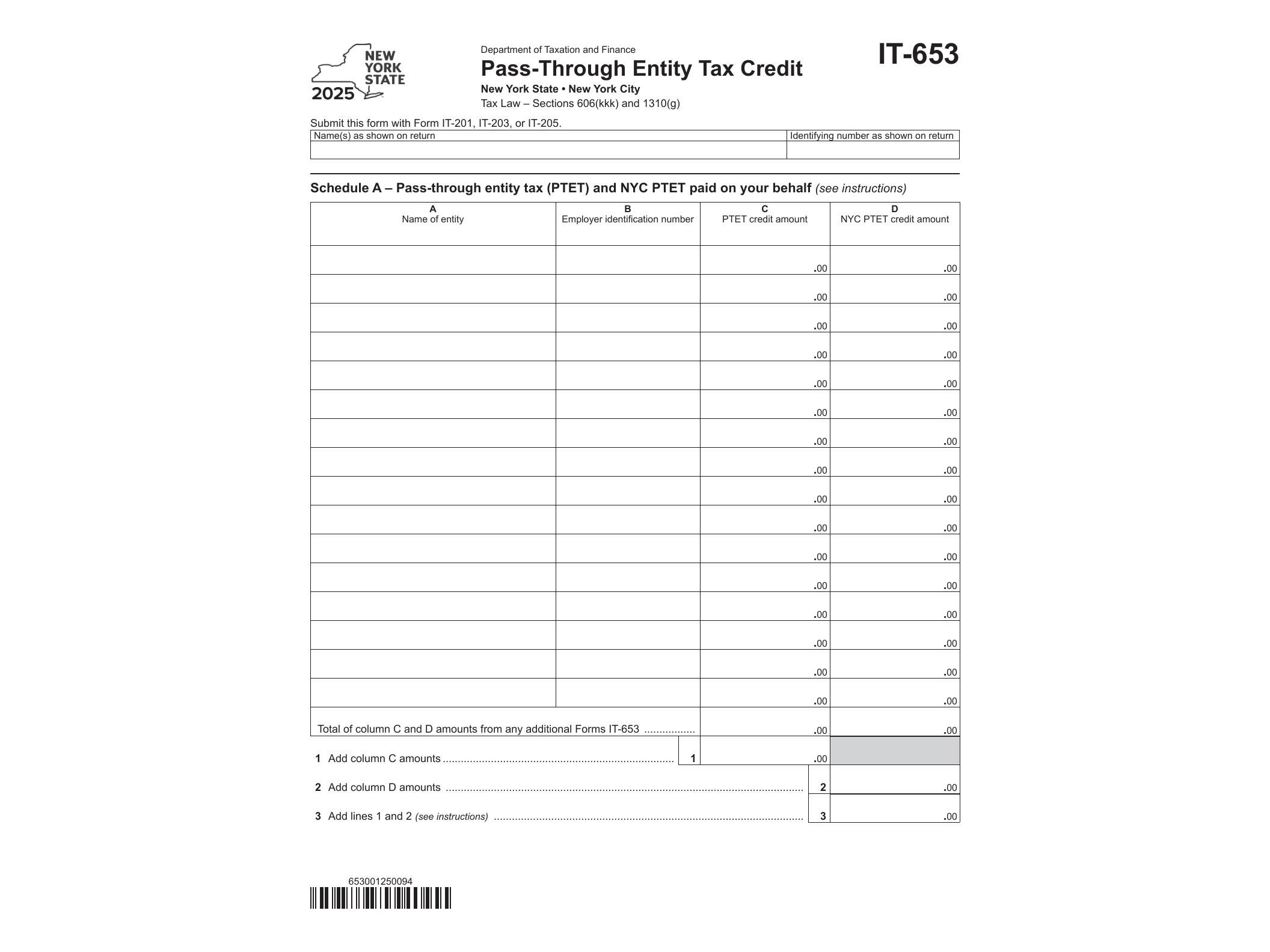
Form IT-653 is how eligible partners, members, and shareholders of a partnership or S corporation claim their share of the New York State Pass-Through Entity Tax (PTET) credit. If the business you’re invested in elected into the PTET regime and paid tax at the entity level, this form is what lets you, as an individual owner, claim that payment back as a credit on your personal New York State income tax return.
The PTET was created as a workaround to the federal $10,000 cap on state and local tax (SALT) deductions. Instead of individual owners paying New York tax on their share of partnership or S corp income and then hitting the SALT cap on their federal return, the entity itself can elect to pay the tax directly to New York. That payment is generally deductible at the entity level for federal purposes, which sidesteps the SALT limitation. Form IT-653 is the mechanism that returns the value of that entity-level payment to the individual owner, so they aren’t taxed twice on the same income.
Who Needs to File Form IT-653
You need this form if you are a partner in a partnership, a member of an LLC taxed as a partnership, or a shareholder in an S corporation that made a valid PTET election for the 2025 tax year. The entity itself files an annual PTET return and issues each owner a share of the credit, typically documented on a schedule the entity provides. You then transfer that information onto Form IT-653 and attach it to your personal New York State income tax return (Form IT-201 for residents or IT-203 for nonresidents and part-year residents).
This isn’t a form you fill out speculatively. You only need it if the pass-through entity actually opted into PTET and actually paid the tax. If the entity didn’t elect PTET, there’s no credit to claim, and Form IT-653 doesn’t apply to you.
What Information Goes on the Form
Form IT-653 requires the entity’s name, its Employer Identification Number, and the amount of PTET credit allocated to you as an individual owner. This information should match what the entity reported to New York State and what appears on the statement they send you (often referred to as the PTET credit summary). If you’re a partner or shareholder in multiple electing entities, you’ll need to list each one separately on the form, since the credit is calculated and allocated entity by entity.
Accuracy matters here. The New York Department of Taxation and Finance cross-checks the credit amounts claimed on individual returns against what the entity reported on its own PTET filing. A mismatch can delay your refund or trigger a notice asking for clarification, so double-check the figures against the documentation the entity provided before submitting.
When and How to File
Form IT-653 is filed alongside your annual New York State personal income tax return, following the same deadlines as your IT-201 or IT-203. It is not filed separately or in advance. If you request an extension for your personal return, the extension covers this form as well since it’s submitted as an attachment rather than a standalone filing.
The form itself is a simple, fillable PDF that New York provides directly through its tax website. Because it’s an AcroForm, you can type your entries directly into the PDF fields on a computer before printing or attaching it to an electronically filed return, which cuts down on transcription errors compared to filling it out by hand.
Owners who are new to New York’s suite of pass-through credits sometimes confuse PTET with other entity-level incentives. If you’re also researching credits tied to specific industries or activities, it’s worth comparing how Form IT-652 for the Employer-Provided Childcare Credit works, since it follows a similar pass-through structure. Businesses in the entertainment sector may also want to look at Form IT-654 for the NYC Musical and Theatrical Production Tax Credit, and agricultural operations should check Form IT-649 covering farm donations to food pantries, as these credits can sometimes apply to the same taxpayers depending on the entity’s activities.
Keep copies of the entity’s PTET credit statement along with your filed IT-653 in case the Department requests supporting documentation later. Since PTET elections and credit calculations happen at the entity level, individual owners generally have limited ability to dispute the allocated amount, so any discrepancies should be raised with the entity’s accountant before the personal return is filed.
Download Official Form IT653 (PDF)
Opens the official government PDF in a new tab