
Download Official Form RP305PRE (PDF)
Opens the official government PDF in a new tab
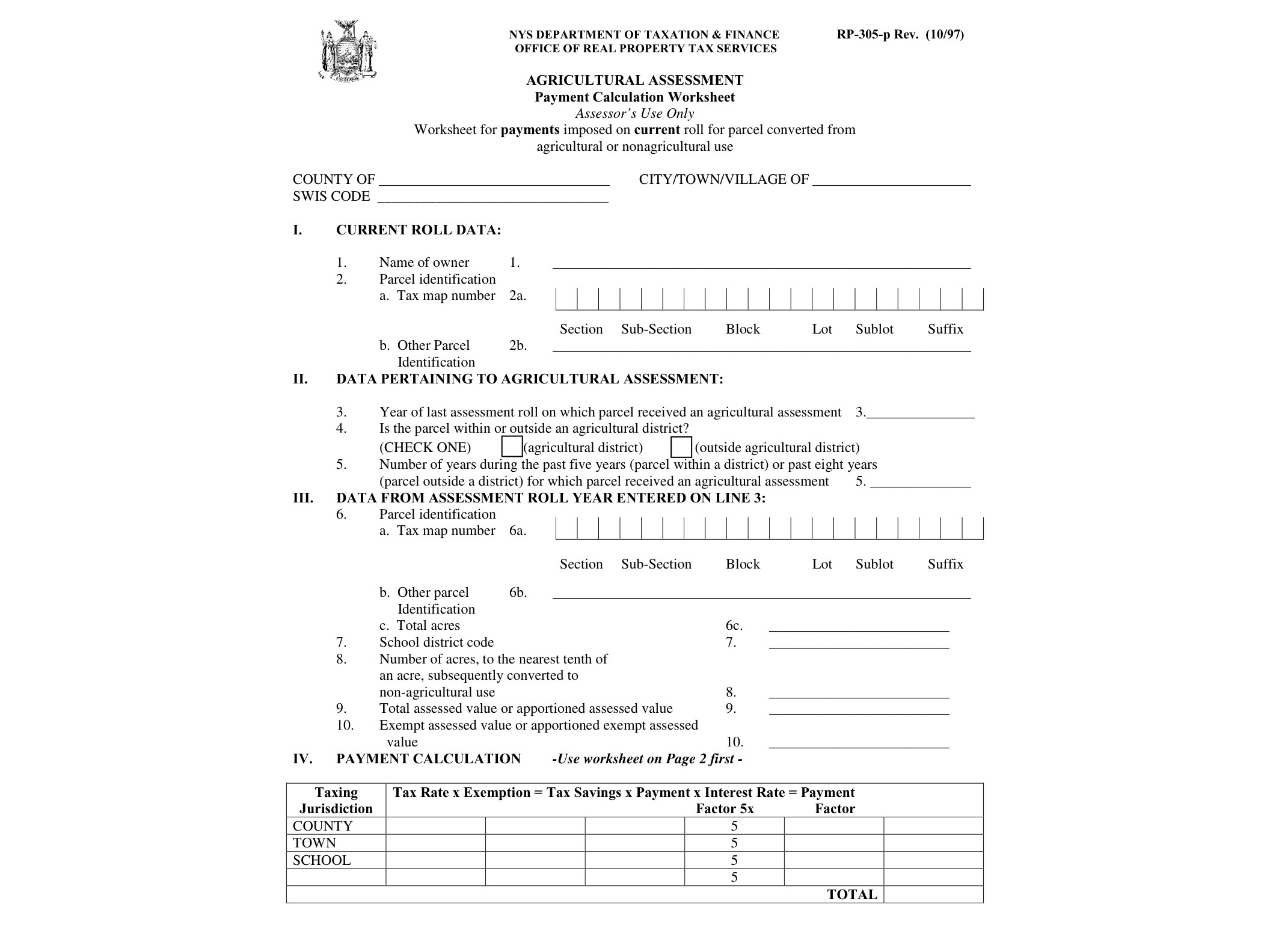
Form RP-305-P, officially titled the Agricultural Assessment Payment Calculation Worksheet, is issued by the New York State Department of Taxation and Finance. It’s used by property owners, assessors, and local officials to calculate the payment owed when land that previously received an agricultural assessment is converted to a non-agricultural use before the required period of continued agricultural use has passed.
New York offers reduced property tax assessments to landowners who keep their property in agricultural production. In exchange for this tax benefit, the owner agrees to keep the land in qualifying agricultural use for a set period. If the land is converted to another use — residential development, commercial use, or anything outside the agricultural definitions under state law — before that period ends, the owner may owe a payment to recapture some of the tax savings received while the land carried the lower assessment. Form RP-305-P is the worksheet used to figure out exactly how much that payment should be.
This form is not something a typical homeowner fills out on their own initiative. It typically comes into play after a notice of conversion has been triggered, often documented through Form RP-305-L, which formally notifies the assessor and property owner that converted land is subject to a payment. Once that notice is issued, RP-305-P is used to work through the actual math: prior assessed values, the agricultural assessment amount, the applicable tax rates for each year the land benefited from the reduced assessment, and the number of years remaining in the conversion penalty period.
Who needs this worksheet? Primarily local assessors and assessment offices use it when processing a conversion case, but property owners and their accountants or attorneys often complete it as well to verify the amount being billed, or to estimate potential liability before deciding whether to convert land use. Farm owners considering selling agricultural land for development, or those who’ve received a notice that their property no longer qualifies for the agricultural exemption, are the main users of this document.
The form requires several pieces of data pulled from assessment rolls: the market value and agricultural assessment value for each affected tax year, the tax rate in effect for those years, and the applicable payment percentage set by statute, which decreases the longer the land was held in agricultural use before conversion. The worksheet walks through these calculations year by year, then totals the amount due. Because agricultural assessment payment rules can involve five years of look-back calculations, having accurate historical assessment records on hand before starting the form saves considerable time.
This form is closely related to other agricultural assessment paperwork that New York property owners may encounter. For example, landowners maintaining their exemption need to periodically confirm eligibility using Form RP-305-R for renewal certification, while those whose farmland doesn’t meet the standard minimum average sales value threshold might instead need Form RP-305-b to apply for an exception. Understanding how these forms connect helps property owners see the full picture of how agricultural assessments are granted, maintained, and eventually recaptured if land use changes.
The PDF version of RP-305-P includes fillable fields, so it can be completed digitally before printing or submitting to the local assessor’s office. Since the calculations depend on multiple years of assessment and tax rate data specific to each municipality, it’s worth double-checking figures against the official assessment roll or consulting with the local assessor directly if any numbers are unclear. Assessors’ offices can also confirm whether a particular parcel is subject to a conversion payment and help walk through the worksheet if the calculation seems complicated.
Because this form deals directly with money owed to local and state tax authorities, accuracy matters. Errors in the worksheet can lead to underpayment notices or disputes with the assessor’s office down the line, so property owners dealing with a land conversion situation should treat this calculation carefully rather than as a quick formality.
Download Official Form RP305PRE (PDF)
Opens the official government PDF in a new tab