
Download Official Form RP305E (PDF)
Opens the official government PDF in a new tab
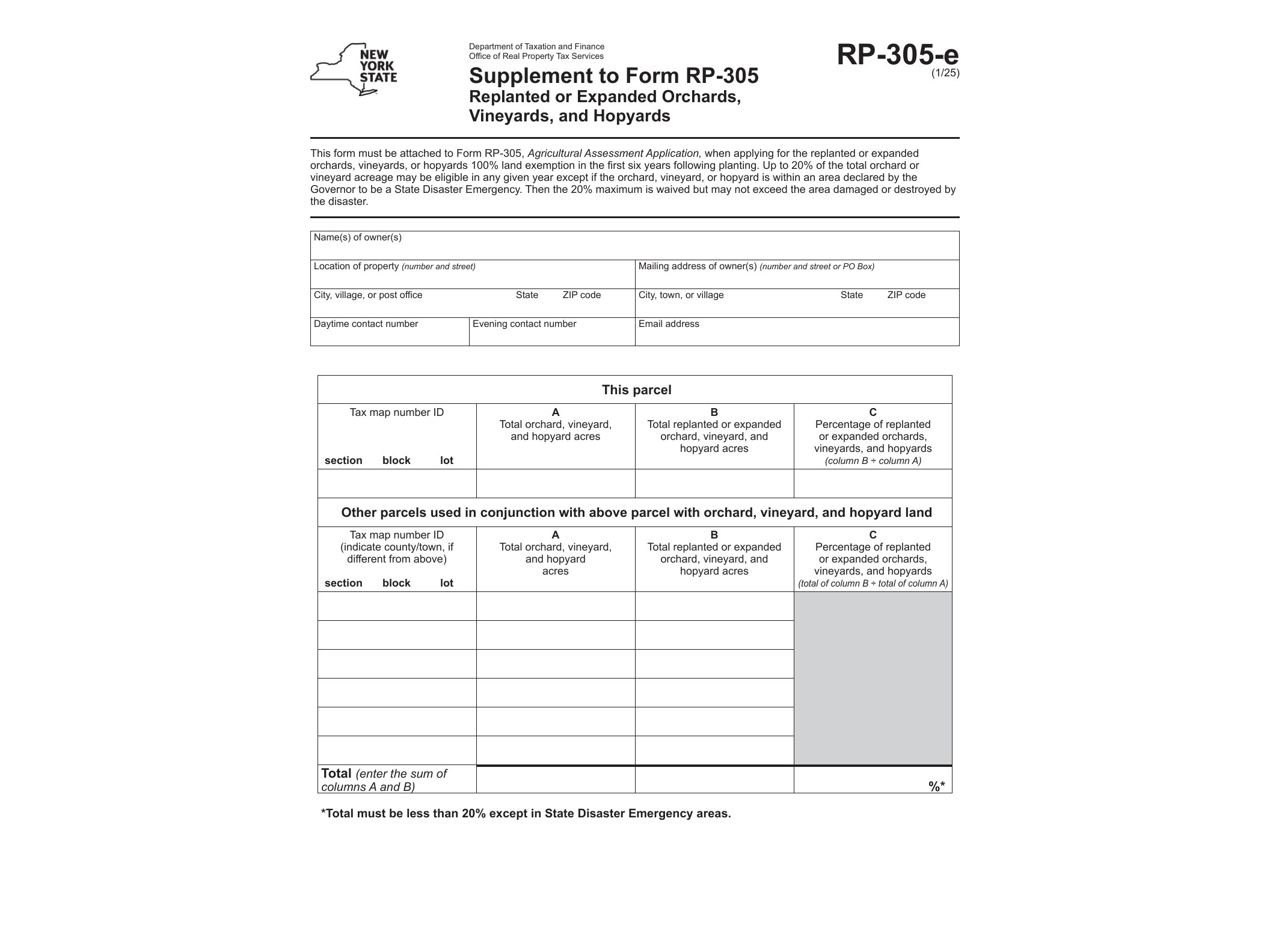
Form RP-305-e is a supplement issued by the New York State Department of Taxation and Finance for landowners who are planting new orchards, vineyards, or hopyards and want that acreage counted toward an agricultural assessment before the crops themselves are generating the typical sales revenue required under the standard rules. It’s filed alongside Form RP-305, the main application for agricultural assessment, rather than on its own.
New York’s agricultural assessment program reduces property taxes on land used for farming, but eligibility generally depends on proving a minimum average gross sales value from the land over the preceding two years. That requirement creates an obvious problem for anyone establishing a brand-new orchard, vineyard, or hopyard: young trees, vines, or hop plants take several years before they produce a marketable crop, let alone generate enough sales to meet the threshold. Form RP-305-e exists specifically to bridge that gap, allowing the assessor to grant agricultural assessment status to newly planted acreage based on projected production rather than past sales history.
Who Needs to File This Form
This supplement is meant for farm owners who are in the early stages of establishing a new orchard, vineyard, or hopyard on land that doesn’t yet meet the standard sales value test. If you’re applying for agricultural assessment for the first time on this new planting, you’ll submit RP-305-e together with your Form RP-305 application. It’s not a substitute for the main form — it’s an addition that provides the assessor with specific details about the new planting, including acreage, planting dates, and expected production timelines.
Landowners who already have established orchards, vineyards, or hopyards that meet the normal sales requirements don’t need this supplement. It’s strictly for newly planted acreage that hasn’t had time to build a sales record yet.
When to Use Form RP-305-e
You’d use this form in the same filing cycle as your initial Form RP-305 application, typically before the taxable status date set by your local assessing unit. Timing matters here because agricultural assessments are tied to the assessment roll for a specific year, so missing the deadline means waiting until the next cycle to apply. If you’ve recently planted new stock and want the acreage to qualify sooner rather than later, filing this supplement promptly with your main application is the way to do it.
Once the orchard, vineyard, or hopyard matures and starts generating the required sales value, future renewals are typically handled through Form RP-305-R, which certifies continued eligibility year after year without needing to resubmit the full original application.
Completing the Form
The PDF is a fillable AcroForm, meaning you can type your information directly into the fields on a computer before printing it for signature and submission — no need to fill it out by hand. You’ll need to provide details about the property, the type of crop being planted, the acreage involved, and the timeline for when the planting is expected to reach typical production levels. Because assessors use this information to project future eligibility, accuracy on planting dates and acreage figures matters more here than on a standard renewal.
If your land doesn’t meet the sales value threshold for reasons other than a new planting — say, due to soil conditions or property size — you may want to look into Form RP-305-B instead, which addresses exceptions from the minimum average sales value requirement more broadly. And if you’re trying to work out whether your land’s sales figures actually clear the bar for agricultural assessment, the Form RP-305-P worksheet can help you run those numbers before you file anything with your assessor.
Once completed, RP-305-e should be submitted to your local assessor’s office along with the main RP-305 application, not mailed directly to the state tax department. Keep a copy for your own records, since you may need to reference the planting details again when it’s time to renew.
Download Official Form RP305E (PDF)
Opens the official government PDF in a new tab