
Download Official Form RP3106 (PDF)
Opens the official government PDF in a new tab
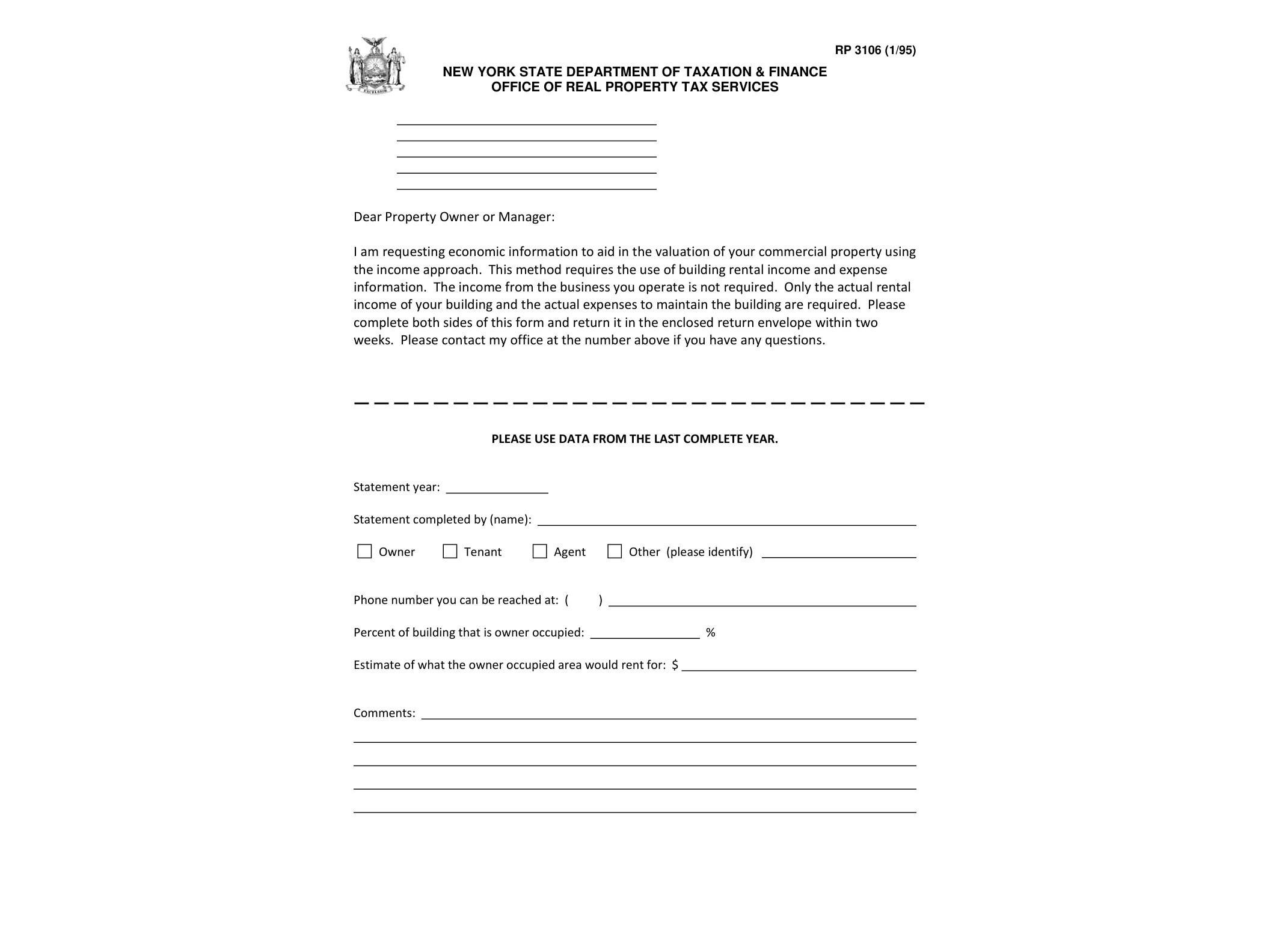
Form RP-3106, officially titled “Economic Information to Aid in Valuation of Commercial Property,” is a data-collection form issued by the New York State Department of Taxation and Finance. Local assessors use it to gather income, expense, and operational details about commercial properties so they can estimate market value more accurately for property tax purposes. Unlike an application for exemption or relief, this form doesn’t grant any benefit — it’s a fact-finding tool that feeds directly into the assessment process.
Commercial property value is often calculated using the income approach, which looks at what a property actually earns rather than relying solely on comparable sales or replacement cost. Assessors need real numbers to run that calculation, and RP-3106 is the mechanism many jurisdictions use to request them directly from the property owner or operator.
Who Needs to File This Form
Owners of commercial real estate in New York State — including office buildings, retail centers, warehouses, and other income-producing properties — may receive this form from their local assessor’s office. It’s typically sent as part of a periodic revaluation cycle or when the assessor is updating records for a specific parcel. If you own or manage commercial property and get a request tied to Form RP-3106, it usually means the assessing unit is actively reviewing your property’s assessed value.
This is different from exemption paperwork like the Form RP-412a filing required for industrial development agency properties, which deals with tax-exempt status rather than valuation inputs. RP-3106 applies whether or not a property carries any exemption, since assessors need income data on taxable commercial parcels too.
When and Why Assessors Request This Information
Assessors send out RP-3106 requests when they need current operating data to support an assessment roll. Common triggers include:
- A townwide or citywide reassessment project
- A pending assessment challenge or grievance where income data supports the valuation
- Routine updates to keep commercial property records current
- A change in ownership or use that prompts a fresh look at value
New York law gives assessors the authority to request this kind of income and expense information from property owners, and there are consequences for not responding — including limits on the owner’s ability to contest the resulting assessment later through a grievance or small claims assessment review. That makes timely, accurate completion worth the effort even though the form itself isn’t glamorous paperwork.
What Information Goes on the Form
RP-3106 asks for details such as gross rental income, vacancy rates, operating expenses, lease terms, and other financial data tied to the property’s performance over a recent period, usually the prior calendar or fiscal year. Because this is an AcroForm PDF, it can be filled out digitally using standard PDF software — you don’t need to print it out and write by hand unless you prefer to. The fillable fields make it easier to keep records consistent from year to year if the same property gets a repeat request.
Property owners who also deal with related valuation and assessment paperwork, such as the homestead base proportions statement covered in Form RP-3109, will notice these forms serve different purposes but often surface during the same municipal assessment cycles, particularly in jurisdictions using split tax rates for homestead and non-homestead classes.
How to Get and Submit the Form
The current version of Form RP-3106 is available directly from the New York State Department of Taxation and Finance as a fillable PDF. Property owners typically receive the form from their local assessor with instructions on where and how to return it, along with a deadline. If you’re filling it out digitally, save a copy for your own records before submitting, since assessors may follow up with questions about specific line items.
If your property also has a nonprofit or exemption component that needs periodic renewal, it’s worth checking whether you have a separate obligation similar to the renewal application process for nonprofit property tax exemptions, since valuation forms and exemption renewals sometimes land on an owner’s desk around the same time of year.
Download Official Form RP3106 (PDF)
Opens the official government PDF in a new tab