
Download Official Form RP3109 (PDF)
Opens the official government PDF in a new tab
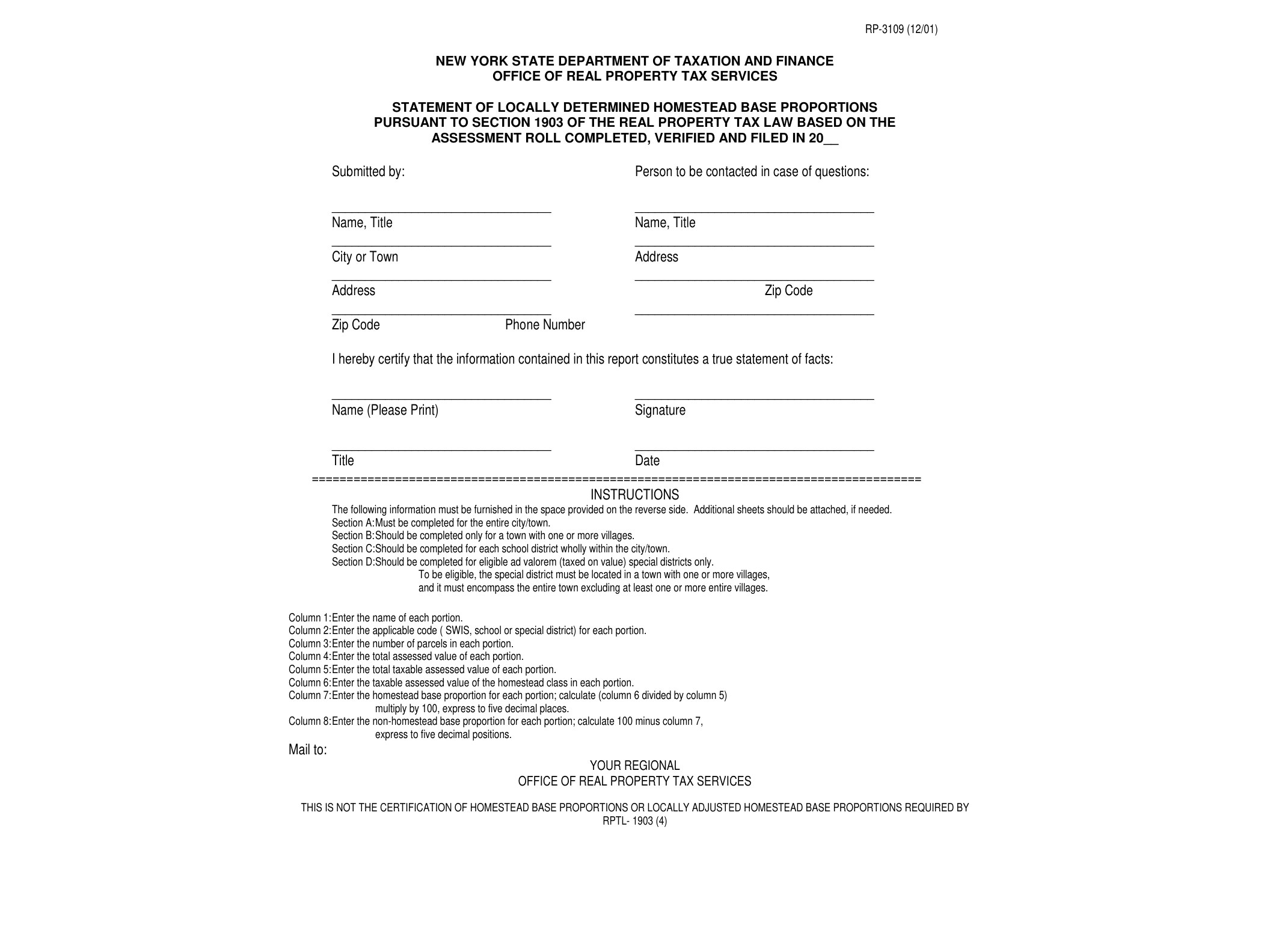
Form RP-3109, issued by the New York State Department of Taxation and Finance, is a specialized property tax form used by local assessing units that have adopted the homestead option under Section 1903 of the Real Property Tax Law. Its full title, “Statement of Locally Determined Homestead Base Proportions Pursuant to Section 1903,” describes exactly what it does: it records the base proportions that separate homestead property (mostly residential) from non-homestead property (commercial, industrial, and other classes) once an assessment roll has been completed, verified, and filed.
If you’re not involved in municipal assessment work, this form probably isn’t something you’ll ever need to file yourself. It’s not a form for individual homeowners or businesses to submit with a tax return. Instead, it’s an administrative tool used by assessors, boards of assessment review, and local taxing jurisdictions to formally establish and document how tax burdens are split between homestead and non-homestead classes within a given assessing unit.
What the Homestead Option Under Section 1903 Actually Does
New York State allows certain cities, towns, and villages outside New York City to adopt what’s called the “homestead option.” Under this system, the assessing unit separates properties into two classes for tax purposes: homestead (primarily one-, two-, and three-family residential properties) and non-homestead (everything else, including commercial and larger apartment properties). Once a jurisdiction adopts this option, it must calculate and preserve base proportions that determine how the total tax levy is divided between these two classes from year to year.
Form RP-3109 is the mechanism for formally recording those base proportions after each new assessment roll is completed. Because assessed values shift annually due to reassessments, new construction, exemptions, and other factors, the base proportions need to be recalculated and documented to keep the homestead/non-homestead split consistent with what the local government originally intended when it adopted the option.
Who Needs to File This Form
The responsibility for filing RP-3109 falls on assessors or other assessing unit officials in municipalities that have adopted the homestead tax option. This typically includes city and town assessors working alongside county real property tax service agencies. If your local government has chosen this classification system, your assessor’s office is required to complete and submit this statement each time a new final assessment roll is verified and filed, ensuring the state and county have an accurate, up-to-date record of the base proportions used for tax apportionment.
Property owners generally won’t interact with this form directly, but the information it contains directly affects how much of the total tax levy falls on residential properties versus commercial and other non-homestead properties in a given jurisdiction. Homeowners curious about why their tax bills are calculated a certain way may find that RP-3109 filings are part of the answer, even though they never see the form itself.
How to Get and Complete the Form
Form RP-3109 is available directly from the New York State Department of Taxation and Finance as a fillable PDF, which means assessing unit staff can type information directly into the form fields before printing or submitting it. The form asks for details about the assessing unit, the assessment roll year, and the calculated base proportions for homestead and non-homestead classes, along with any required certifications from the assessor.
Because this form ties directly into the broader property tax classification and exemption framework in New York, assessors working with RP-3109 often deal with related property tax forms as well. For instance, jurisdictions handling nonprofit exemptions may also be familiar with the application for real property tax exemption for nonprofit organizations or its renewal counterpart, the renewal application for nonprofit property tax exemption. Assessing units that participate in shared services arrangements might also cross paths with Form RP-3616 for optional county services state aid, since both forms involve coordination between local assessors and state or county tax agencies.
Because RP-3109 has direct consequences for how tax levies get distributed across an entire community, accuracy matters. Assessors filing this statement should double-check their base proportion calculations against the current assessment roll before submission, since errors can affect tax apportionment for every property owner in the jurisdiction until corrected in a subsequent filing.
Download Official Form RP3109 (PDF)
Opens the official government PDF in a new tab