
Download Official Form RP412A (PDF)
Opens the official government PDF in a new tab
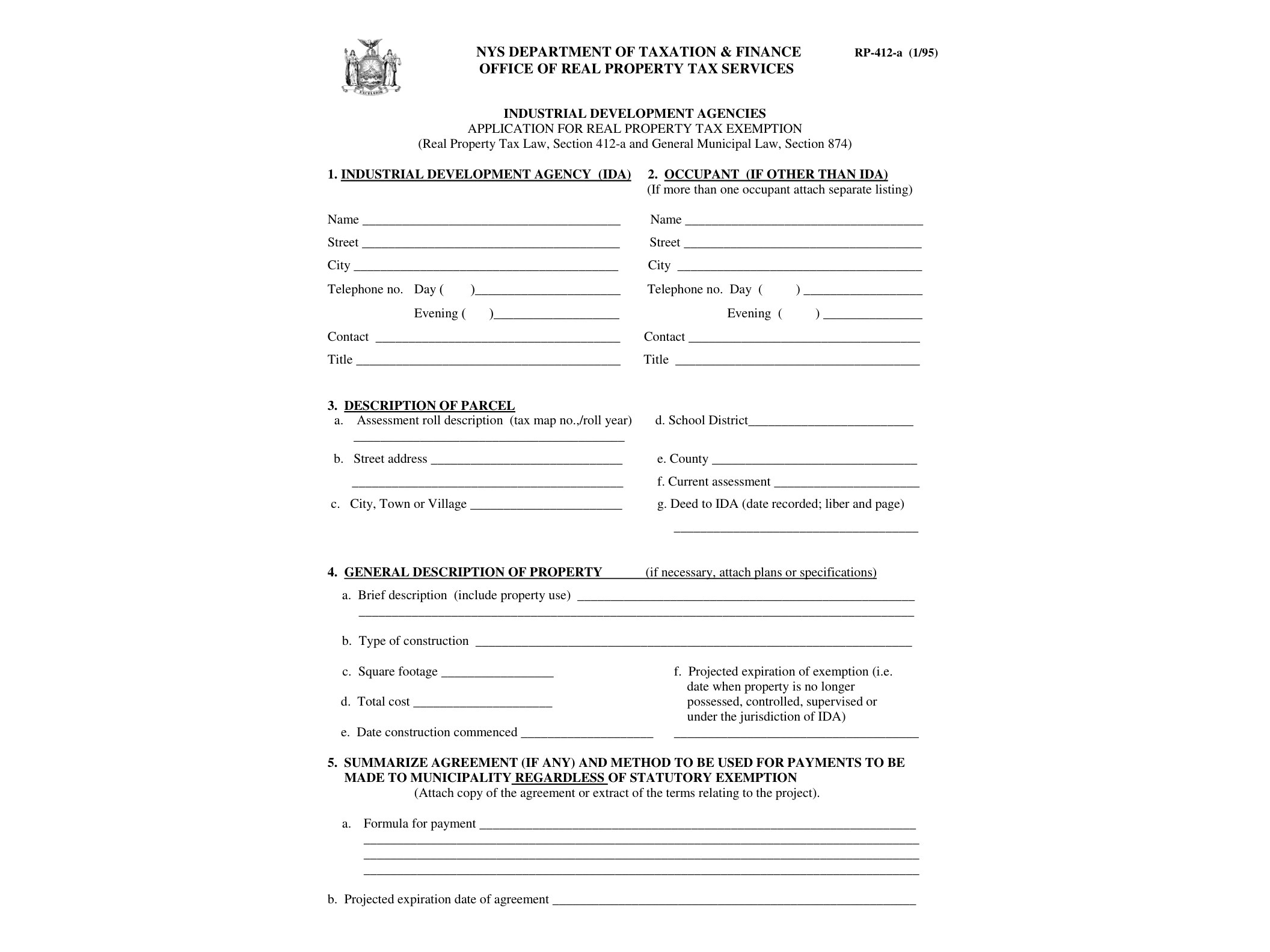
Form RP-412a, officially titled Application for Real Property Tax Exemption for Property of an Industrial Development Agency, is issued by the New York State Department of Taxation and Finance for use by local Industrial Development Agencies (IDAs). It allows an IDA to claim exemption from real property taxes on land and buildings it owns under Section 412-a of the Real Property Tax Law (RPTL).
Industrial Development Agencies exist to promote economic growth by acquiring property, financing projects, and leasing facilities to private companies under agreements that often include payment-in-lieu-of-taxes (PILOT) arrangements. Because the underlying real property is technically owned by a public benefit corporation rather than the private business using it, the law allows that property to be exempt from standard real property taxation. Form RP-412a is the mechanism through which an IDA formally requests that exemption from the local assessor.
Who Needs to File This Form
This form is specifically for Industrial Development Agencies, not for private businesses or individual property owners. If your organization is an IDA that has acquired title to a property as part of a development project — whether through a sale-leaseback, lease-purchase arrangement, or straightforward acquisition — you’re the one responsible for filing RP-412a with the assessor in the municipality where the property is located.
Companies that lease facilities from an IDA don’t file this form themselves. Instead, the IDA handles the exemption application on the property’s behalf, and the terms of any payment obligations to the local taxing jurisdictions are typically spelled out separately in a PILOT agreement between the IDA and the company.
When to Submit RP-412a
Timing matters with this form. Like most real property tax exemption applications in New York, RP-412a needs to be filed with the local assessor by the taxable status date, which varies somewhat by municipality but generally falls on March 1 in most of the state (with some exceptions in New York City and certain counties). Filing after that deadline can push the exemption to the following assessment year, so IDAs acquiring new property should coordinate the acquisition timeline with the local filing deadline whenever possible.
The form is generally filed once when the property is newly acquired by the IDA, and exemption status is typically continued in subsequent years as long as the property remains under IDA ownership and used for its intended project purpose. Assessors may periodically request updated documentation to confirm continued eligibility.
How to Complete and Submit the Form
Form RP-412a is available as a fillable PDF directly from the New York State Department of Taxation and Finance website, and it can be completed on-screen before printing for signature and submission. The form asks for standard identifying details: the IDA’s name and address, a description of the property (including tax map identification and location), the nature of the project, and certification that the property is owned by the agency and used in connection with an approved project.
Once completed, the form is submitted to the assessor’s office in the city, town, or village where the property sits — not to the state tax department directly. It’s a good idea to keep a copy of the filed form along with any supporting project documentation, since assessors or auditors may request it later to verify the exemption remains valid.
IDAs juggling multiple exemption and reporting obligations often find themselves filing several related property tax forms throughout the year. For agencies also dealing with nonprofit-owned property, the renewal application for nonprofit property tax exemption covers a similar but distinct exemption category. Municipalities managing state aid alongside these exemptions may also want to review the optional county services application for state aid, and assessors working through homestead-related calculations can reference the statement of locally determined homestead base proportions for related assessment procedures.
Because exemption rules and local filing deadlines can shift slightly from one assessing unit to another, IDAs should confirm specific requirements with the assessor’s office handling the property in question before submitting the form.
Download Official Form RP412A (PDF)
Opens the official government PDF in a new tab