
Download Official Form RP466G (PDF)
Opens the official government PDF in a new tab
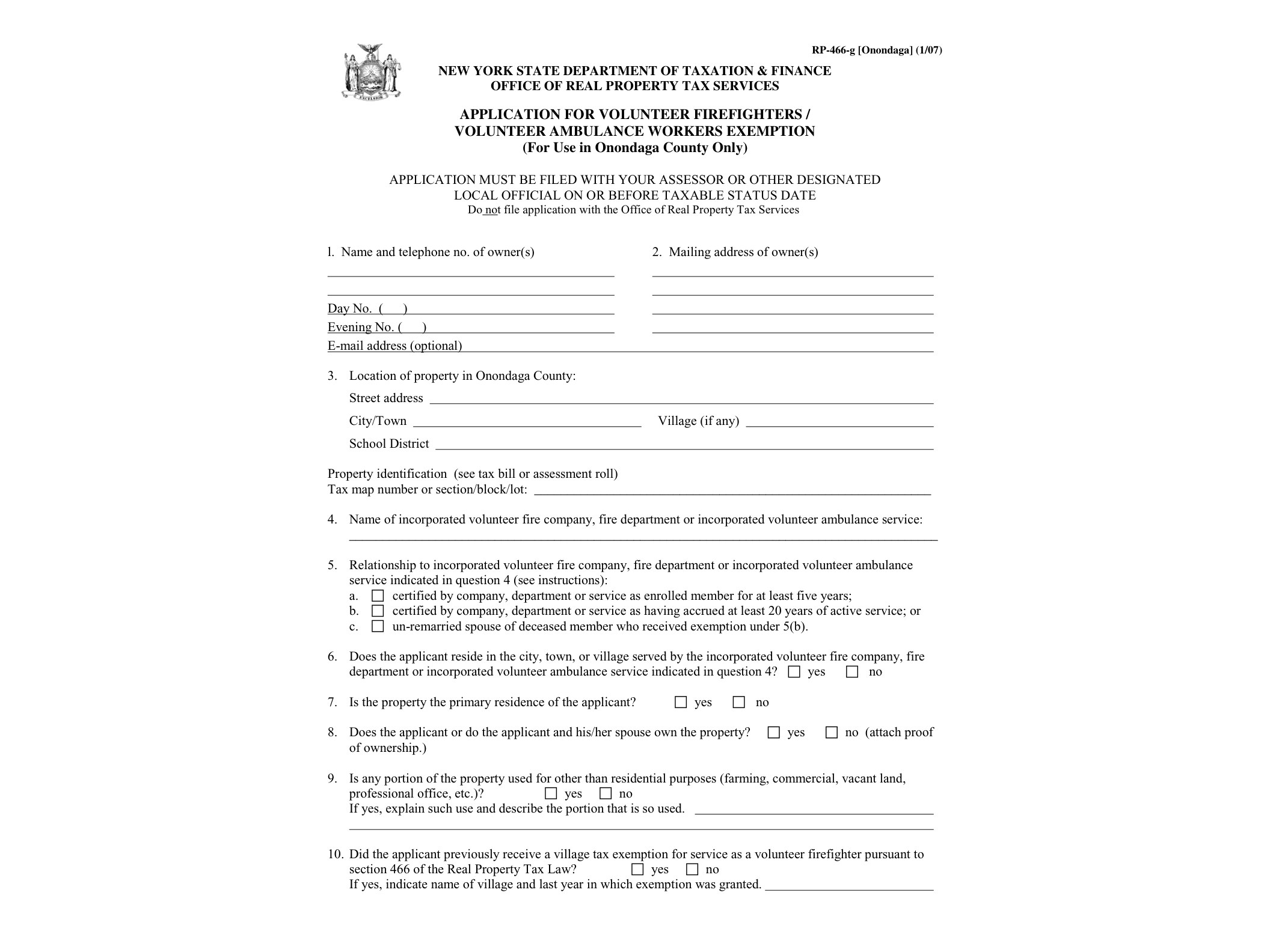
Form RP-466-G is the official application New York State residents in Onondaga County use to request a partial property tax exemption for enrolled members of volunteer fire departments and volunteer ambulance services. It’s issued by the New York State Department of Taxation and Finance, but the exemption itself is granted at the local level, based on rules that Onondaga County towns and villages have adopted under Real Property Tax Law.
This form is specific to Onondaga County. Other counties in New York have their own versions of this exemption application, tailored to local option provisions passed by their governing bodies. If you live in a different county, this exact form won’t apply to you — you’d need the version issued for your county instead, such as Form RP-466-D for Columbia County or Form RP-466-H for Ulster County.
Who Needs This Form
You should file RP-466-G if you’re an enrolled member of an incorporated volunteer fire company, fire department, or volunteer ambulance service located in Onondaga County, and you own residential property within a municipality that has opted into this exemption. Not every town or village automatically offers it — the local legislative body has to pass a resolution adopting the exemption before residents can apply. It’s worth checking with your town or village assessor to confirm your municipality participates before you submit paperwork.
The exemption is meant to recognize the service of volunteers who might otherwise be difficult to recruit and retain, especially in smaller communities that rely heavily on unpaid emergency responders. In many cases, the exemption applies a percentage reduction to the assessed value of the applicant’s primary residence, though the exact amount depends on local law.
Eligibility Requirements
Generally, applicants need to show they’ve been active volunteer firefighters or ambulance workers for a minimum number of years — often five years of service is the baseline, though some municipalities allow the exemption after fewer years or extend it to volunteers who’ve served a set number of years and reached a certain age, plus surviving spouses in some cases. The property must be the applicant’s primary residence, and it can’t be used for anything other than residential purposes to qualify fully.
Because these details vary by locality even within the same county, it’s smart to read the specific eligibility section on the form itself and confirm requirements with your local assessor’s office before applying.
When to File
Like most property tax exemption applications in New York, RP-466-G needs to be submitted to your local assessor by the taxable status date, which in most municipalities falls on March 1st, though some areas use different dates. Missing this deadline usually means waiting until the following year’s assessment cycle, so it’s not something to leave until the last minute if you’re newly eligible or renewing documentation.
How to Fill Out and Submit the Form
RP-466-G is a fillable PDF, so you can complete it digitally on your computer before printing it for signature and submission. The form asks for basic identifying information about the property owner, details about the property itself (including the tax map number if you have it), and certification of volunteer service status, which typically needs to be verified by an authorized officer of the fire company or ambulance service.
Once completed and signed, the form goes to your local assessor’s office — not to the state Department of Taxation and Finance — since assessment and exemption processing happens at the municipal level. Keep a copy for your records, and if your volunteer status or property ownership changes in future years, check whether you need to refile or simply notify the assessor.
If you’re helping a family member or reviewing similar programs elsewhere in New York, it can help to compare how neighboring counties structure their applications, like Form RP-466-E used in Lewis County, since the underlying eligibility concepts are similar even when local percentages and service requirements differ.
Download Official Form RP466G (PDF)
Opens the official government PDF in a new tab