
Download Official Form RP467D (PDF)
Opens the official government PDF in a new tab
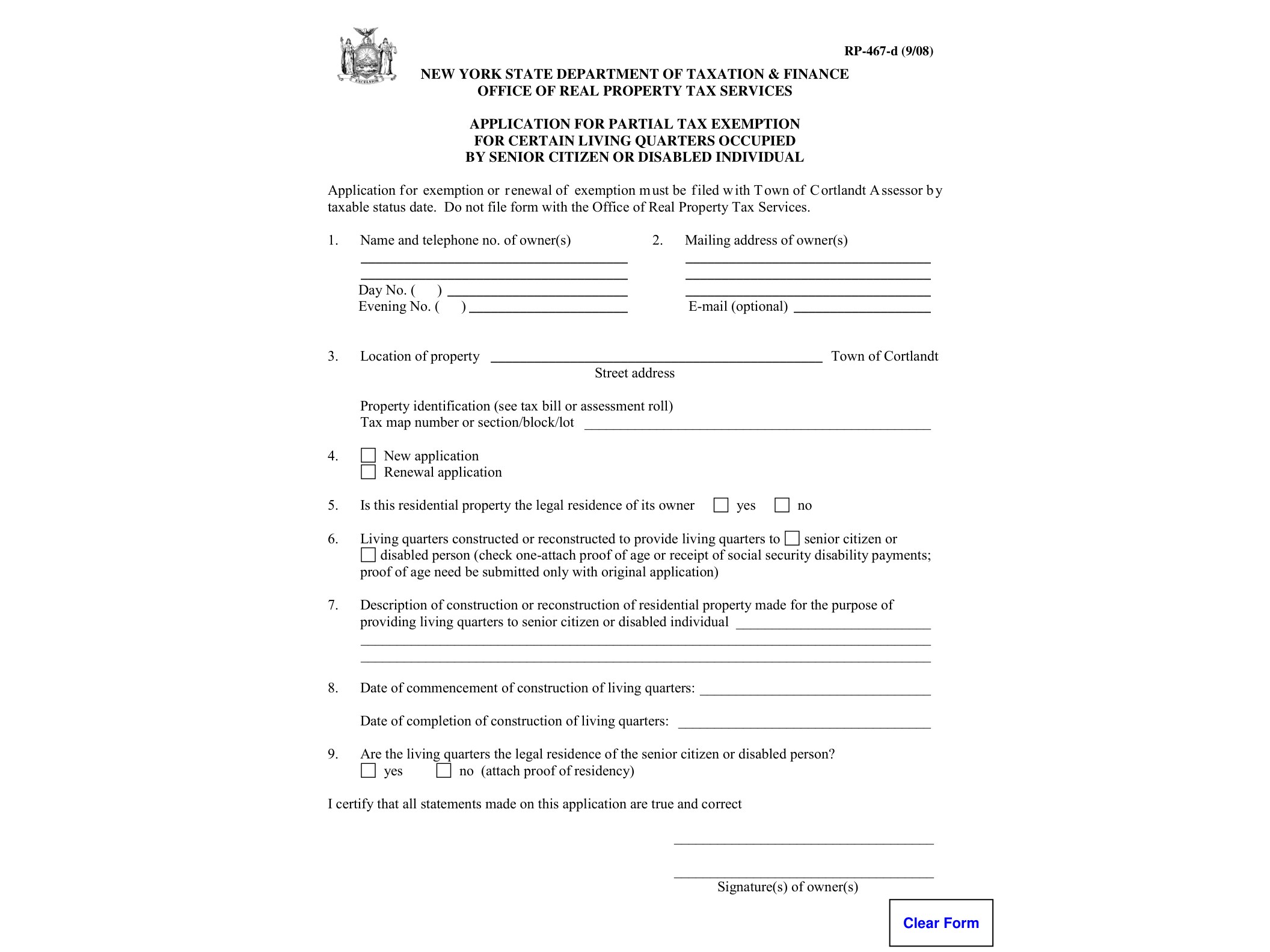
Form RP-467-D is issued by the New York State Department of Taxation and Finance, and it applies to a fairly specific but useful situation: a homeowner who has added or converted living quarters on their property specifically to house a senior citizen or a disabled family member. This form is used to apply for a partial property tax exemption tied to the value that construction added to the property.
The logic behind this exemption is straightforward. When a family builds an in-law apartment, converts a garage, or adds a separate living space so an older relative or a disabled person can live on the same property, that construction typically increases the assessed value of the home. Without some relief, the family ends up paying higher property taxes simply for accommodating a relative who needs housing and support nearby. RP-467-D lets local assessors exclude a portion of that added value from the taxable assessment, easing the burden created by the improvement itself.
Who Should File Form RP-467-D
This form is meant for property owners who meet a few conditions at once. First, the property must include separate living quarters constructed or reconstructed for the purpose of housing a parent or grandparent who is 62 years of age or older, or a family member with a disability, regardless of age. Second, the exemption only covers the increase in assessed value resulting from that specific construction — not the entire property value. If the added quarters didn’t raise the assessment, there’s nothing to exempt under this particular form.
It’s also worth noting that this exemption applies at the discretion of the local municipality, since counties, cities, towns, villages, and school districts each decide individually whether to offer it. Before filling anything out, homeowners should confirm with their local assessor’s office that the exemption is actually available in their jurisdiction.
When to Use This Form
Homeowners typically file RP-467-D after completing construction or renovation work that created the accessory living space. The application needs to be submitted to the local assessor, and there are usually specific filing deadlines tied to the local assessment calendar — often in early spring, but this varies by municipality. Missing the window generally means waiting until the next assessment cycle, so it helps to check local deadlines as soon as construction wraps up.
The exemption isn’t automatically renewed indefinitely without any oversight. Assessors may ask for periodic confirmation that the qualifying senior or disabled relative still occupies the space, since the exemption is tied directly to that continued use.
How to Fill Out and Submit RP-467-D
The form itself is an AcroForm PDF, meaning it can be filled out digitally on a computer before printing, which makes the process considerably less tedious than filling it out by hand. It asks for standard identifying details: the property owner’s information, a description of the constructed or reconstructed living quarters, the relationship of the occupant to the owner, and supporting details about the added assessed value.
Applicants should be ready to include documentation that supports the claim, such as records related to the construction cost or the assessor’s determination of value increase. Because eligibility hinges on the added value from the physical construction, having clear records on hand speeds up the review process considerably.
This form belongs to a broader family of New York property tax exemption applications administered at the local level, similar in structure to exemptions like the one covered in our overview of Form RP-466-G for Onondaga County volunteer firefighters, or the versions used in Columbia County under Form RP-466-D and Ulster County’s Form RP-466-H. Like those forms, RP-467-D is filed directly with the local assessor rather than with the state tax department, so processing times and specific requirements can differ from one town to the next.
Once submitted, the assessor reviews the application and determines whether the exemption applies and for how much value. If approved, the exemption reduces the taxable assessment tied to the added living space for as long as the qualifying occupant continues to live there and the homeowner continues to meet the program’s conditions.
Download Official Form RP467D (PDF)
Opens the official government PDF in a new tab