
Download Official Form RP471 (PDF)
Opens the official government PDF in a new tab
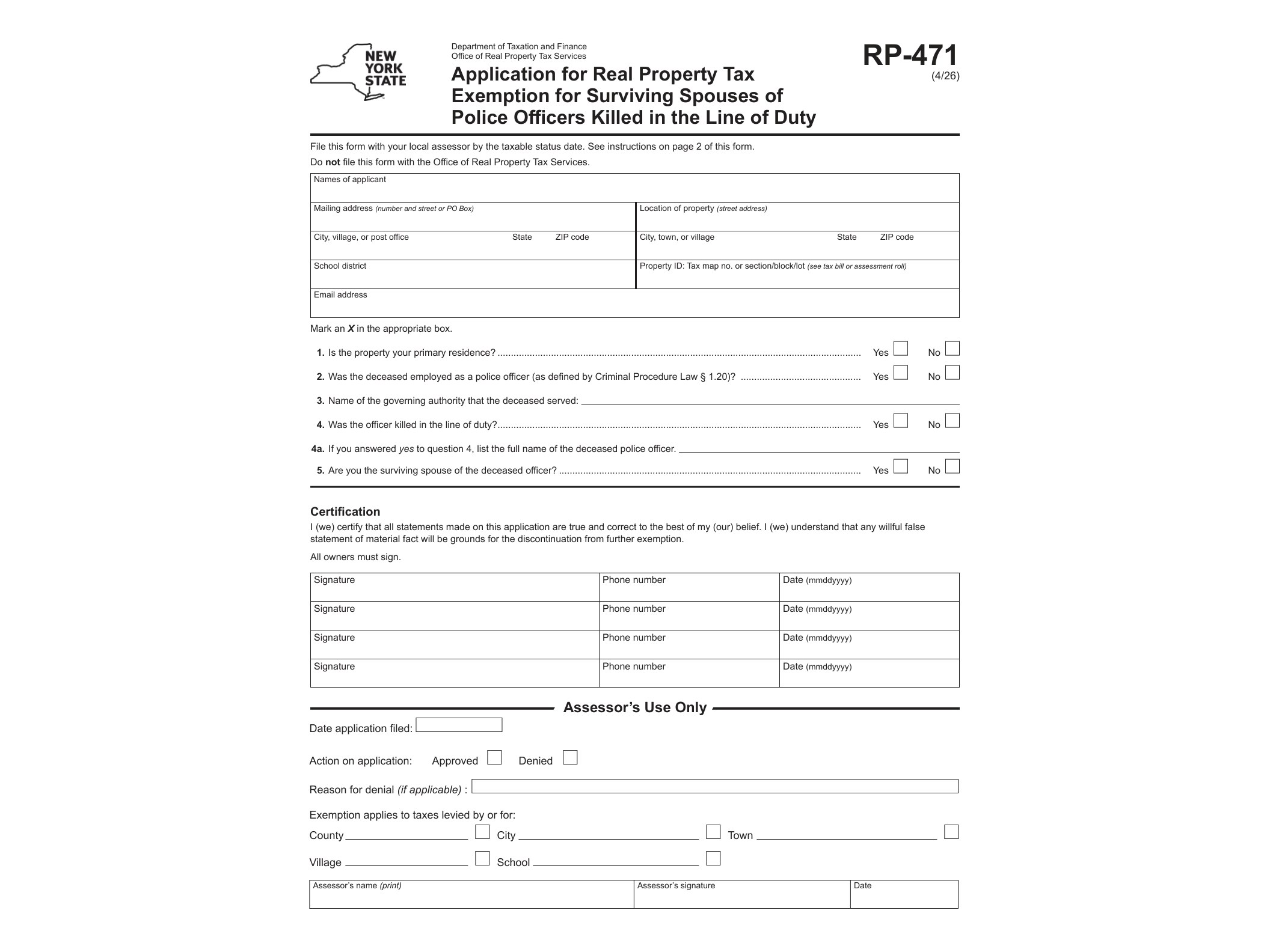
Form RP-471 is a New York State property tax exemption application specifically designed for the surviving spouse of a police officer who died in the line of duty. The New York State Department of Taxation and Finance, through its Office of Real Property Tax Services, issues this form to allow eligible spouses to reduce or eliminate the property tax burden on their primary residence following an unimaginable loss.
Unlike general homestead or senior exemptions, this benefit exists solely to honor the sacrifice made by law enforcement officers and to ease the financial pressure on the families they leave behind. It’s a relatively narrow exemption compared to broader programs, but for the families who qualify, it can mean substantial savings on annual property tax bills.
Who Needs This Form
You should file Form RP-471 if you are the surviving spouse of a police officer who was killed while performing official duties in New York State, and you own real property that serves as your primary residence. The exemption typically applies to the assessed value of the home, though the exact percentage or dollar amount of relief can vary depending on the local municipality’s adopted rules, since counties, cities, towns, and school districts each have some discretion in how they implement this exemption under Real Property Tax Law.
It’s worth noting that this exemption is separate from other property tax relief programs available in New York, such as exemptions for veterans, senior citizens, or disaster-affected property owners. If you’re also researching other exemption categories, you might find it helpful to compare programs like the Income Worksheet for the Senior Citizens Exemption, which serves a completely different population but follows a similar local assessment process.
When to File
Form RP-471 must be submitted to your local assessor’s office, not to the state tax department directly. Each municipality sets its own filing deadline for exemption applications, and these deadlines are usually tied to the local taxable status date, which in most of New York falls on March 1st, though some counties and cities have different dates. Because deadlines vary so much by jurisdiction, it’s essential to check with your town or city assessor before assuming you have until a specific date.
If your spouse’s death in the line of duty happened partway through the year, you’ll want to file as soon as you’re able, since exemptions generally apply going forward from the assessment roll date rather than retroactively. Missing the local deadline could mean waiting an entire additional tax cycle before the exemption takes effect, so timing matters here more than with many other tax forms.
How to Complete and Submit the Form
The current version of RP-471, revised in April 2026, is available as a fillable PDF, meaning you can type your information directly into the form on a computer before printing it for signature and submission. The form asks for standard identifying details: your name, the property’s address and tax map parcel number, information confirming your relationship to the deceased officer, and documentation supporting the circumstances of the line-of-duty death.
You’ll typically need to attach supporting evidence, such as an official death certificate and documentation from the employing police department or agency confirming that the death occurred in the line of duty. Local assessors may request additional proof depending on their specific verification procedures, so it doesn’t hurt to call ahead and ask exactly what they’ll need before you submit your paperwork.
Once completed, the form and any attachments go to the assessor’s office for the city, town, or county where the property is located. Assessors review these applications alongside other exemption requests, similar to how they process forms tied to assessment relief after disasters. If your application is ever rejected, you should receive formal notice explaining the reason, much like the notification process used for denied senior citizen exemptions.
If you’re unsure whether your municipality has adopted this exemption at all, since local governments must opt in under state law, contact your assessor’s office directly before filing. Some jurisdictions may not have implemented the exemption, or may have adopted a different percentage reduction than neighboring towns, so a quick phone call can save you from submitting paperwork that won’t apply in your area.
Download Official Form RP471 (PDF)
Opens the official government PDF in a new tab