
Download Official Form RP5217CF (PDF)
Opens the official government PDF in a new tab
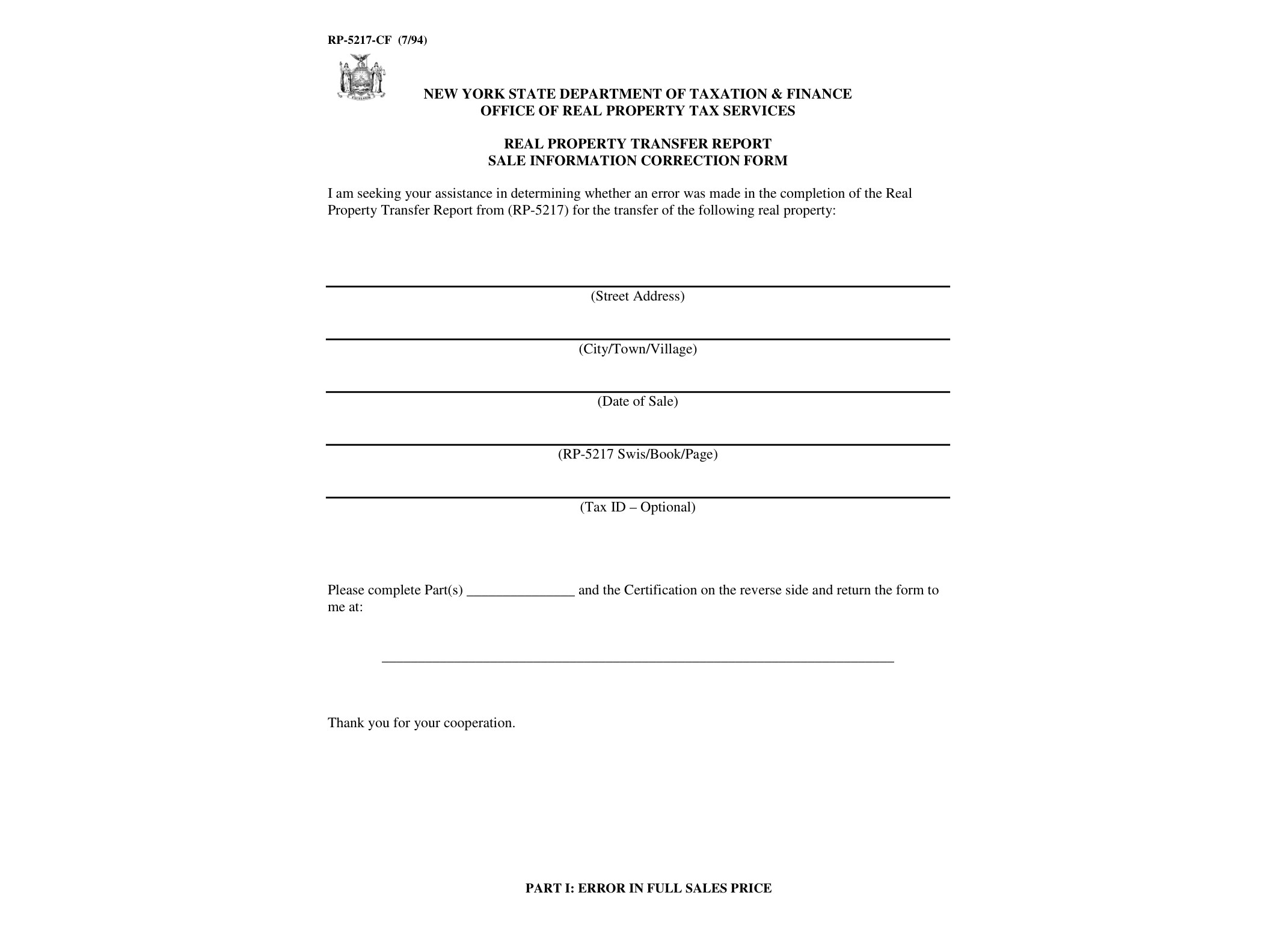
Form RP-5217-CF is issued by the New York State Department of Taxation and Finance to fix errors on a previously filed Real Property Transfer Report (Form RP-5217). Whenever a deed is recorded in New York, the original RP-5217 captures details about the sale — price, financing terms, property type, and buyer/seller information — that county assessors and the state use to track market activity and update assessment rolls. If any of that information turns out to be wrong or incomplete after the deed has already been recorded, this correction form is the mechanism for setting the record straight.
The form is short but specific. It asks for the same identifying data as the original transfer report — the county, the SWIS code, the tax map/parcel number, and the liber/page or document number of the recorded deed — so the county clerk’s office and the Office of Real Property Tax Services (ORPTS) can match the correction to the correct filing. From there, it lets the filer indicate which fields were reported incorrectly and provide the corrected sale price, sale date, financing details, or other transaction data.
Who Needs to File This Form
This correction form is typically used by attorneys, title companies, real estate agents, or the property owners themselves when they discover a mistake on the RP-5217 submitted at closing. Common reasons for filing include a transposed sale price, an incorrect date of sale, a mismatched deed type, or an error in how the transaction was classified (arm’s-length vs. non-arm’s-length, for example). County assessors also sometimes request a correction if the sale data they receive doesn’t reconcile with the deed itself.
Because the original RP-5217 feeds directly into the state’s sales data used for equalization rates and assessment equity studies, inaccurate information can distort local assessment figures. That’s part of why the correction process exists as its own standalone form rather than requiring a full refiling of the original report.
When It’s Used
Form RP-5217-CF is filed after the fact — meaning the deed has already been recorded and the original RP-5217 has already been submitted. It isn’t used to replace the initial transfer report at closing; it’s strictly a follow-up correction. There’s no strict statutory deadline printed on the form itself, but corrections are best submitted as soon as the error is identified, since delayed corrections can affect assessment rolls or equalization calculations tied to that filing period.
It’s worth noting that this form only addresses sale information errors. If the issue involves something like an incorrect transmittal to ORPTS during the original filing process, you may instead need to look at related paperwork such as the RP-5217-APP-1 application/agreement for RPS035 transmittal, which governs how transfer data gets submitted electronically to the state in the first place.
How to Get and Complete the Form
The form is a fillable PDF (AcroForm), so it can be typed directly into using Adobe Acrobat Reader or similar software before printing for submission — no need to fill it out by hand. Once completed, it’s generally filed with the same county recording office or assessor that received the original RP-5217, since local officials are the ones who maintain the underlying sales data.
If you’re also dealing with assessment notices tied to a recent transfer, it may help to review how counties handle related notifications, such as the RP-551-NTC pro-rated tax and omission notice, since a corrected sale report can sometimes trigger a follow-up notice from the assessor’s office. And if you work regularly with property transfer filings on behalf of a municipality or assessing unit, it’s also worth knowing about the RP-5100 request for secure access, which governs how assessment community members get authorized to submit and manage this kind of data electronically.
Keep a copy of both the original RP-5217 and the completed RP-5217-CF for your records, since discrepancies between deed data and reported sale information can resurface later during assessment reviews or audits.
Download Official Form RP5217CF (PDF)
Opens the official government PDF in a new tab