
Download Official Form RP953 (PDF)
Opens the official government PDF in a new tab
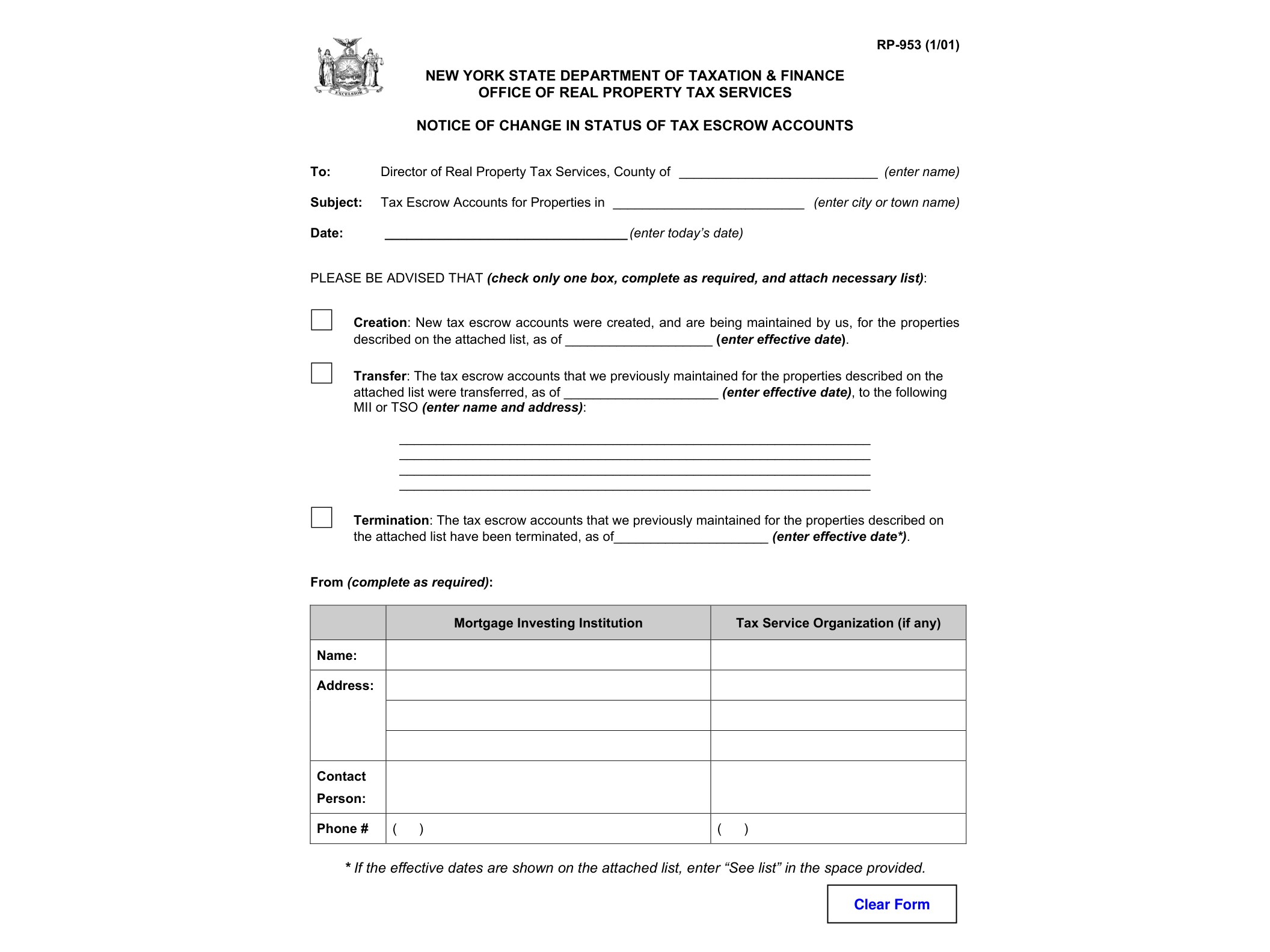
Form RP-953, officially titled Notice of Change in Status of Tax Escrow Accounts, is a New York State Department of Taxation and Finance form used to inform local assessors and tax collecting officers when a property’s tax escrow arrangement changes. It’s a niche but important form for anyone involved in mortgage servicing or property tax administration in New York.
When a homeowner takes out a mortgage, the lender often sets up an escrow account to collect and pay property taxes on the owner’s behalf. Tax bills, in that case, get sent directly to the lender or its servicing agent rather than to the property owner. Form RP-953 exists to keep local tax offices updated whenever that arrangement starts, stops, or transfers to a new servicer. Without this notice, tax bills can end up going to the wrong party, which creates confusion and sometimes leads to missed payments or duplicate billing.
Who Needs to File Form RP-953
This form is generally used by mortgage lenders, loan servicers, and banks that manage escrow accounts for property owners. It’s also relevant to local assessors and tax collectors who rely on accurate escrow status records to route tax bills correctly. If a mortgage is paid off, refinanced, or transferred to a different servicer, the party responsible for the escrow account should submit this notice so the municipality’s records reflect the current situation.
Property owners themselves rarely fill out this form directly, since it’s primarily a communication tool between financial institutions and local tax offices. However, homeowners who notice their tax bills are going to the wrong place after paying off a mortgage may want to confirm with their lender that this notice was filed.
When This Form Is Used
Form RP-953 comes into play in a few common scenarios:
- A mortgage is paid in full and the escrow account is closed, meaning future tax bills should go directly to the property owner.
- A mortgage is refinanced or sold to a new lender, requiring a change in who receives the tax bill.
- A loan servicing company changes, even though the underlying mortgage stays with the same lender.
- An escrow account is newly established, and the lender needs to start receiving tax bills for a property that previously had them sent to the owner.
In each of these cases, timely filing helps avoid a lapse where nobody receives the bill, or worse, where two parties both believe the other is paying.
How to Get and Complete the Form
The form is available as a fillable PDF directly from the New York State Department of Taxation and Finance website. Because it supports digital entry, you can type information directly into the fields before printing it for submission or signature, which speeds up processing for institutions handling multiple properties at once.
Completing RP-953 typically requires the property’s tax map identification number, the owner’s name, the mailing address for tax bills, and details identifying the escrow account status change, including the new servicer’s name and contact information if applicable. The form is submitted to the assessor or tax collecting officer of the municipality where the property is located, not to the state tax department itself, since assessment and billing records are maintained locally.
For related third-party billing situations, some lenders and property managers also need to request duplicate tax bills be sent to an outside party, which is handled separately through Form RP-953-ATT. That form works alongside RP-953 when multiple parties need copies of the same tax bill.
Anyone managing property tax compliance across a portfolio of properties in New York, including utility or franchise assessments, may also find it useful to review related filings like Form RP-575 for electric generating facilities or Form RP-7141 for special franchise valuation disputes, since these forms often intersect with the same local assessment offices that process RP-953 notices.
Because assessment practices can vary slightly by county and municipality, it’s worth checking with the local assessor’s office if there’s any uncertainty about submission deadlines or required attachments before sending in the completed form.
Download Official Form RP953 (PDF)
Opens the official government PDF in a new tab