
Download Official Form RP923 (PDF)
Opens the official government PDF in a new tab
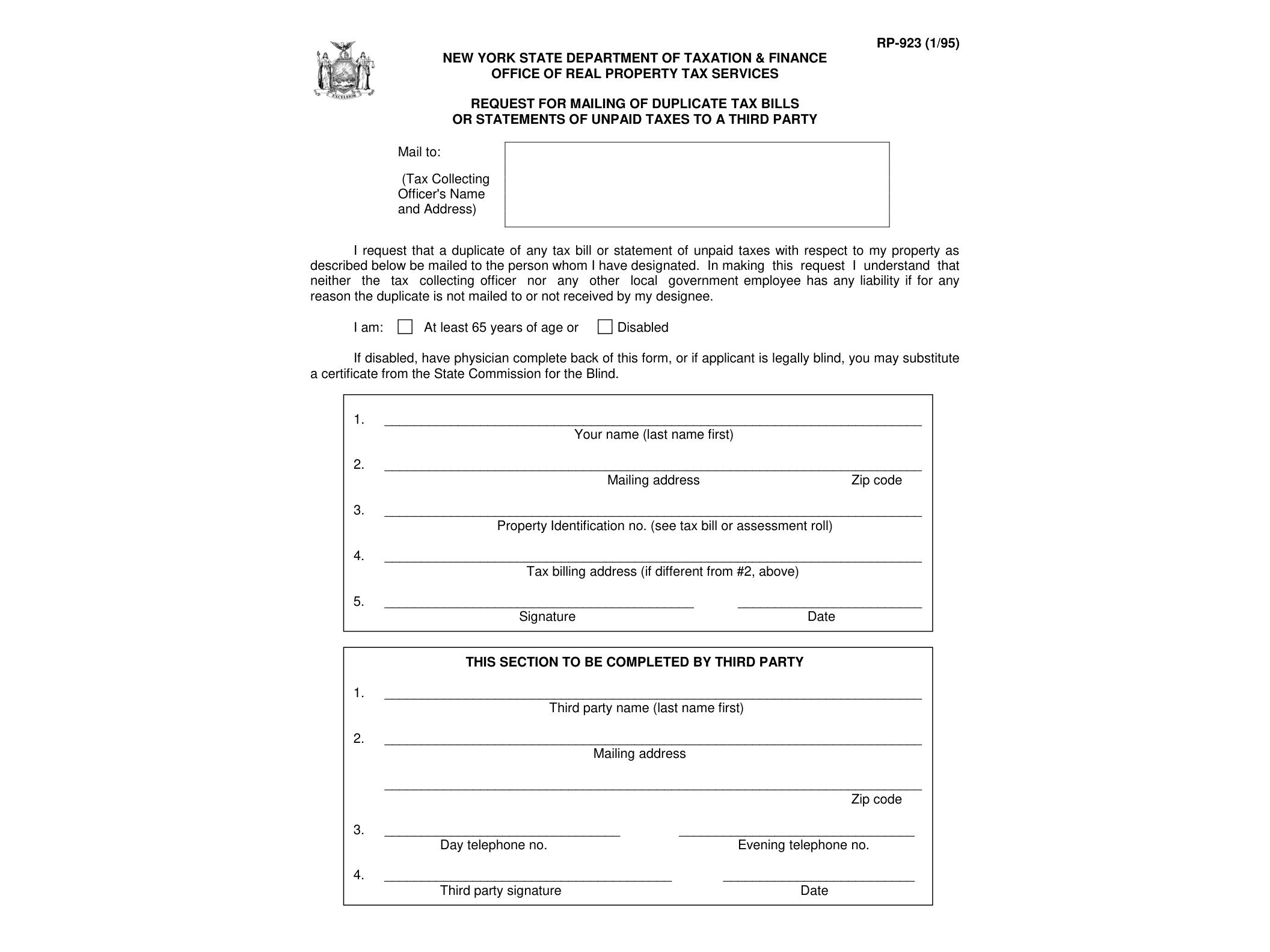
Form RP-923, officially titled “Request for Mailing of Duplicate Tax Bills or Statements of Unpaid Taxes to a Third Party,” is a form issued by the New York State Department of Taxation and Finance through the Office of Real Property Tax Services (ORPTS). It’s used by property owners who want a copy of their tax bill, or a statement showing unpaid taxes, sent directly to someone other than themselves — typically a mortgage lender, bank, accountant, attorney, or property management company.
This isn’t a form for filing an appeal or disputing an assessment. It’s purely administrative: it authorizes the local tax collector or assessor’s office to mail duplicate billing information to a designated third party so that person or institution stays informed about the property’s tax status without needing to contact the owner every time a bill goes out.
Who Needs This Form
Form RP-923 is most commonly used by:
- Property owners whose mortgage is held by a bank or lender that wants direct notice of tax bills, even if taxes are paid through an escrow account.
- Landlords or property managers who oversee tax payments for owners who live out of state or aren’t easily reachable.
- Accountants or attorneys handling a client’s real estate tax matters and who need duplicate statements for record-keeping or compliance.
- Title companies or closing agents who need documentation of unpaid taxes during a property transaction.
If you’ve recently refinanced, changed lenders, or brought on a new property manager, this is the form that keeps the new third party in the loop on tax billing without requiring you to forward paperwork manually every cycle.
When to Use It
You’d file this form any time there’s a change in who should receive tax billing information on your behalf. Common triggers include:
- Setting up a new mortgage escrow arrangement and wanting the lender to receive bills directly.
- Switching banks or refinancing, which often requires updating who’s on file for duplicate billing.
- Hiring a new accountant or property manager who needs ongoing visibility into your tax obligations.
- Correcting or updating an outdated third-party mailing arrangement that’s no longer accurate.
Keep in mind this form doesn’t replace the original bill sent to the property owner — it simply adds a duplicate mailing to a third party you designate. If your mortgage servicer changes again down the road, you’ll need to submit an updated RP-923 to reflect the new party.
How to Fill It Out
The form asks for basic identifying details: the property owner’s name and address, a description of the property (including the tax map or parcel number), and the name and mailing address of the third party who should receive the duplicate bill or unpaid tax statement. Because the PDF is a fillable AcroForm, you can complete it on your computer using Adobe Acrobat Reader or similar software, then print it for signature and submission.
Once completed, the form typically needs to be submitted to the local assessor’s office or tax collector responsible for the property in question, not directly to the state Department of Taxation and Finance. Local procedures can vary slightly, so it’s worth checking with your municipality’s assessor if you’re unsure where to send it.
If you’re dealing with other property-related filings alongside this one, it may help to look at related forms handled by the same office. For example, property owners managing escrow accounts often also encounter Form RP-953, which covers changes in tax escrow account status. Those who’ve made charitable property contributions might also need Form RP-980-A-ACC for acknowledging charitable contributions. And owners of larger commercial or industrial properties, such as electric generating facilities, should be familiar with Form RP-575, the annual reporting form for those facilities.
Because RP-923 deals with ongoing communication about tax bills, it’s a good idea to double-check the third party’s mailing address before submitting, and to follow up with your local assessor’s office if duplicate bills don’t start arriving within a billing cycle or two.
Download Official Form RP923 (PDF)
Opens the official government PDF in a new tab